
Simanaitis Says
On cars, old, new and future; science & technology; vintage airplanes, computer flight simulation of them; Sherlockiana; our English language; travel; and other stuff
STRUCTURAL INSTABILITY
IT MAY seem odd that the BBC World Service got me thinking of dynamical systems being structurally stable or not. However, this happened at 6:05 a.m. on Thursday, November 13, 2014.

Robert B. Cialdini, Regents’ Professor Emeritus of Psychology and Marketing, Arizona State University.
What prompted this was a radio interview with Professor Robert B. Cialdini, whose specialty is the psychology of persuasion, of how people can be influenced by one thing or another. Cialdini was hyping a new book, and doing an admirable job of it too. The interview is in the BBC World Service Archives at http://goo.gl/YKj2NS.

The small BIG: small changes that spark big influence by Steve J. Martin, Noah J. Goldstein and Robert B. Cialdini, Grand Central Publishing, 2014. Also available as an audio CD.
The authors build on an early work, Cialdini’s Influence: The Psychology of Persuasion, Revised Edition originally published in 1984 and containing his six principles of influence. Briefly: authority, social proof, commitment and consistency, liking, reciprocity, and scarcity.
Cialdini says people look to authority figures, sometimes even faux ones. “I’m not a doctor, but I play one on TV and….”
People tend to pattern themselves after others around them. To wit, they read restaurant reviews in social media (even though the reviewers are complete strangers to them).
Once people commit to something, even in a small way, their self-image promotes continued compliance. “Here, please take this flower—and listen to my message….”
Liking the other person is important in what’s come to be known as viral marketing. For instance, the customer is counted on liking the purveyor of George Foreman Grills or Mary Kay Cosmetics.
People tend to return a favor, thus the reciprocating power of a free sample. “You show me yours and I’ll ….”
Last, if something is perceived to be in limited supply, people don’t want to miss out. “One left in stock….”
Each of these means of persuasion can display benevolence as well as a dark side, and ethical aspects are addressed too. In The Small B!g, Cialdini and his colleagues offer interesting examples of both good and bad.
A Beijing restaurant hyped a few items on its menu with asterisks identifying them as “popular.” Whether initially popular or not, the starred items quickly became so.
Britain’s Inland Revenue, its tax authority, added one sentence at the end of late notices that increased compliance from 67 to 83 percent: “Your neighbors in [community here] are paying their taxes promptly.”
The power of the Internet is particularly strong, in that it combines aspects of reciprocity, liking and social proof. Cialdini cites a statistic that 98 percent of online shoppers read the site’s product reviews before making the purchase. He said, “Amazing! We can’t persuade 98 percent of people to believe the world is round!”

Influence – Science and Practice – The Comic by Robert B. Cialdini, illustrated by Nathan Lueth.
Cialdini cites the importance of humor in persuasion and suggests beginning a memo with a cartoon. Or publishing a comic version of a psychology treatise. In Polish.

But what does this have to do with dynamical systems being structurally stable or not?
Briefly, structural stability is characterized by how well the paths in a dynamical system react to perturbation. If a small nudge somewhere within a system grows no larger, or even dampens out, then the system is structural stable. (A tap on an undriven pendulum is an example.)
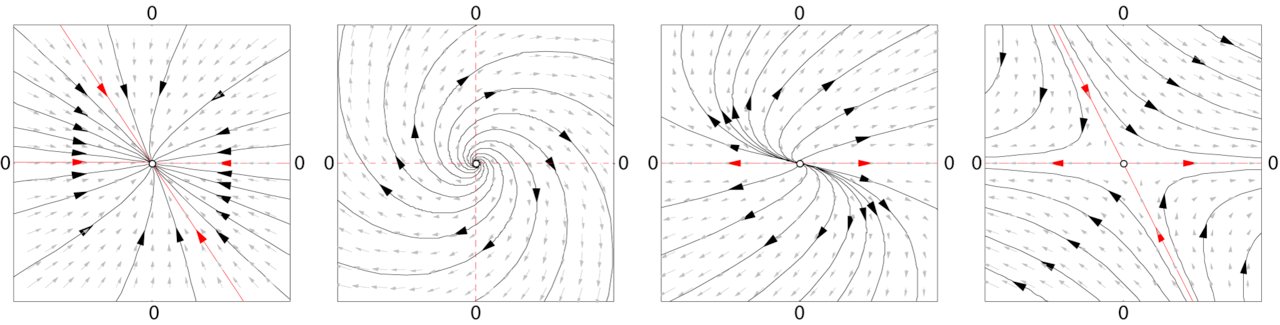
Linear vector fields can exhibit sensitivity to initial conditions. Non-linear systems are even more bizarre. And don’t forget chaos theory.
If, however, an arbitrarily small jog causes a major change, then the system is structurally unstable. Weather is the classic example of this, with the apocryphal butterfly in the Amazon leading to a snowstorm in Duluth.
Or, listening to BBC at 6:05 a.m. and hearing that one bad online review can close a restaurant.
That is, if you haven’t figured this out already, life isn’t structurally stable. ds
© Dennis Simanaitis, SimanaitisSays.com, 2014
 Simanaitis Says
Cialdini might appreciate this bill collector humor: We’ve looked everywhere for your check, could it still be in your checkbook?