
Simanaitis Says
On cars, old, new and future; science & technology; vintage airplanes, computer flight simulation of them; Sherlockiana; our English language; travel; and other stuff
WALK RIGHT IN, SIT RIGHT DOWN
VITRA FURNITURE has been good for Weil am Rhein, Germany. This Swiss family-owned furniture firm has its headquarters in town, located in the southwestern tip of Baden-Wurttenberg, German’s southwestern-most state.

Weil am Rhein, Germany, population around 30,000, the home of Vitra Furniture Company.
Part of Weil am Rhein abuts France, part abuts Switzerland and, back when it mattered, there was even a triple border point in town.
Vitra entered the furniture market in 1957 as a licensed producer of the American Herman Miller office line, including designs by Charles and Ray Eames. Its link with the Eames heritage continues to this day.
Through Vitra influence, the city of Weil am Rhein has several building designed by world renowned architects. There are factory facilities by Nicholas Grimshaw and Álvaro Siza Vieira, a fire station by Zaha Hadid and the Vitra Design Museum by Frank Gehry. (See http://goo.gl/vvVwSS for details about the museum.)

The Vitra Design Museum, designed by Frank Gehry.
In 1995 – 1996, the Vitra Design Museum set an exhibition of 100 masterpieces from its collection of furniture art.

100 Masterpieces from the Vitra Design Museum Collection Vitra Design Museum, 1996, published for the exhibition, July 10, 1995, to January 21, 1996.
Chairs were the primary pieces on exhibit, with several tables, cabinets and shelving elements. Here are some of my favorites.

Indoor-Outdoor Reclining Armchair No. 684, designed by Charles and Ray Eames, manufactured by Hermann Miller Furniture Company, 1958 to present. This and other images from the Vitra exhibition catalog.
The original Eames Reclining Armchair No. 684 was designed for indoor-outdoor use, upholstered in Saran synthetic fiber (related chemically to the original Saran Wrap). Naugahide artificial leather became the upholstery material of choice when the original material proved unamenable to the outdoors.
I enjoyed a black Naugahide Eames No. 684 in my R&T office. The design was also a featured piece at “Birth of the Cool” (http://wp.me/p2ETap-1ah).
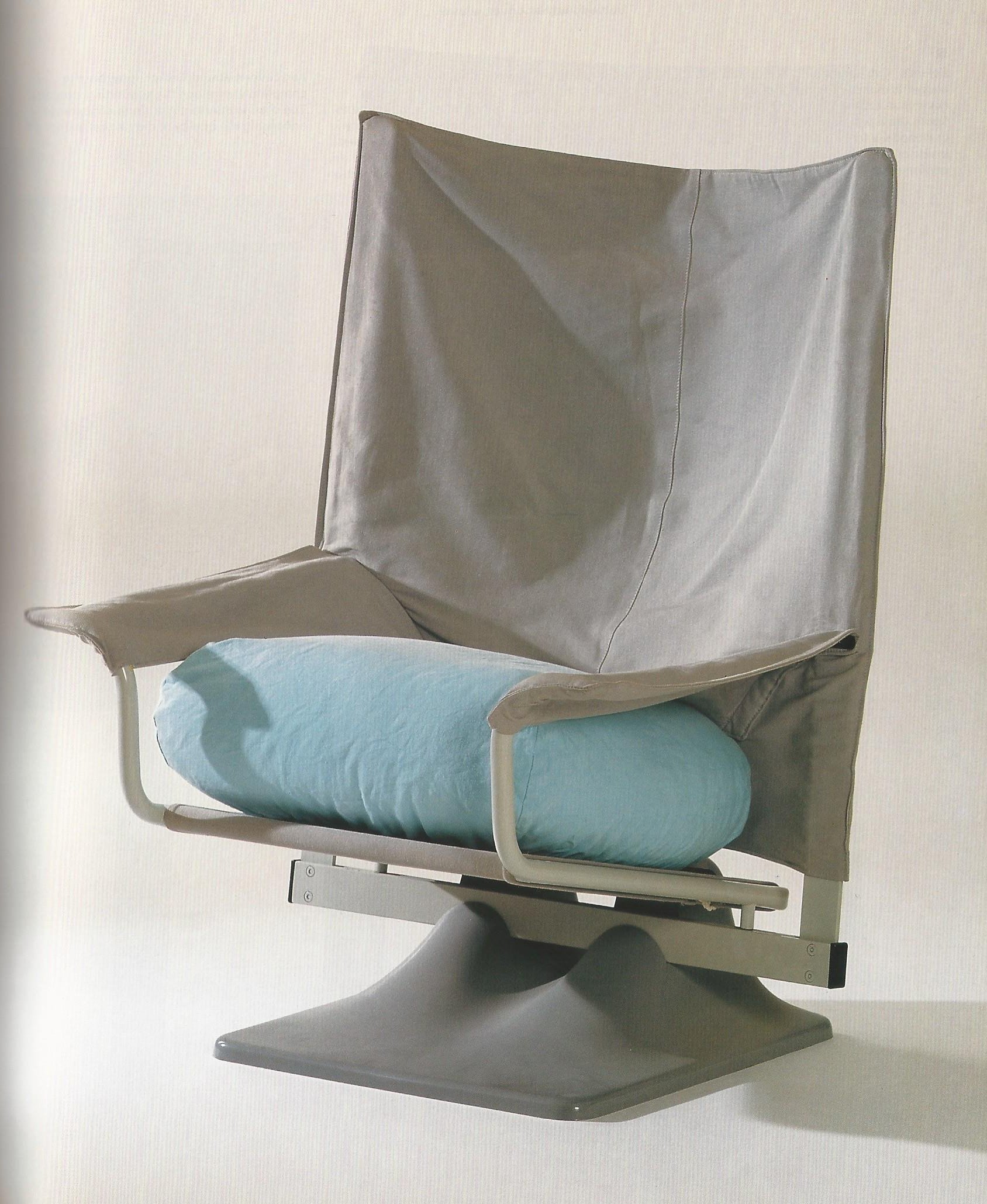
AEO, designed by Paolo Deganello with Archizoom Design, 1973 to present.
The “AEO” stood for the first and last letters of the Greek alphabet, Alpha and Omega. Deganello designed the chair as separate elements serving particular ergonomic functions. What’s more, he envisioned a network of small suppliers producing individual parts, thus linking craftsmanship with mass production. At one time, the AEO was available as a build-it-yourself kit.
According to the Vitra catalog, minimalism has long been a goal of designers. Among reasons for this are availability of materials and economy of production as well as purity of aesthetics.

Plywood Armchair, designed by Gerald Summers, 1933 – 1934. Below, its single-sheet plan.

Gerald Summers’ idea of cutting and forming a single sheet of plywood into an artfully shaped armchair appeared to be elegant employment of materials and labor. However, he produced only 120 examples of the chair. Cost of production proved prohibitive and the rear legs were structural weakpoints.
Even with “form follows function” as an objective, the catalog observes that there’s still room for decoration, for elements of expression that are in harmony with technology and construction.

Peacock Chair, Imperial Hotel, Tokyo, designed by Frank Lloyd Wright, 1921 – 1922.
Frank Lloyd Wright believed that furnishings should be ornamental extensions of a building. The hexagonal theme of his Peacock Chair echoed many architectural elements of his Imperial Hotel where the chairs were used.
Unlike the hotel (which survived the Great Kantō Earthquake of 1923), fragile Peacock Chairs were replaced at least three times in the life of the hotel, which itself was replaced by the modern Imperial in 1968. (See http://wp.me/p2ETap-11v.)
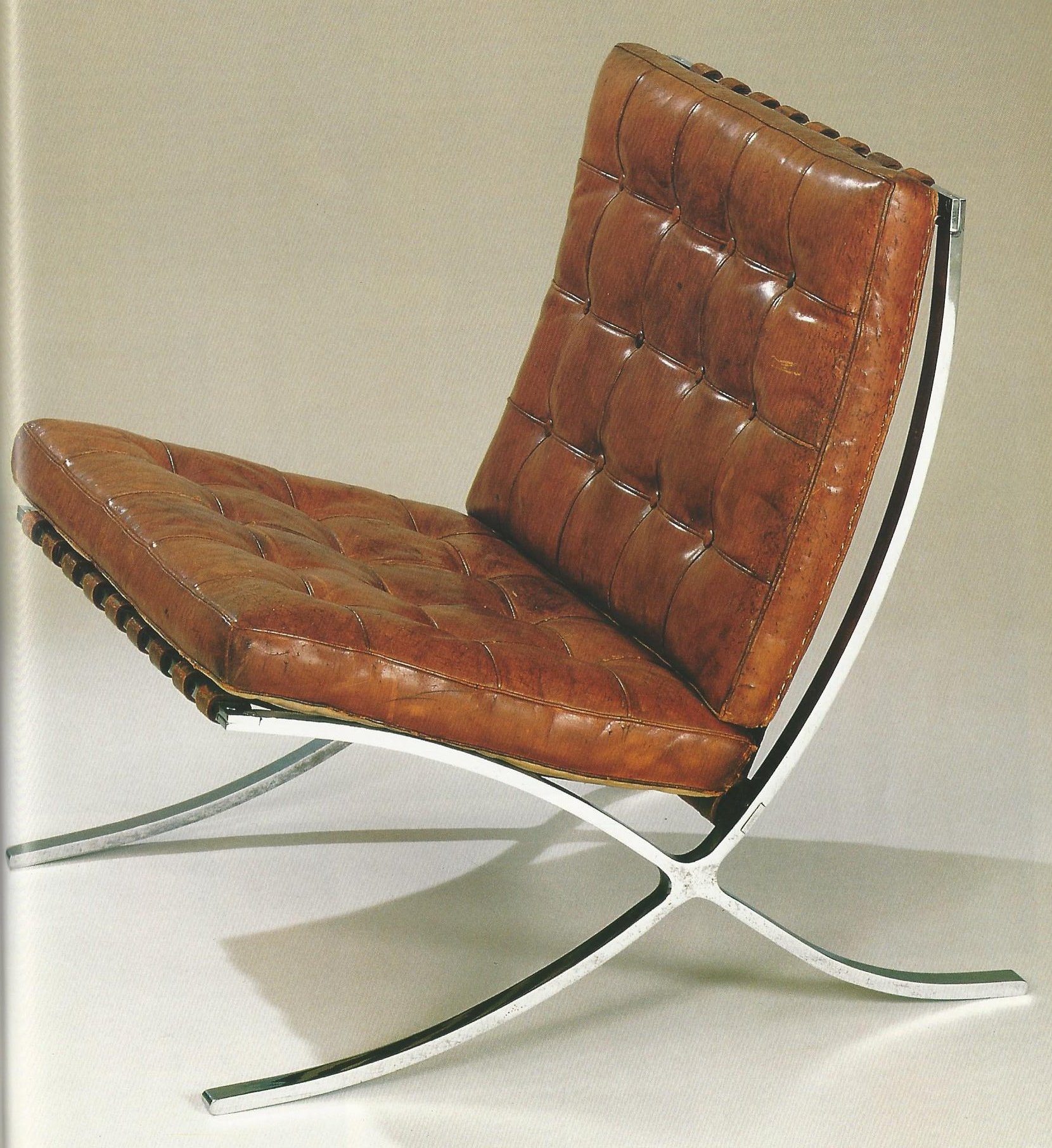
MR 90, Barcelona Chair, designed by Ludwig Mies van der Rohe, 1929 to present.
Mies van der Rohe designed the German Pavilion and its furnishings for the 1929 World’s Fair in Barcelona, Spain. What has become known as the Barcelona Chair is an iconic piece of 20th century design.
The chair’s basic shape pays homage to an ancient scissor-shape folding chair, a symbol of prestige among Egyptian rulers and, later, the Roman Empire sella curulis (serving as a magistrate’s chair). The characteristic pattern of a Barcelona Chair’s leather upholstery is evocative of the ancient design’s interlaced wooden slats.
The R&T offices had two Barcelona Chairs as well as those Eames Armchairs. John and Elaine Bond certainly knew how to furnish a workplace. ds
© Dennis Simanaitis, SimanaitisSays.com, 2014
 Simanaitis Says
Hello Dennis, I am making a scale model of the Gerald Summers chair. Could you please tell me where you got the plan view of the sheet from?
Jacques
Hello,
All images shown were from that wonderful Vitra exhibition catalog cited in the article. What a neat project!