
Simanaitis Says
On cars, old, new and future; science & technology; vintage airplanes, computer flight simulation of them; Sherlockiana; our English language; travel; and other stuff
DAVID MACAULAY’S WORLD
THANKS TO David Macaulay, we can understand something about building a Pharaoh’s pyramid, a Roman city, a medieval castle, a Gothic cathedral and the underpinnings of a modern city intersection. And, thanks to Macaulay, I might even be able to explain the workings of an automobile differential.

David Macaulay, born in Lancashire, England, in 1946, American illustrator and author of works on architecture, science, engineering and history, MacArthur Fellow, recipient of a Caldecott Medal, a Deutscher Jugendliteraturpreis, a Dutch Silver Slate Pencil Award and the Brandford Washburn Award.
Macaulay studied at the Rhode Island School of Design, where he serves as a visiting critic. His writing and illustrating career began with Cathedral: The Story of Its Construction, Revised and in Full Color

Cathedral: The Story of its Construction, by David Macaulay, Sandpiper, 1973.
One of Macaulay’s exceptional talents is his sense of moderation. He provides just enough detail to promote understanding. His books are often listed in the Children’s category, age 10 – 14 years, though I beg to differ: Educated adults can learn a lot—most pleasurably—about science, engineering, architecture and history through his works.
Macaulay has written and illustrated a total of 27 books, including Motel of the Mysteries (a wonderful satire of archeology that gives new meaning to those triangular folds in hotel toilet paper).

The Way Things Work
A good starting point is The Way Things Work, or its digitally-updated The New Way Things Work. Categories include “Mechanics of Movement,” “Harnessing the Elements,” “Working with Waves” and “Electricity & Automation,” and conclude with “Eureka! The Invention of Machines.” There is also a most information “Glossary of Technical Terms.”
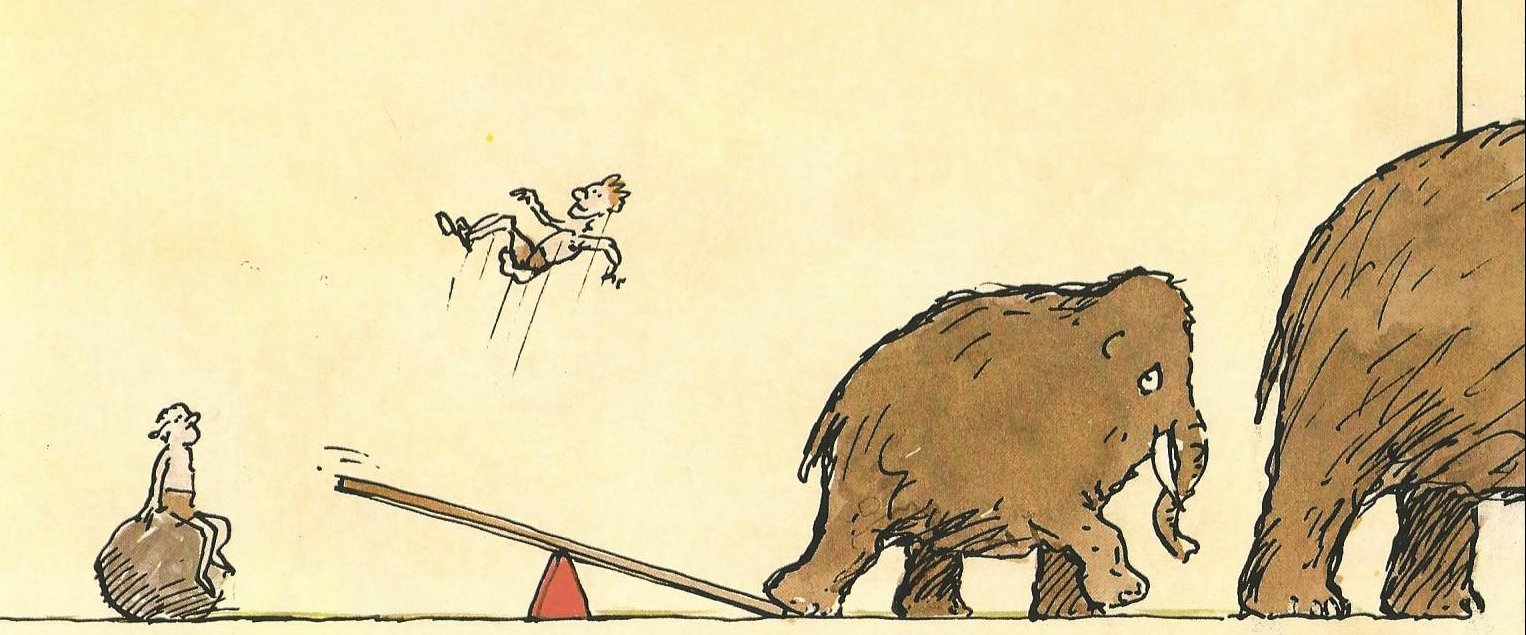
A wooly mammoth and seesaw contribute a working description of the lever. This and other images from The Way Things Work.
Recurring characters are a family of woolly mammoths who get involved with everything from levers to aerodynamics.
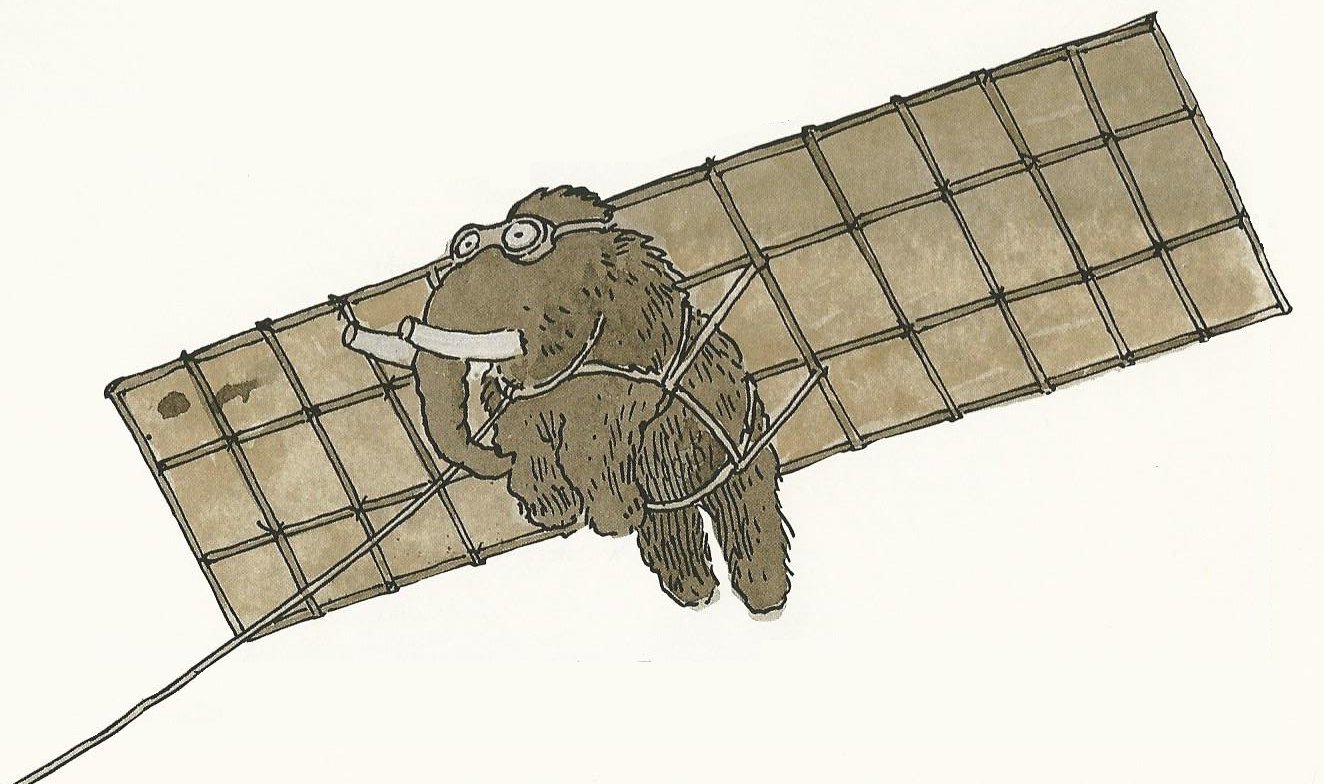
However, every page offers more than just entertainment; it offers illumination, often in areas that are seemingly unrelated. A car’s rack-and-pinion steering, for example, shares an operating principle with a wine-bottle corkscrew. Egg beaters and drill chucks both use bevel gears. Macaulay also reminds us that a salad spinner shares the concept of epicyclic gear with a modern car’s automatic transmission (and with patent evasion on James Watt’s steam engine).
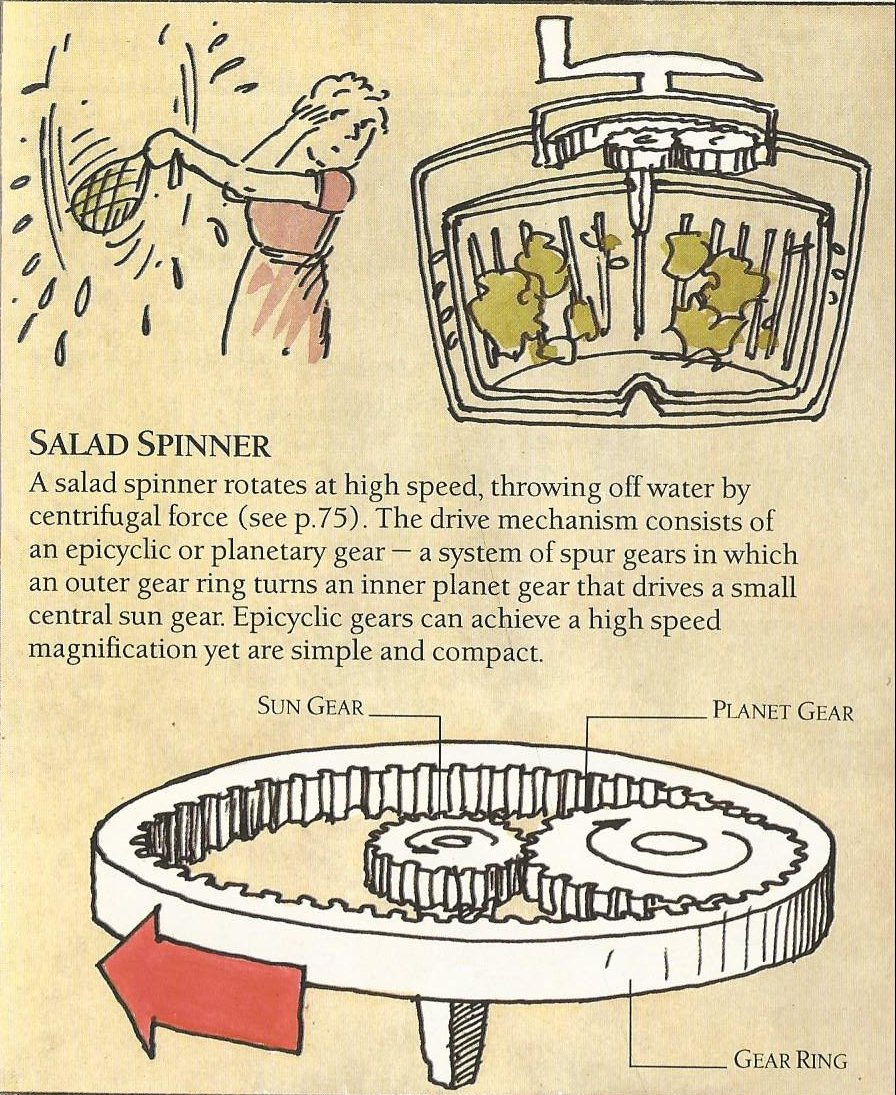
The Salad Spinner.
Building on these descriptions of gears, Macaulay tackles the concept of an automobile differential, the gizmo that accounts for an outer drive wheel turning at a greater speed than the inner one in a corner. Succinctly, Macaulay notes, a differential depends on two sun gears connected to free-wheeling planet pinions.
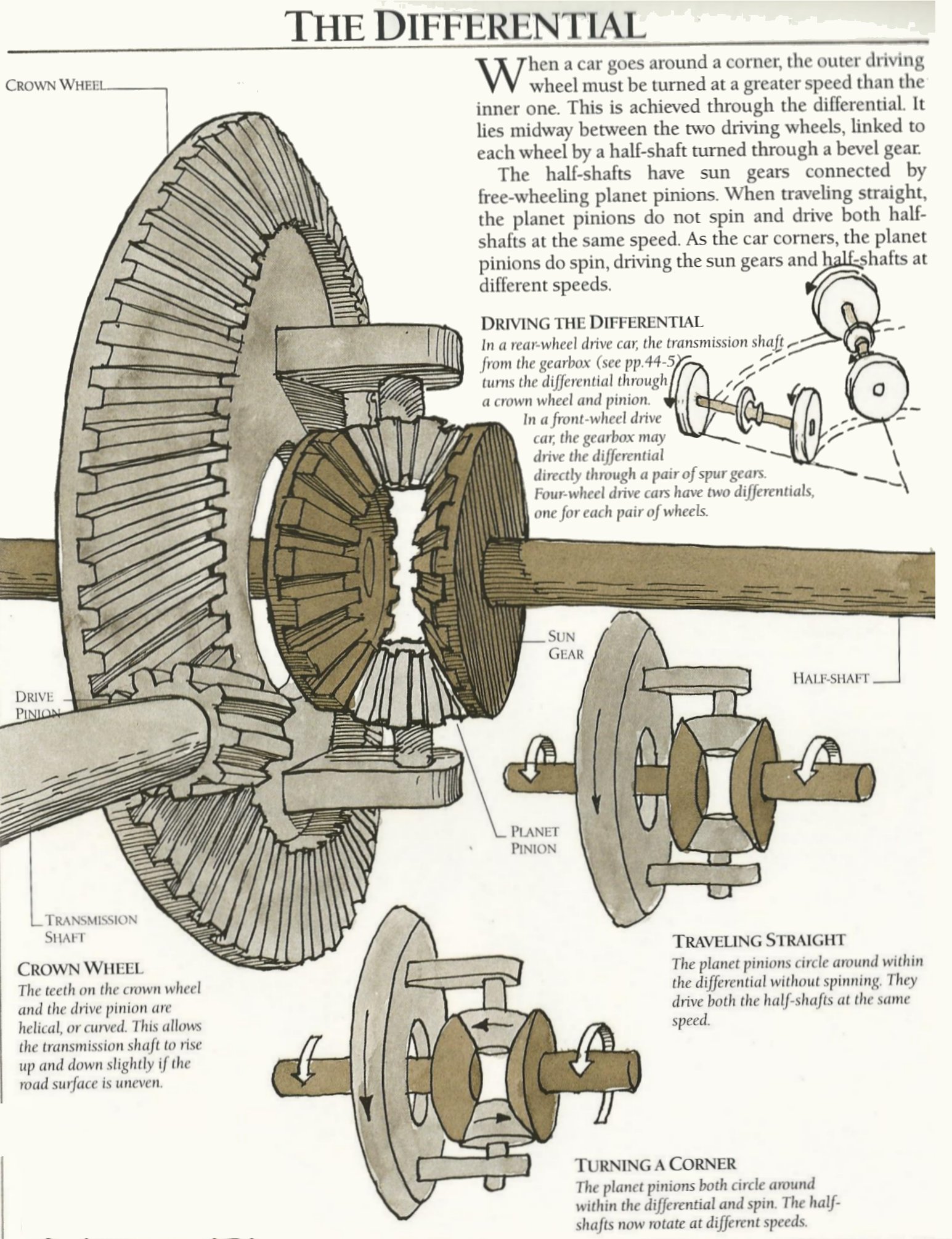
The Differential.
When the car is traveling straight, the planet pinions are driven by the crown wheel without spinning. When the car goes through a corner, the planet pinions spin, driving their sun gears, and corresponding half-shafts, at different speeds.
As another example, pre-Macaulay, I had only a vague idea of a helicopter’s rotor (its blades don’t just spin around like horizontal propellers).
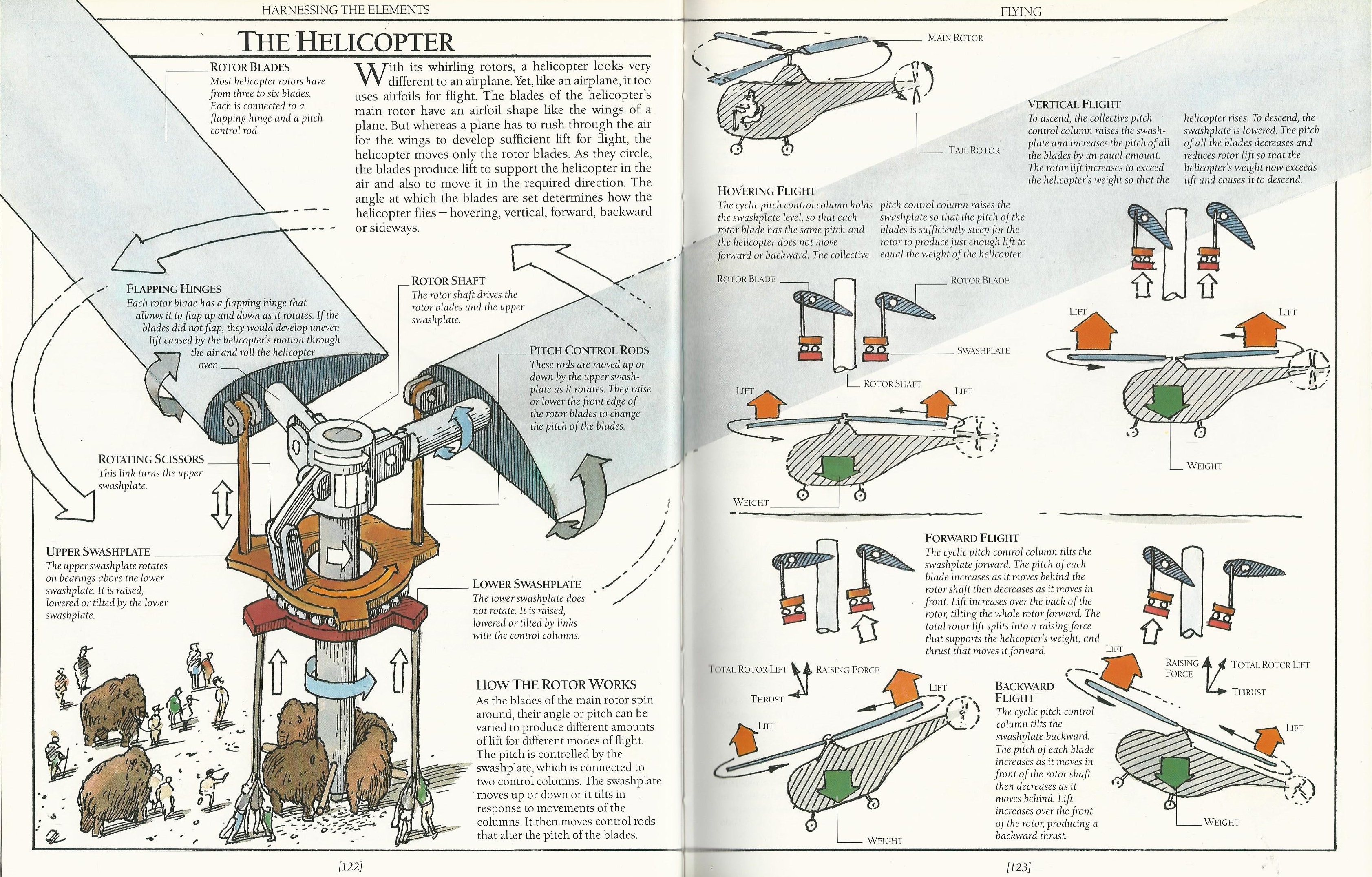
The Helicopter.
Macaulay’s two-page illustrations of helicopter swashplates, pitch control rods and adjustable hinges accompany this succinct description: “As the blades of the main rotor spin around, their angle or pitch can be varied to produce different amounts of lift for different modes of flight.”
As noted, just enough details to promote understanding. Thanks, David. ds
© Dennis Simanaitis, SimanaitisSays.com, 2014
 Simanaitis Says
I’d love to see him try to explain how a torque-sensing differential works. I seem to recall a column of yours that made the attempt, and though the details are lost to my 70-year-old memory (All I remember is that it depended on the principle that a worm gear can only drive, and cannot be driven), I do think I was able to grasp it at the time.
Yes, you nailed it: The Torsen diff works on the principle of a worm gear being unidrivable. If, indeed, that’s a word….
Pingback: The works of David Macaulay | The Helpful Librarian