
Simanaitis Says
On cars, old, new and future; science & technology; vintage airplanes, computer flight simulation of them; Sherlockiana; our English language; travel; and other stuff
SOME VTOL AIRCRAFT
VTOL STANDS for vertical takeoff and landing, as it applies to fixed-wing aircraft (not rotary-wing or helicopters). Here’s a brief sampling of the type and its variants. Maybe you’ll share others.

Lockheed XFV, first flight June 1954; project canceled June 1955.
The Lockheed XFV Salmon was an experimental American tail-sitter built in the early 1950s to maneuver vertically. Its turboprop engine drove counter-rotating three-blade propellers.
The aircraft was designed to operate from the afterdeck of an ordinary ship. One prototype flew; another airframe awaiting a more powerful engine was built before the project was canceled in June 1955, a year after its first flight.
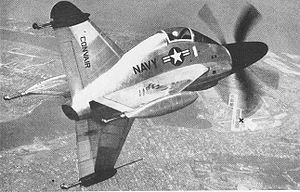
Convair XFY Pogo, first flight August 1954, project canceled August 1955.
Convair had an experimental tail-sitter at the same time. The XFY Pogo was a delta-wing, twin-prop VTOL craft designed for the same small-warship service as the Lockheed XFV. Three prototype Pogos were built; only the second one ever flew.
Both the Lockheed and Convair VTOLs required extraordinary pilot skill for vertical maneuvering. In particular, the pilot had to look over his shoulders during landing. Also, jet fighters of the era were more capable in ordinary flight.

Hawker Siddeley Harrier Jump Jet, first flight 1966, last production 2003, still in service.
The Harrier Jump Jet fighter served in the British Royal Navy, NATO forces and Royal Air Force from the mid-1960s. Its variants continue today with the U.S. Marine Corps and the Indian, Italian, Spanish and Royal Thai Navy, albeit being phased out for the Lockheed Martin F-35B Lightning II.
Formally, the Harrier is a Short Takeoff Vertical Landing design. It gains this STOVL capability from vectored thrust, with its engine exhaust directed to outlets in the aircraft’s nose, tail and wingtips. The Jump Jet can take off vertically, though only with less than its maximum load. Typically, short takeoff runs are preferred. Landings are vertical, with only a modicum of forward speed, likely for enhanced pilot vision.

Dornier Do 31, first flight 1967, project canceled 1970.
The Dornier Do 31 used two means of achieving its VTOL performance. Its twin turbojets mounted in inboard nacelles contributed adjustable ducted thrust; and, in each wingtip pod, four small downward-directed jet engines provided dedicated lift.
Dornier designed the Do 31 to meet NATO specifications for VTOL aircraft capable of tactical support. Its fuselage had a rear loading ramp for cargo, a vehicle or personnel.
The company started with a proof-of-concept rig and continued with three prototypes, one of them flyable. A video (http://goo.gl/DXjuOD) shows capabilities of the Do 31; another (http://goo.gl/2VjLBz) includes some scarier aspects of testing at around its 2:50 mark. High costs, technical issues and a change in NATO needs led to the project’s cancellation in 1970.

Bell Boeing V-22 Osprey, first flight 1989, still in service.
The Bell Boeing V-22 Osprey transport aircraft achieves its VTOL through pivoting its engine nacelles, thus directing its propellers’ thrust vertically. The goal is to offer functionality of a conventional helicopter combined with long-range, high-speed performance of a turboprop aircraft. Some call this configuration a “tilt-rotor” aircraft; its propellers’ diameter precludes ground-based maneuvering with the nacelles in their flying orientation.

An Osprey being refueled in flight.
The aircraft’s service in the U.S. Marine Corps and Air Force has not been without controversy. Marine Corps data suggested the Osprey’s mishap rate was approximately half that of an average aircraft in the USMC fleet. Opponents said the data were doctored. A U.S. Government Accountability Office study concluded that “… the V-22’s enhanced speed and range enable personnel and internal cargo to be transported faster and farther than is possible with the legacy helicopter it is replacing.”

Lockheed Martin F-35B Lightning II, first F-35 flight 2006, being phased into service by 2017.
The F-35B is the STOVL variant of Lockheed Martin’s F-35 stealth multi-role fighter. The aircraft’s STOVL capabilities mean it can land on carriers without a tail hook. Nor is its takeoff catapult-assisted.
The F-35B’s vertical-flight hardware replaces about one-third of the original design’s fuel volume. It trades other design criteria, including a 7g stress limit compared with an F-35A’s more high-performance 9g.
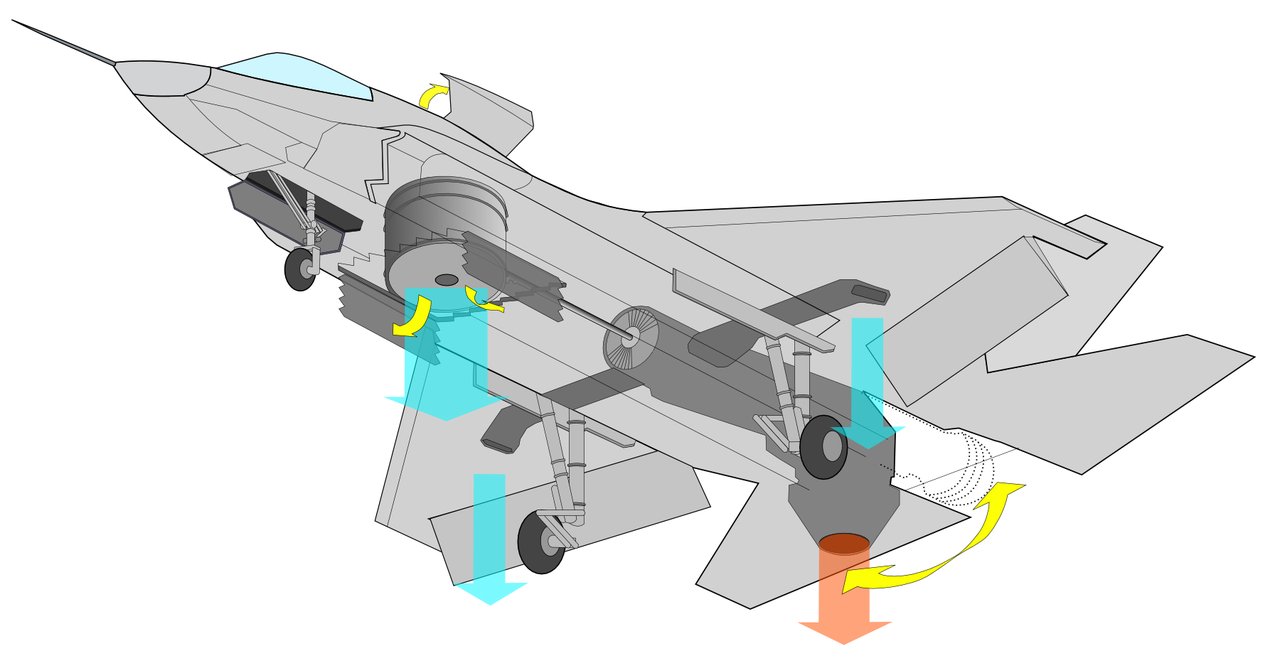
The F-35B uses thrust-vectoring and a lift fan for its STOVL. Image by Tosaka.
Unlike the Harrier Jump Jet, the F-35B has a separate lift fan which derives its spin from the main engine. The latter’s thrust-vectoring is designed to distribute its jet exhaust over an extended oval area to mitigate damage to the flight deck. A fine video of the F-35B in action was brought to my attention by Ray DeTournay (see http://goo.gl/pMz6oR). ds
© Dennis Simanaitis, SimanaitisSays.com, 2014
 Simanaitis Says
Canadair CL-84 from early 60’s – similar to Bell Osprey in many respects
Hi, Paul,
I see there’s a YouTube of the Canadair at http://goo.gl/d136Ci. As you note, it’s similar to the Osprey, though its wings tilt, not just the wingtip nacelles.
See the films “Tru Lies” and “Live Free or Die Hard” for popular (fantastic) depictions of the Harrier in flight. Also, the current TV series “Agents of Shield” depicts some rather fantastic VTOL craft.