
Simanaitis Says
On cars, old, new and future; science & technology; vintage airplanes, computer flight simulation of them; Sherlockiana; our English language; travel; and other stuff
SAE TIDBITS
SAE INTERNATIONAL, what used to be called the Society of Automotive Engineers, continues to be the premier assemblage of the world’s engineers devoted to transportation. Years ago, 1976 – 1978, I worked there, and I’ve been an SAE member ever since.

Each issue of Automotive Engineering, its monthly magazine to members, offers tech tidbits of a wide variety. Here’s a sample.
Have you ever pondered the mpg of a fully loaded 18-wheeler? Certainly those in the trucking industry give this a lot of thought.

As reported in Automotive Engineering, July 2014, Cummins and Peterbilt have an update of their SuperTruck Demonstration tractor-trailer, and a super rig it is.
A typical long-haul semi averages 5.5 to 6.5 mpg, not surprising when you consider the total weight can be 80,000 lbs. Think 23 cars.
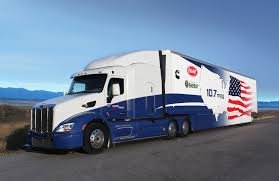
The Cummins-diesel Peterbilt transports this same load at 10.7 mpg.
This is an amazing 75-percent improvement in an area where automotive engineers would run over granny for an added 0.1 mpg. Along with this mpg improvement comes a 43-percent reduction in greenhouse gas emissions compared with performance of a 2009 baseline rig. Improvements come from all areas, the engine and drivetrain, aerodynamics, tires, materials and more.

In the same July 2014 issue of Automotive Engineering, Texas Instruments proposes the use of Bluetooth Smart wireless connectivity in place of conventional cables. Bluetooth Smart is a low-power version of technology linking cellphones to cars and the like.
A Bluetooth Smart device consumes less than 1 microamp in its “sleep mode,” meaning it requires next to no power when the car isn’t running. (To put this in perspective, a AA battery’s capacity is perhaps 600 milliamp-hours, 600,000 microamp-hours.)
TI calls its version SimpleLink and says it’s designed for applications where data transfer is minimal. Applications in the automotive world would include adjusting mirrors, operating windows and controlling interior lights.

Eliminating controller cables has multiple benefits: Cables add weight, take up space and, especially, require complex assembly. Imagine replacing the tangle of 20 steering-wheel infotainment cables with a single 6 x 6-mm chip.

The technology could also be used in key fobs, such a device powered by a coin cell battery.
The last tidbit from Automotive Engineering, July 2014, is about incredibly tiny automotive emissions, the PM2.5 particulates. Particulate matter is mini soot, the minute waste products of combustion. And the smallest sort, the PM2.5 variety, is less than 2.5 microns (0.0001 in.) in diameter. (Think 10,000 of them making one inch.)
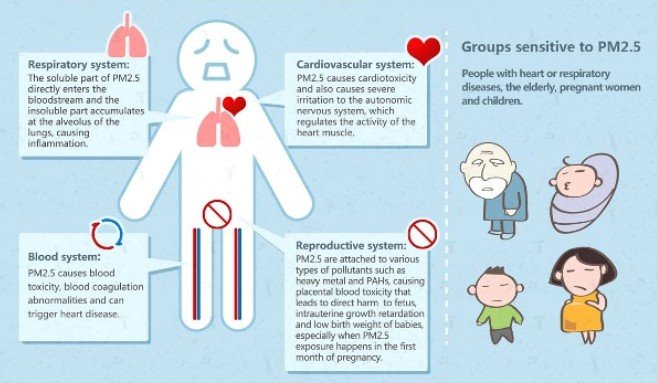
Image from http://www.China.org.cn.
Preliminary findings indicate that this tiny soot is particularly harmful because it penetrates the blood/air membranes of humans and animals. However, no definitive studies have addressed the epidemiology of particulates; that is, how much is tolerable for an acceptable level of risk. Part of the challenge is identifying the appropriate metric. These things are so tiny that even a bunch of them has very low mass.
For example, Euro 5/6 regulations, portions of which become effective in 2017, have a 0.005 g/km limit on particulate mass of all sorts. But it also introduces a PN aspect, as in “particle number.” The PN limit is 6.0 x 10¹¹ particles/km.
How do you suppose they count 600,000,000,000 of these little critters? ds
© Dennis Simanaitis, SimanaitisSays.com, 2014
 Simanaitis Says
Old technology too, belatedly brought to bear on this Supertruck. It uses one drive axle, like practically all European highway trucks that can legally gross not only 80, but 88,000 to 97,000 lbs.This alone saves ~.4 mpg. and ~400 lbs. (Hmmm, 88K and 97K rounds off to 40 and 44M tonnes. Coindence?)
Just about all US trucks tagged for the 80K max. have two drive axles, i.e., a “tandem”. Why? Because that’s the way we’ve always done it, and we don’t pay $6+ for a gallon of fuel.
And single tires vs. duals, again old technology, provide similar fuel and weight savings.