
Simanaitis Says
On cars, old, new and future; science & technology; vintage airplanes, computer flight simulation of them; Sherlockiana; our English language; travel; and other stuff
ENZYME HELPS HYDROGEN STORAGE
HYDROGEN IS the energy carrier of the future. What’s more, with production fuel-cell cars only a year away, H2 transport and storage are becoming important right now.

A recent article in Science, 13 December 2013, published by the American Association for the Advancement of Science, has the word “elegant” describing use of a single enzyme producing Formic acid, HCOOH, a storage fuel that’s a chemical equivalent of hydrogen.
In truth, much of this Science article is beyond my meager knowledge of biology. (I believe I may have been setting up an autocross or rally at the time.) Nevertheless, words like “elegant” get my attention.
The enzyme, HDCR, is derived from Acetobacterium woodii, a bacterium that’s predominately used to make Acetic acid as a byproduct of its anaerobic (oxygen-independent) metabolism. In this new approach, HDCR (which stands for hydrogen-dependent carbon dioxide reductase) is termed “strikingly simple” in transforming CO2 and H2 into Formic acid.
“Strikingly simple.” That’s more my biological level.
These findings about hydrogen transport and storage are promising on several levels, including electricity produced from renewables. Wind and solar sources don’t necessarily coincide with societal needs of electricity—either in time or place. Long-line transmission and batteries have their tradeoffs with regard to transport and storage.
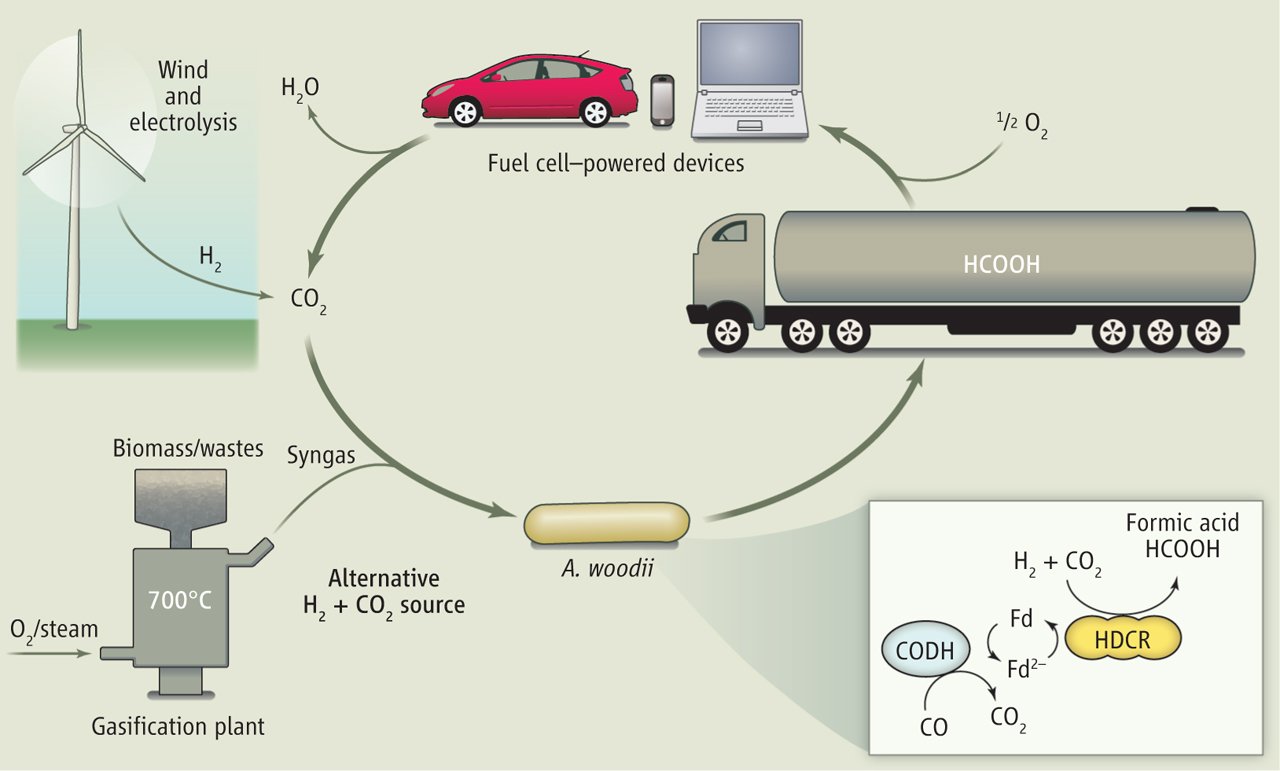
Storing hydrogen with enzymes: Hydrogen, carbon dioxide and A. woodii cooperate to yield an easily transportable and efficiently applicable fuel. Image from Science, 13 December 2013.
As shown above, A. woodii could play an important role in this.
Concludes the Science article, “These exciting advances in anaerobic microbiology will go a long way toward helping to develop a sustainable H2 economy that exploits microbial metabolic diversity for H2 storage.”
Plus, it’s compelling to see words like “exciting” used in these highly technical settings. ds
© Dennis Simanaitis, SimanaitisSays.com, 2014
 Simanaitis Says
Looks interesting , but I’m less of a chemist/biologist than you. Does the pictogram imply that the introduction of the A.woodii enzyme transform the “hydrogen” into a liquid that is easily transported in temperate temperature conditions, rather than “cold”, sub zero temperatures which liquid hydrogen requires now? If so, this would solve many of the infrastructure/storage/ dispensing problems facing Fuel Cell vehicles ( living on the East Coast doesn’t bode we’ll for Hydrogen infrastructure advances-I’m guessing I’ll never have the opportunity to own a fuel cell vehicle! Or have I misinterpreted the pictogram??
Ed Kopacz
Hi, Ed,
I doubt that anyone can be less a chemist/biologist than me…. What occurs, I guess, is that the A. woodii helps the process of making Formic acid from H2 and CO2. The Formic acid is liquid, dense in H2, easily transportable–and useable (directly? I don’t know) in fuel cells.
Apparently this is much more efficient than super-cold liquid H2 and more dense than compressed H2.