
Simanaitis Says
On cars, old, new and future; science & technology; vintage airplanes, computer flight simulation of them; Sherlockiana; our English language; travel; and other stuff
BEETLE BITS
A GOOD number of us have recollections of the original Volkswagen Beetle, and a recent piece in the London Review of Books, September 12, 2013, caught my eye. The article, “Autoerotisch,” by Cambridge Professor Richard J. Evans, reviews a new book placing the VW Beetle into 20th Century politics, economics and culture.
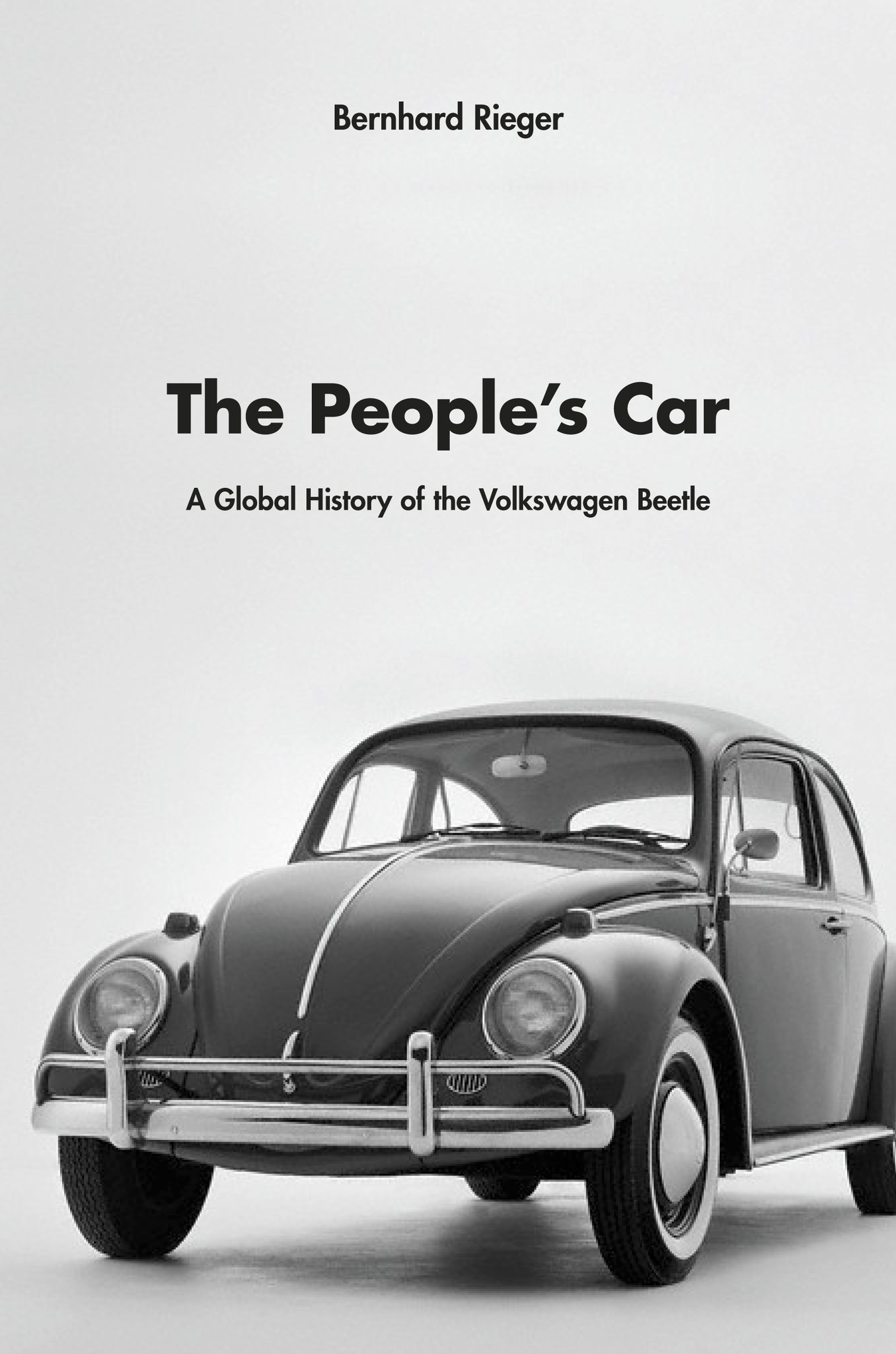
The People’s Car: A Global History of the Volkswagen Beetle, by Bernhard Rieger, Harvard University Press, 2013. It’s listed at both www.abebooks.com and www.amazon.com.
Rieger’s book and Evans’ review contain lots of familiar material (e.g., the Beetle proving that small need not mean low-quality). However, the review also contains many bits that are new to me, and possibly to you too.
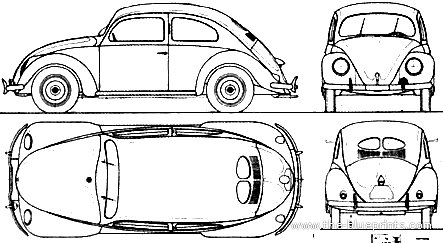
The Volkswagen, c. 1941. The rear glass got more expansive over the years, though little else was changed. Image from www.the-blueprints.com.
It’s well known, for instance, that Volkswagen is German for People’s Car. You might be aware of a similar term, Volksschlepper, the “People’s Tractor” built by Porsche between 1952 and 1963. (See www.wp.me/p2ETap-vw for my own Volksschlepping experience).
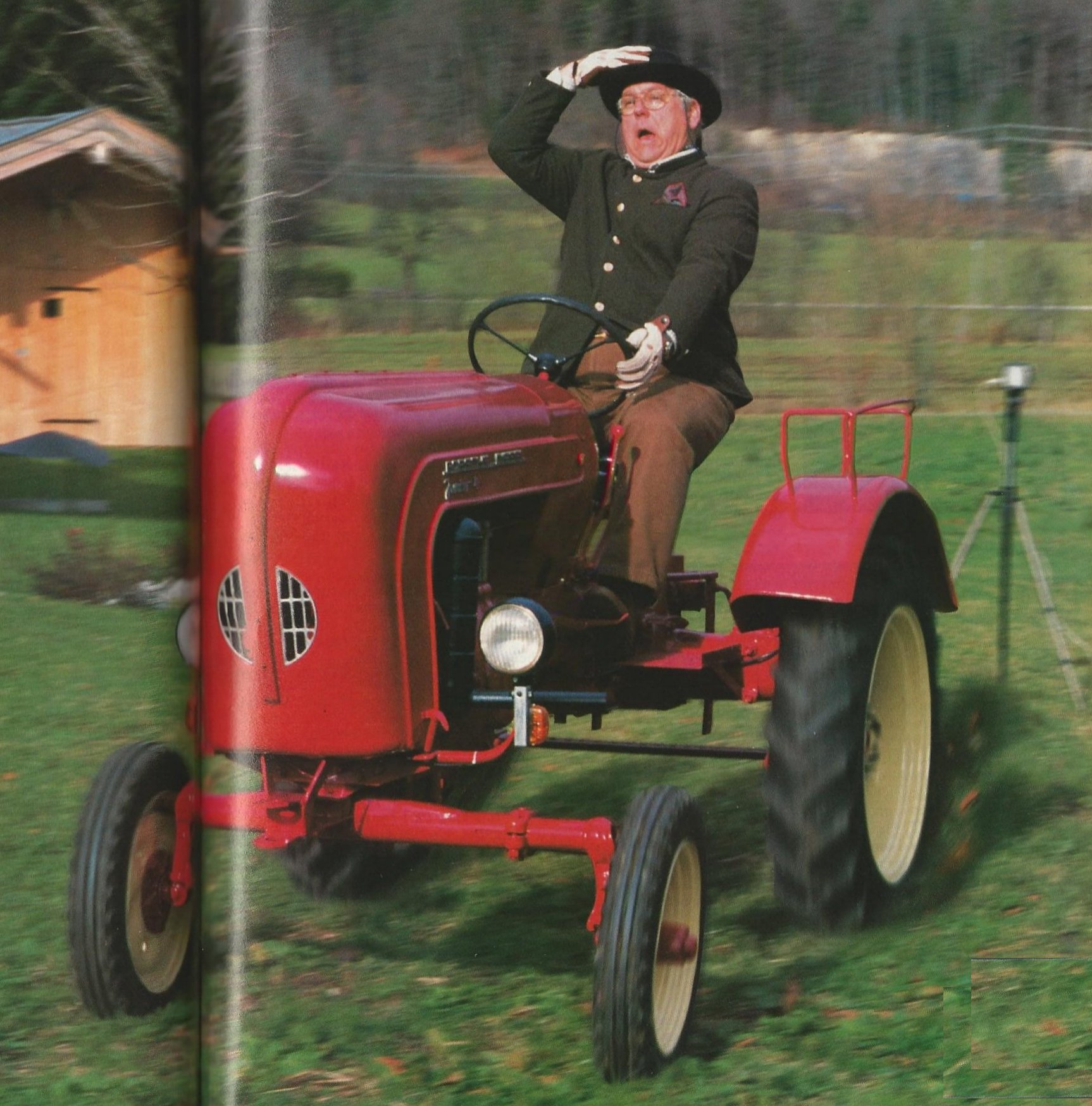
Don’t try this at home, kids. I’m a professional.
Evans notes that Joseph Goebbels, the Third Reich’s propaganda minister, overworked the Volks bit with things like the Volksempfänger (literally, People’s Receiver).
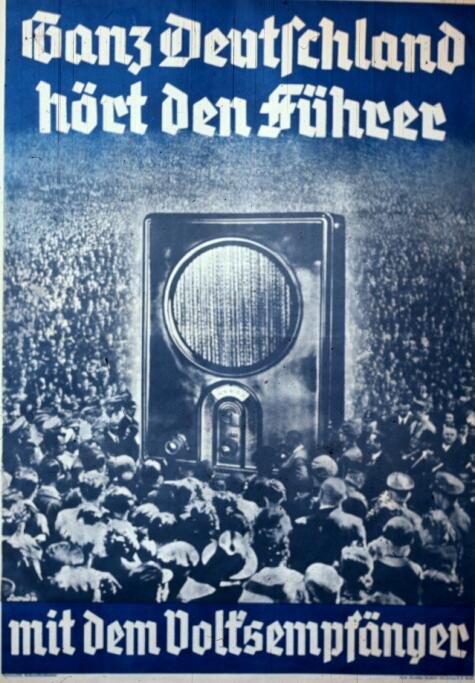
A contemporary pitch for the Volksempfänger.
Evans describes the Volksempfänger as “a cheap and cheerful little wireless [radio], with no short-wave so that listeners wouldn’t tune in to foreign broadcasts.”
There was also the Volkskühlschrank (literally, People’s Cool Closet), coveted in a country with few home refrigerators.
Originally, the Beetle wasn’t the People’s Car; it was the KdF-Wagen, Kraft durch Fruede (Strength through Joy) being a slogan of the Labour Front, the Third Reich’s successor to German trade unions.
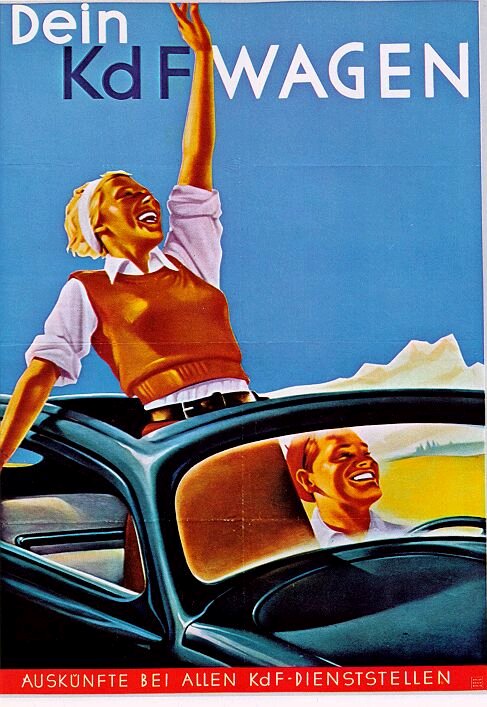
The KdF-Wagen generated this fine example of Fascist Realism.
I close with a related story. Back in the 1980s, Road & Track maintained a collection of one-page historical snippets to accommodate last-minute needs.
What with a healthy separation of editorial and advertising, those in editorial rarely knew the exact nature of a late ad. It was often, “We just got another one; it needs two-page separation from any other automaker’s ad.”
Fine. Except that the particular historical snippet chosen just happened to describe the KdF-Wagen and its official savings book supposedly leading to ownership. (Truth was, the money went directly into arms production.)
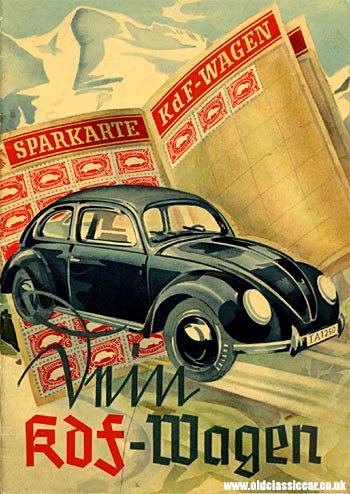
Buy enough Five-Reichmarks stamps and own your own car? Not likely. Image from www.oldclassiccar.co.uk.
A neat mini-item, the KdF piece included a photo of a guy named Hitler with the salesman smile.
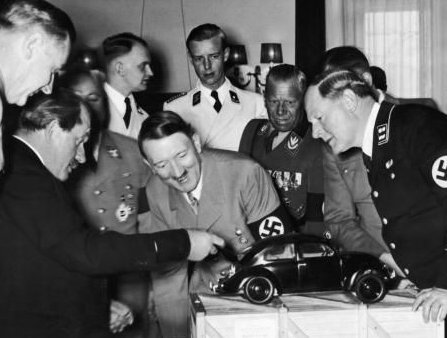
There are a multiplicity of possible captions here, many of them inappropriate.
Little did R&T editorial know that the late ad immediately following this snippet was a multi-page insert from—you guessed it—Volkswagen.
Yes, there was healthy separation of editorial and advertising; but separation didn’t have to be outright antagonism. ds
© Dennis Simanaitis, SimanaitisSays.com, 2013
 Simanaitis Says
I remember that VW ad incident from my days at R&T. I believe the article was written by Jim Wren, formerly the historian/librarian at the Motor Vehicle Manufacturers Association. And boy, did VWOA hit the roof!
Of more recent interest is the book written by Dutch journalist Paul Schilperoord which convincingly argues that Porsche copied the “volkswagen” ideas of Jewish publisher/engineer Josef Ganz. That book represents some of the most original editorial research I’ve ever seen.
A few of us gray hairs well remember the VW and it’s impact on America and it’s culture .
I’m a long retired VW Mechanic and still drive and enjoy my 1959 VW #113 DeLuxe Sedan, stock yet it still goes fine and gets good fuel economy .
-Nate