
Simanaitis Says
On cars, old, new and future; science & technology; vintage airplanes, computer flight simulation of them; Sherlockiana; our English language; travel; and other stuff
JAPANESE AESTHETICS, COURTESY OF MAZDA
SOME YEARS back, Mazda offered a short course in Japanese aesthetics through publication of several books. Being the Nipponophile I am, I am delighted to share details here. The four in my collection are also listed at www.amazon.com and www.abebooks.com.
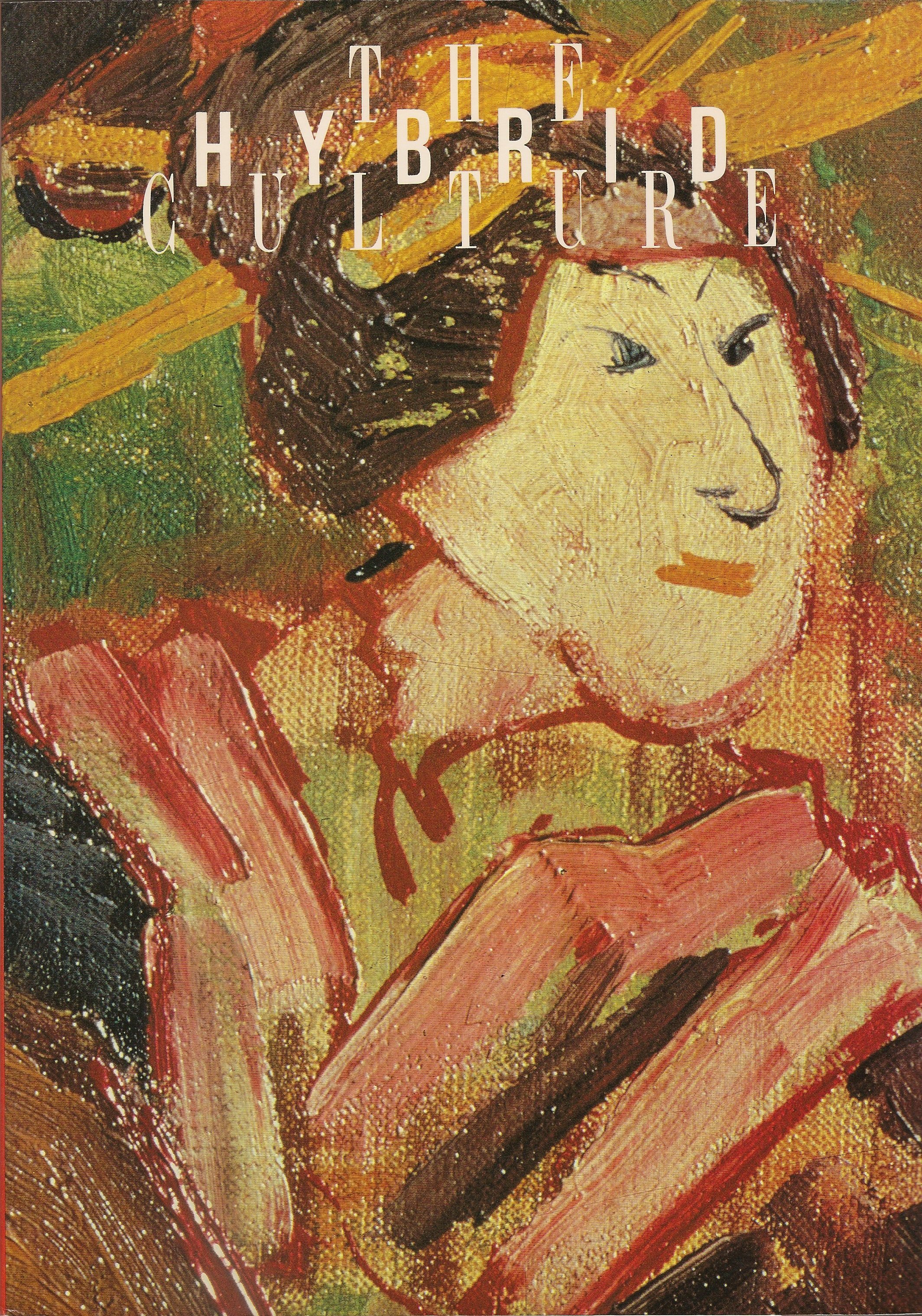
The Hybrid Culture: What Happened When East and West Met, edited by Yoshida Mitsukuni, Tanaka Ikko and Sesoko Tsune, Mazda, 1984.
Japan’s earliest interactions with the West came in 1543 with Portuguese adventurers—and their muskets and, eventually, cannons.
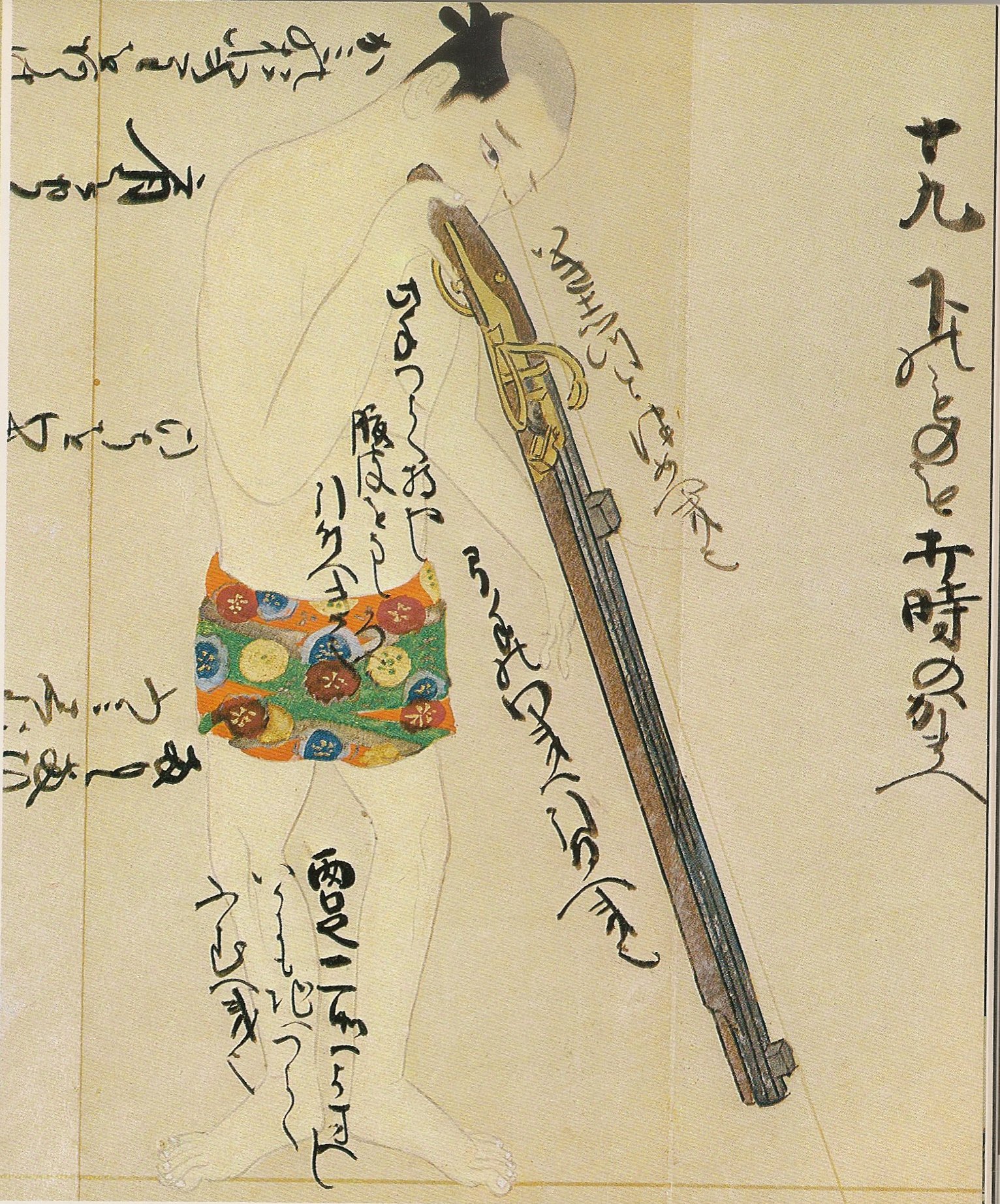
From a manual of operation for the arquebus (musket), 1607. Image from The Hybrid Culture.
Hardly a propitious introduction for hybridization of East and West.
By 1600, Will Adams, of Shogun fame (www.wp.me/p2ETap-1ln), arrived in Japan on a Dutch vessel. Within 38 years, Dutch traders were Japan’s only primary contact with the Western world.
It wasn’t until 1853 that America’s Commodore Matthew Perry and his Black Ships challenged the Tokugawa Shogunate’s isolation. See www.wp.me/p2ETap-1r8 for the Westernization of the ensuing Meiji Era (1868 to 1912).
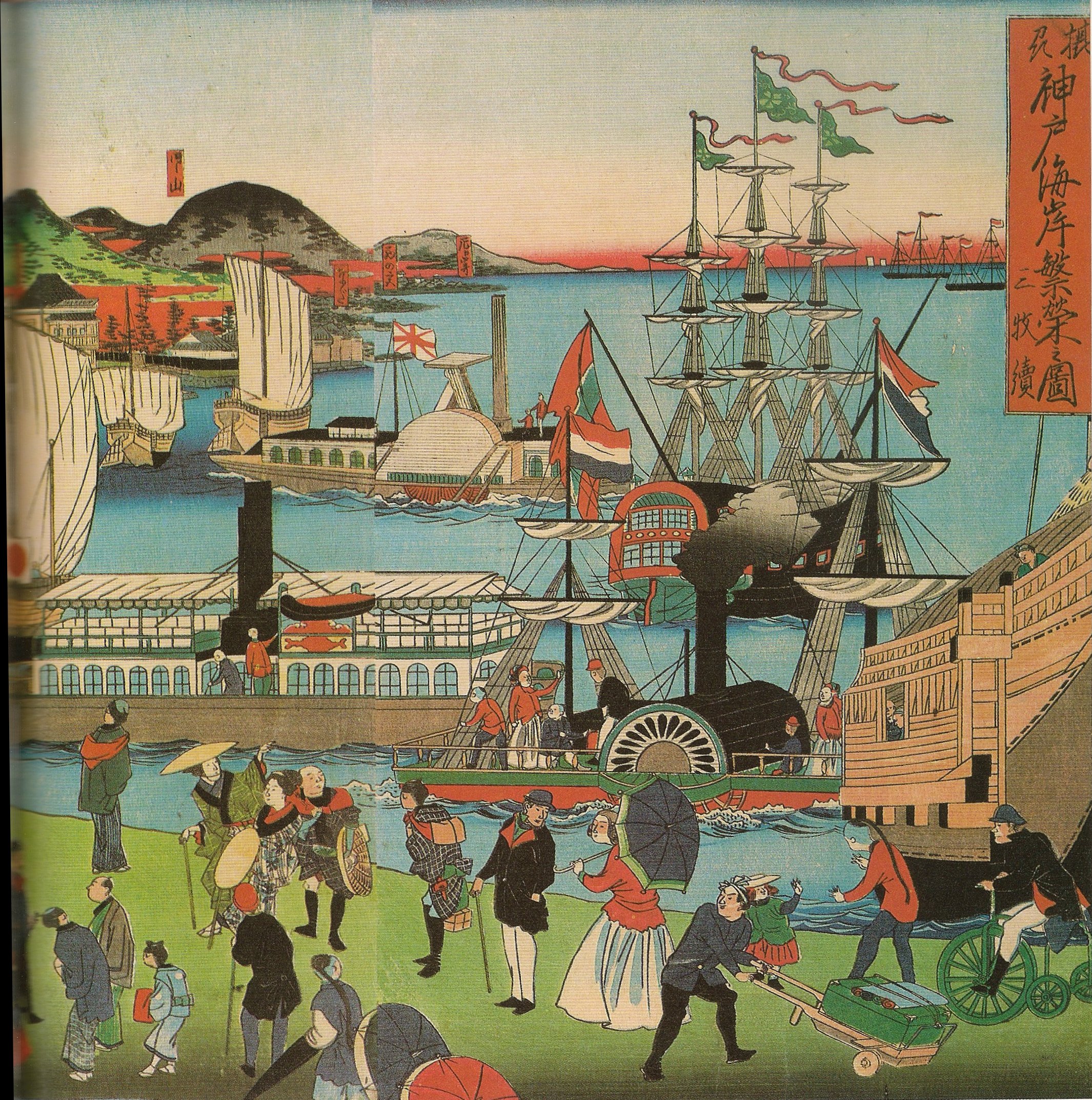
“Prosperous Kobe Waterfront Street,” c. 1865. Image from The Hybrid Culture.
The last chapter of The Hybrid Culture brings matters up to the date of its 1984 publication, everything from 1922’s opening of Frank Lloyd Wright’s Imperial Hotel in Tokyo (www.wp.me/p2ETap-11v), through World War II, to the Beatles’ 1966 visit, to 1983 when “Ballad of Narayama” won the Cannes International Film Festival’s Grand Prix.
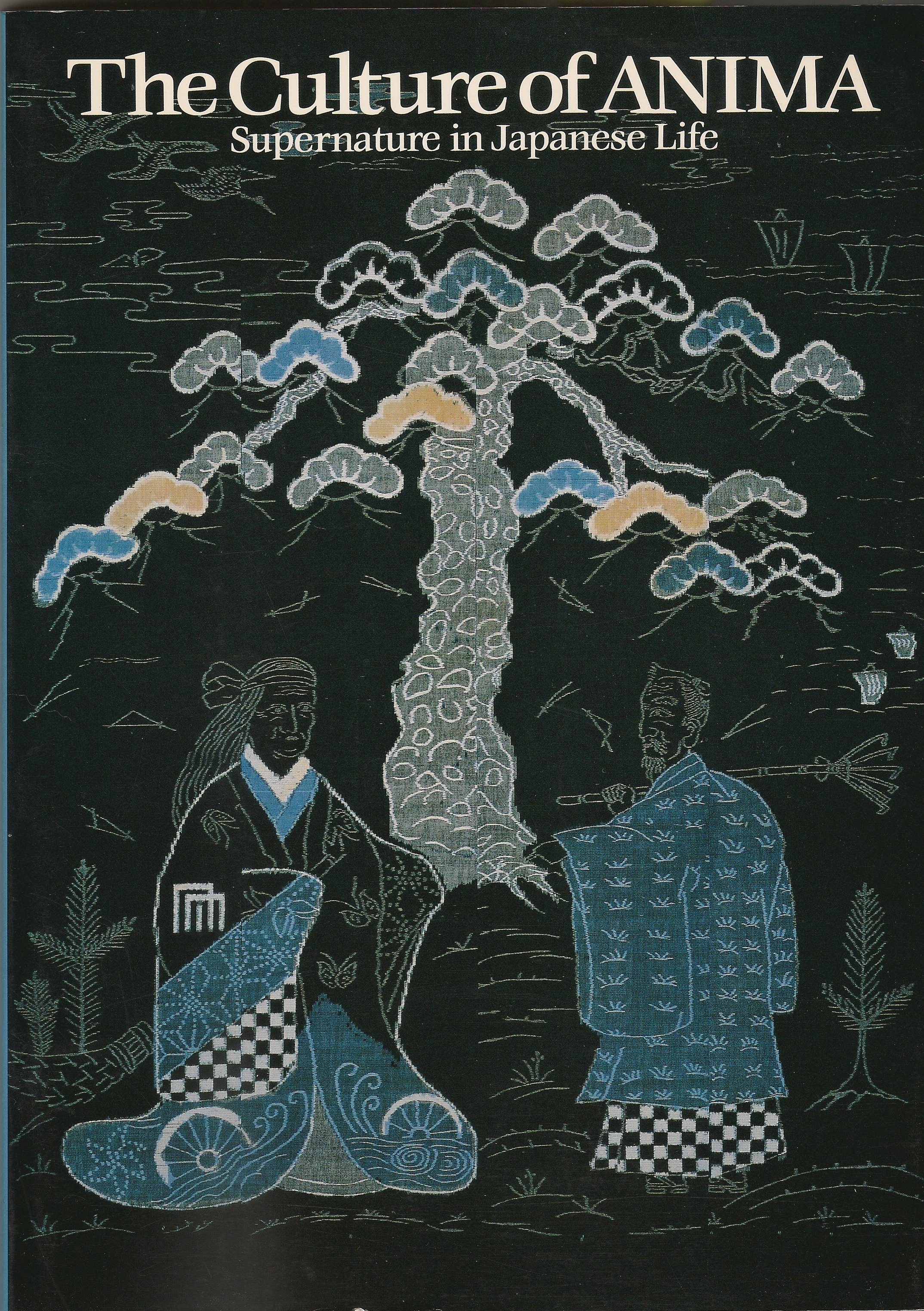
The Culture of Anima: Supernature in Japanese Life, edited by Yoshida Mitsukuni, Tanaka Ikko and Sesoko Tsune, Mazda, 1985.
Anima has resonance with the Western concept of soul, broadened to include spirits embodied in all things, living as well as inanimate. Admire a forested Japanese mountain, and it’s easy to understand that anima reside in its peak, amid its soaring Cryptomeria trees and in the encircling mist.
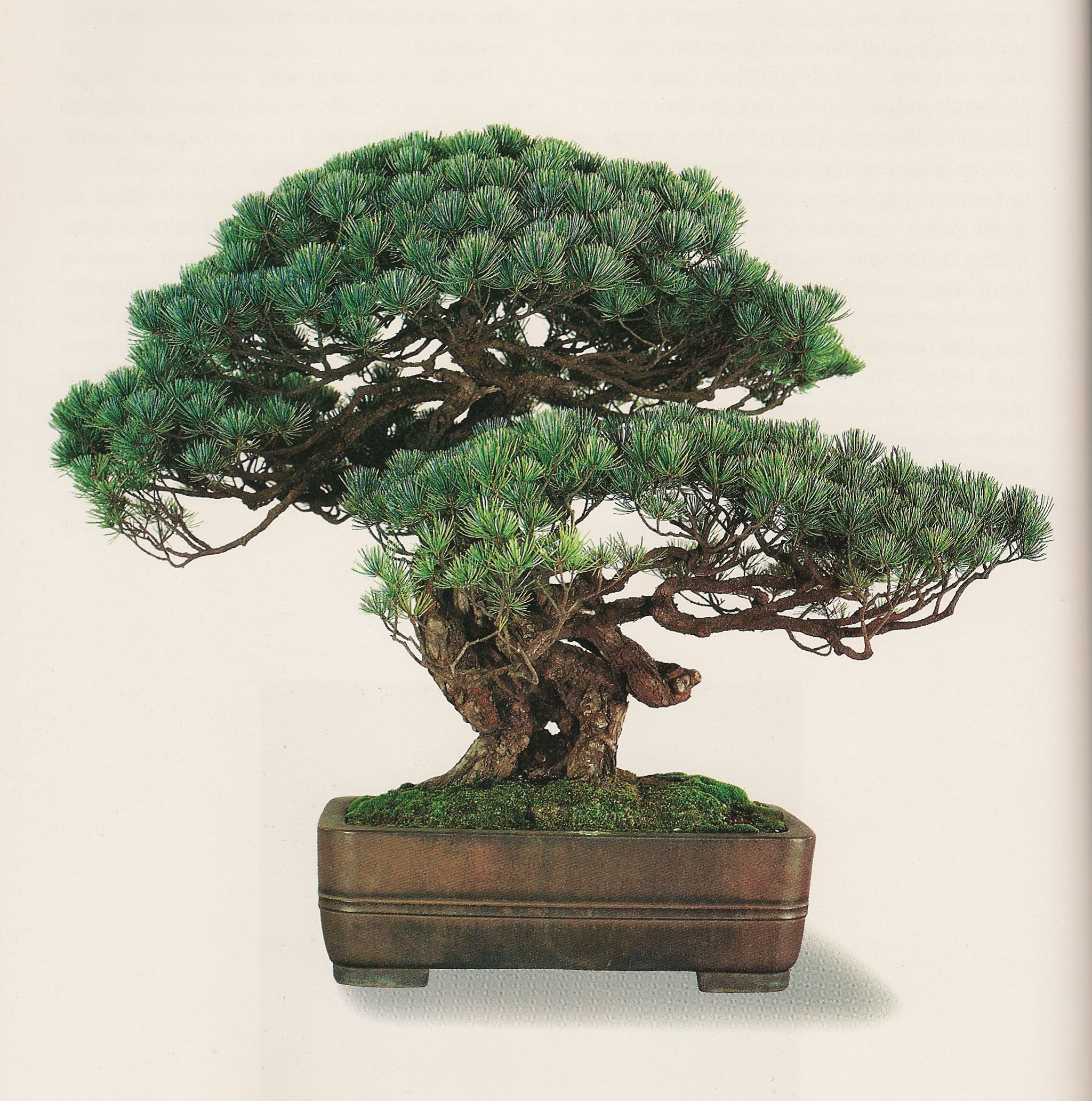
Bonsai trees, some hundreds of years old, suggest the weight of time and insignificance of man. Image from The Culture of Anima.
Anima exist in flora, fauna and in metamorphoses of man’s objects, as exemplified in masks and makeup used in ritual and drama. See www.wp.me/p2ETap-Ei.
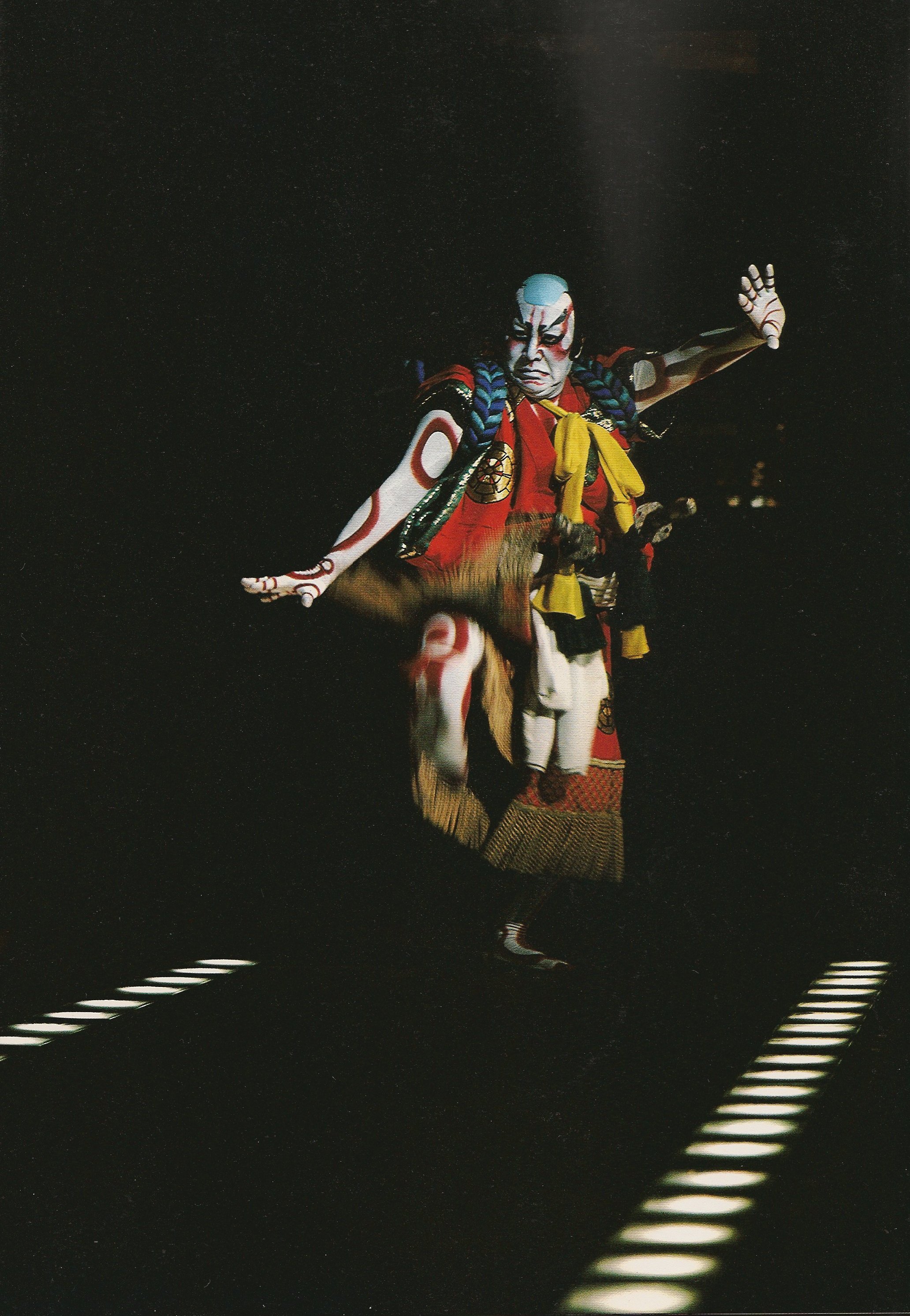
This kumadori makeup of an Aragoto character (Kabuki “tough guy”) enhances his superhuman aura. Image from The Culture of Anima.
The third book in my collection charactetreizes asobi, the Japanese concept of leisure, everything from traditional parties viewing the moon to the raucousness of a pachinko parlor (www.wp.me/p2ETap-1i5).
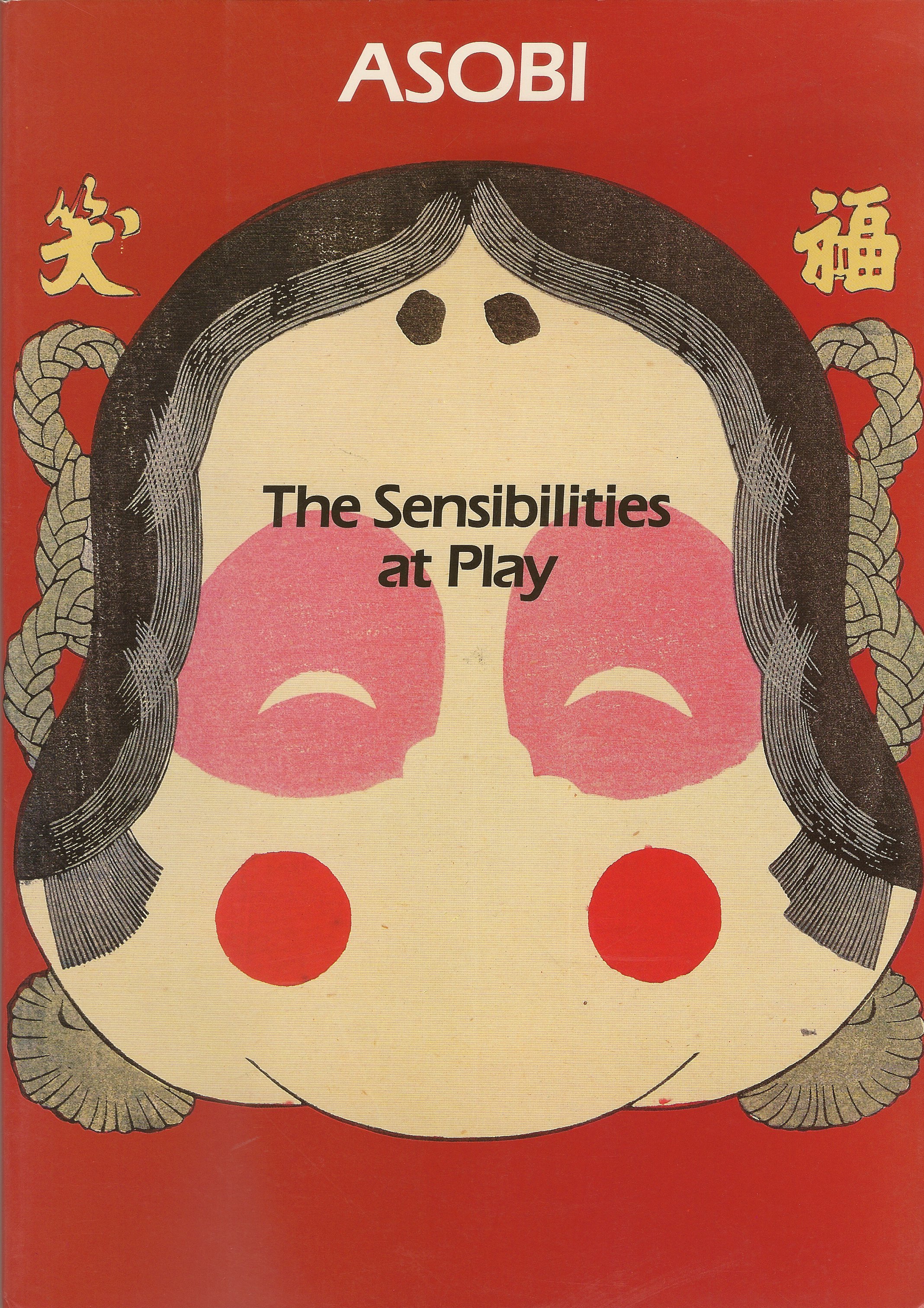
Asobi: The Sensibilities at Play, by Yoshida Mitsukuni, Tanaka Ikko and Sesoko Tsune, Mazda, 1987.
Asobi is multidimensional, including play, competition, chance, simulation and even vertigo. This last one, ilinx, is described as “a purely physiological breakaway from reality,” the giddy pleasure sought, for instance, in a scary rollercoaster ride.
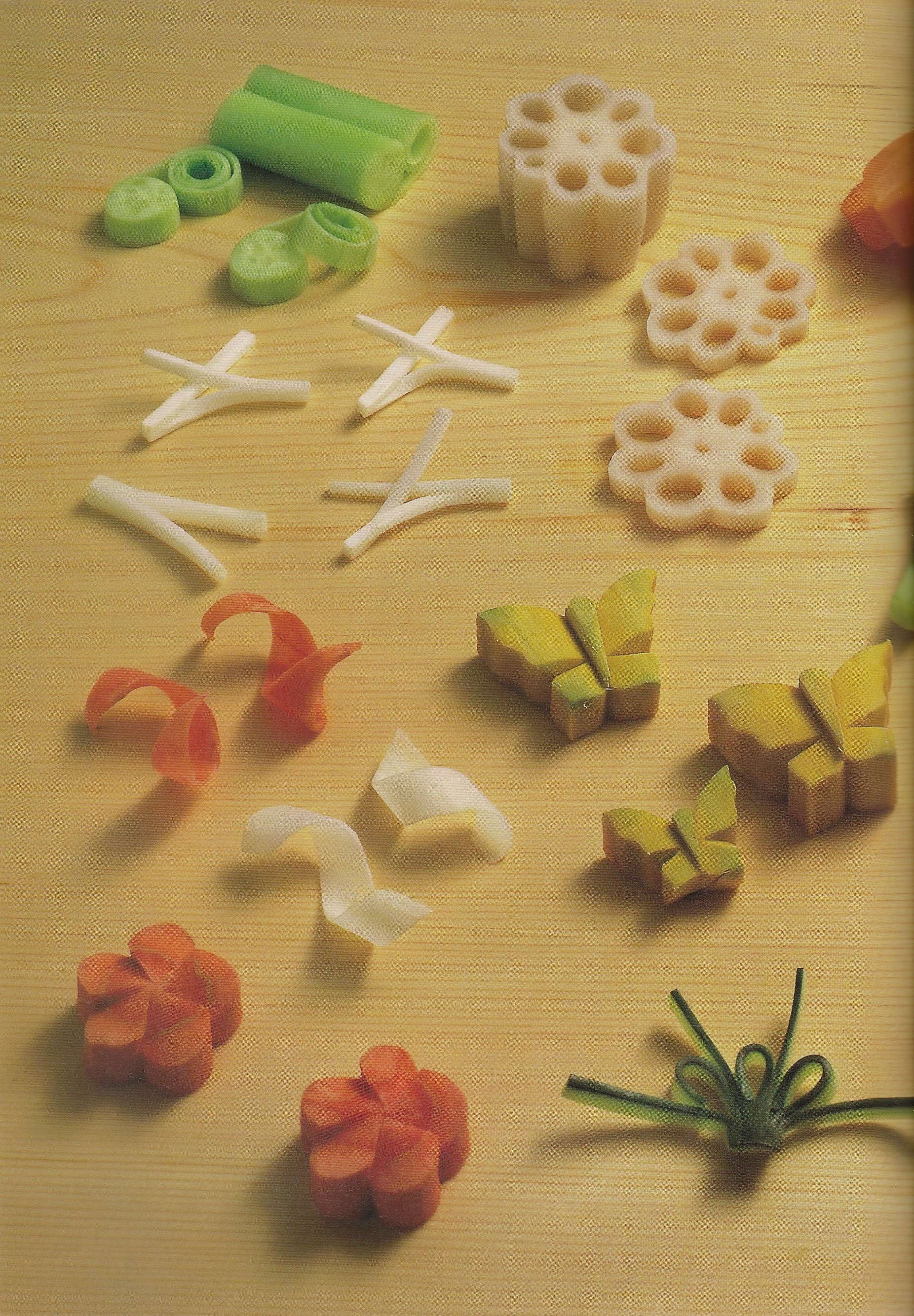
Cuisine exhibits play and simulation in its artistically cut vegetables. Image from Asobi.
The Japanese love of competition extends from classic sumo to modern Grand Prix racing. We know its Jan-Ken-Pon game as “Rock-Paper-Scissors.”
The fourth book examines Japanese aesthetics, especially in the traditional sense.
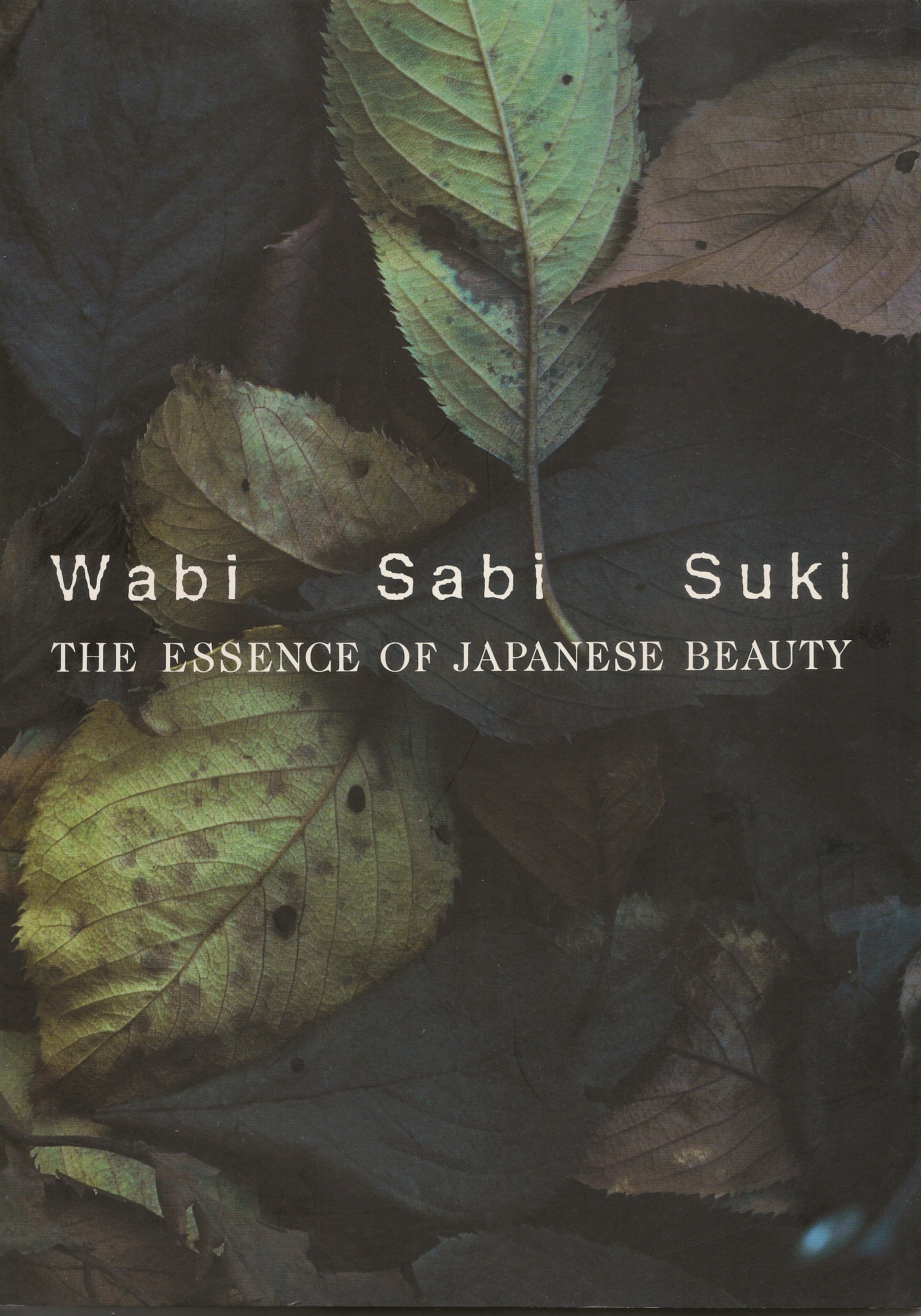
Wabi Sabi Suki: The Essence of Japanese Beauty, by Yoshida Mitsukuni, Tanaka Ikko and Sesoko Tsune, Mazda, 1993.
The book sets out definitions in its first pages. Wabi is marked by tranquil simplicity, the beauty of rocks existing just so in raked sand. Sabi, which literally means “rust” or “patina,” is characterized by treasuring the passage of time, in nature and the works of man. Suki, originally describing attraction and curiosity, also suggests aesthetic adventure, seeking a new appreciation.
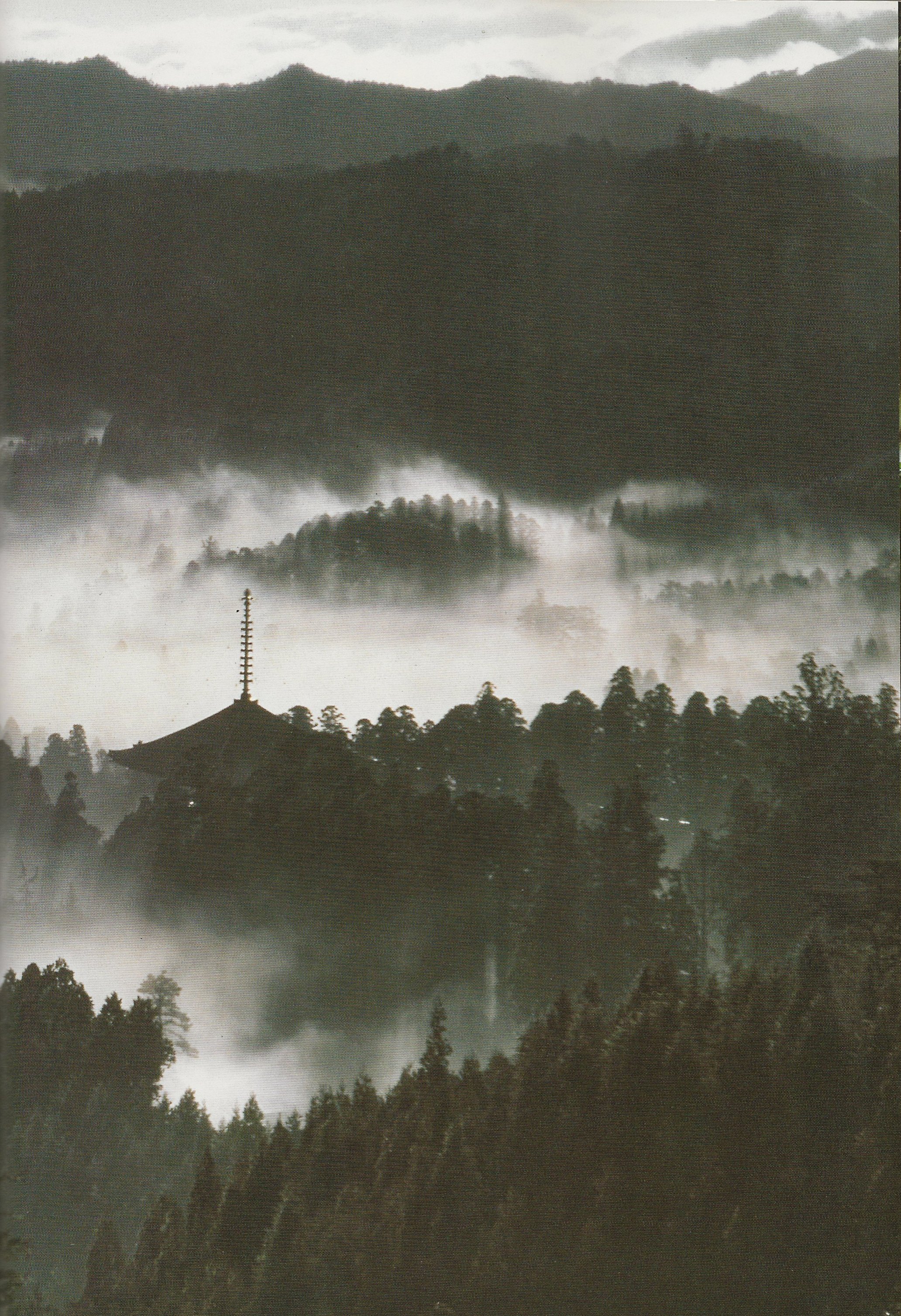
Mist around Yamato region. It’s a place evidently rich in anima, yet note the aesthetic adventure of that modern transmission tower. Image by Iwamiya Takeji from Wabi Sabi Suki.
The Katsura Rikyo Detached Palace in Kyoto is exemplary of all three of these concepts (www.wp.me/p2ETap-1hc).
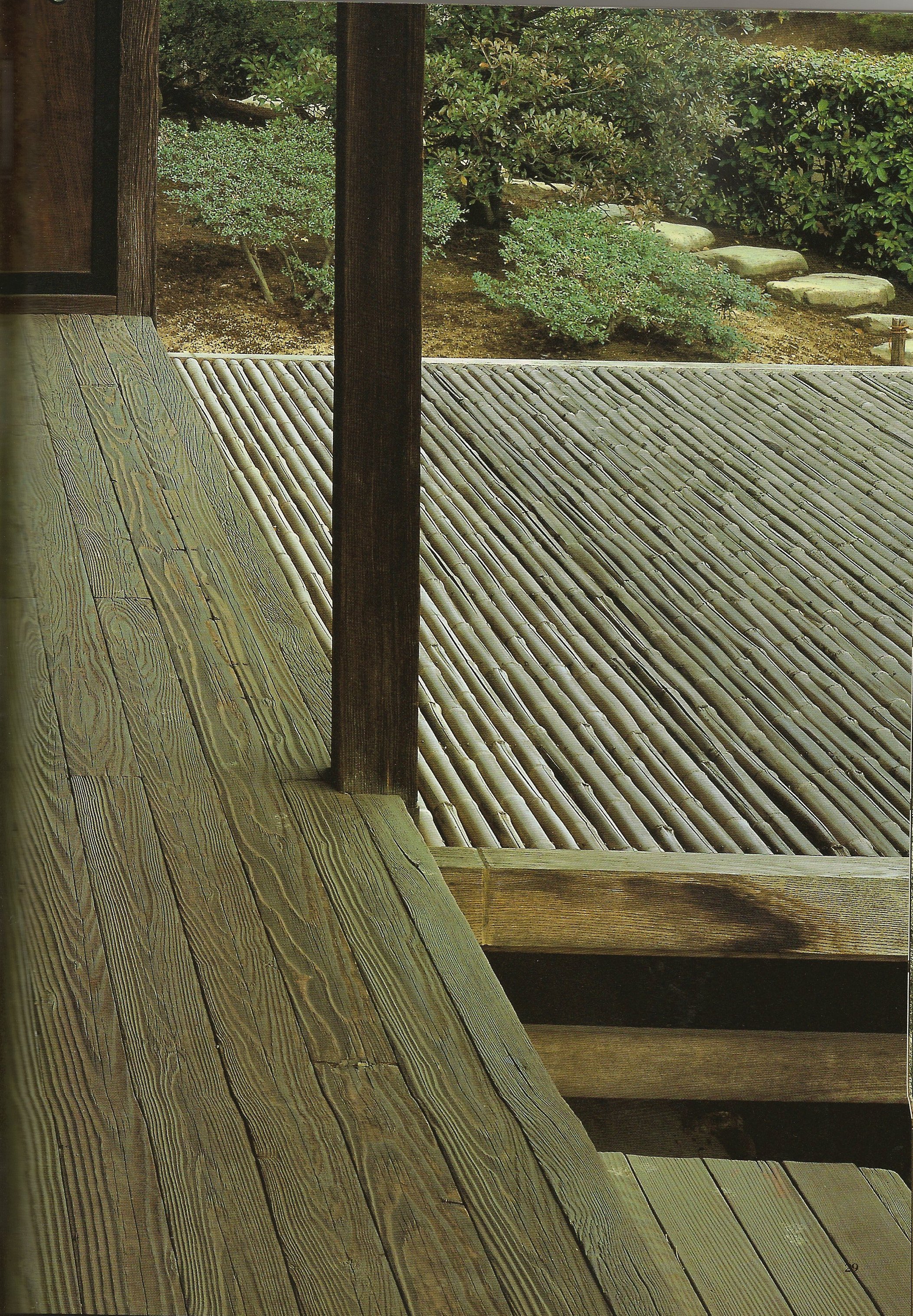
The Old Shoin, Katsura Villa, Kyoto. Image from Wabi Sabi Suki.
Katsura’s use of natural materials exudes wabi; its Seventeenth Century construction ensures sabi.
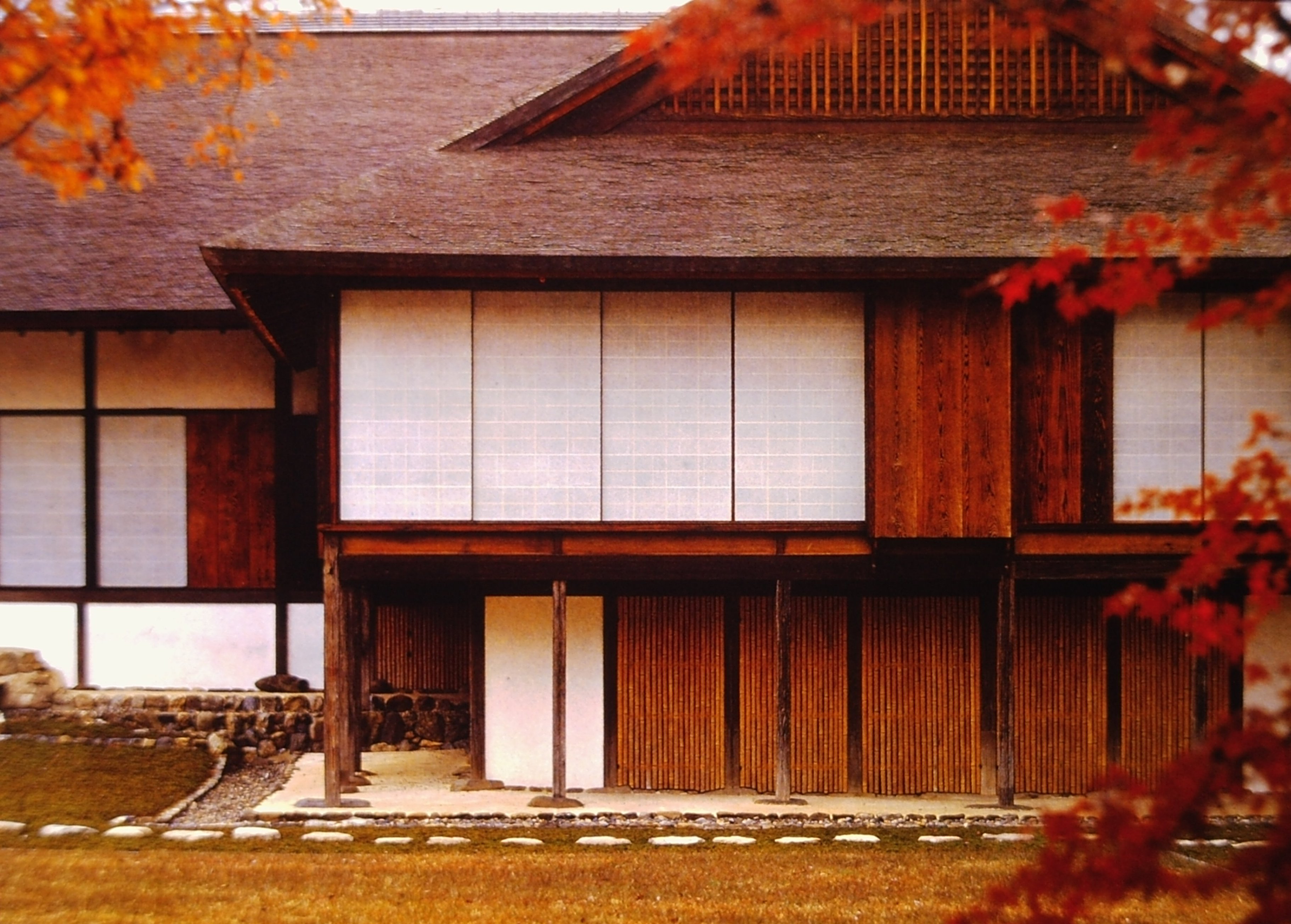
And its resonance with the modern art of Mondrian gives me a suki thrill. ds
© Dennis Simanaitis, SimanaitisSays.com, 2013
 Simanaitis Says
Hello from Tokyo,
I am not completely sure, but I think this is the full list of the Mazda Books series:
1. The Compact Culture (1982)
2. The Hybrid Culture (1984)
3. The Culture of ANIMA-Supernature in Japanese Life (1985)
4. The People’s Culture from Kyoto to Edo (1986)
5. ASOBI-The Sensibilities at Play (1987)
6. Naorai: Communion of the Table (1989)
7. Tsu Ku Ru: Aesthetics at Work (1990)
8. Wabi Sabi Suki-The Essence of Japanese Beauty (1992)
Each one of them are still a very valuable insight to Japanese Culture, not to mention Tanaka Ikko on board as Graphic Editor.
rafbalboa
The University of Tokyo
Hi Rafael,
Thanks for providing me with some more books published by Mazda Books series. In addition to those, I have a book titled ‘Harmony With Nature: Heritage of Craftsmanship’ published by Mazda Corporation in 1986. In case you would like to collect another interesting book on Japanese culture, I fully recommend ‘The Iroha of Japan’ published in 1979 (edited by Tsune Sesoko).