
Simanaitis Says
On cars, old, new and future; science & technology; vintage airplanes, computer flight simulation of them; Sherlockiana; our English language; travel; and other stuff
A COYOTE TALE
IT’S ONE of North America’s more encouraging ecological tales: Coyotes are thriving. Never endangered, never protected, Canis latrans (Latin for “barking dog”) was once indigenous to roughly the U.S. Mountain Time Zone. By the early 1900s, coyotes had migrated westward to the Pacific, northward toward the Yukon and to the northeast around the Great Lakes. Today, there’s only a single portion of the U.S. that coyotes have yet to colonize—New York’s Long Island.

A roadside coyote in Arizona. Image by marya (emdot).
News of the coyote’s success comes from “Predators in the ’Hood,” by Virginia Morell, in Science magazine, 20 September 2013, published by the American Association for the Advancement of Science.

Quoted in the article, Stanley Gehrt, wildlife biologist at The Ohio State University, said, “There are more people than ever and yet we’re seeing a resurgence and acceptance of these predators. Thirty years ago, no one would have predicted this would happen.”
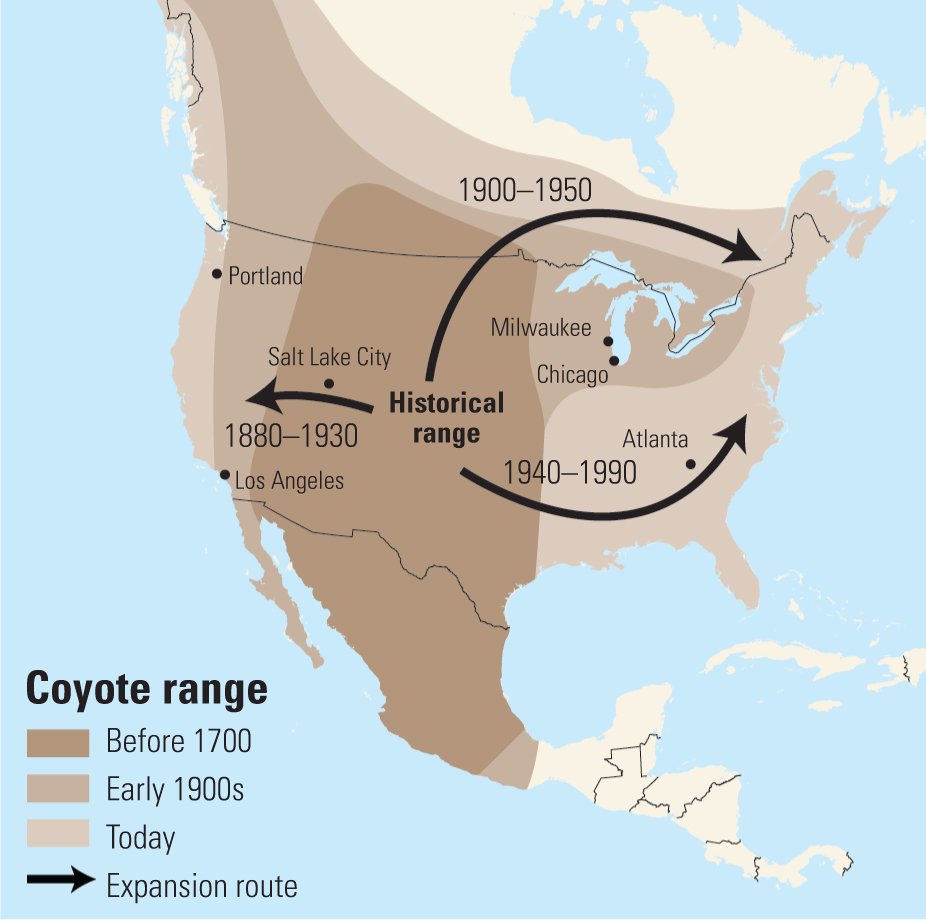
Coyote range over time. Image from Science, September 20, 2013.
One reason for this is a greening of the U.S. environment. According to a 2012 U.S. Forest Service report (see http://goo.gl/TYNnTb), during the last 100 years forestland across 20 northern states has expanded by 28 percent; this, despite human population growing by 130 percent. Cities contain more tree cover as well. Neighborhoods have more cottontail rabbits and white-tail deer.
And coyotes.
Mark Weckel, conservation biologist at New York City’s American Museum of Natural History, said in the Science article, “Maybe having coyotes living next to us isn’t what we were going for when we talked about ‘greening’ our cities. But this is the result—and it’s a positive thing. If they’re successful here, it means we’ve succeeded.”
Another reason is purely evolutionary. Coyotes (together with bears and cougars, also thriving) are the last of Pleistocene carnivores. These species have survived because they’re shy and less aggressive than other dwellers of this epoch, 2.5 million to 11,700 years ago (the world’s most recent glacier age). That is, left to themselves, this wildlife interacts with humans in a generally benign manner.
And, vice versa: Note the popularity of TV news videos showing bears in suburban swimming pools or maneuvering their favorite trash bins.
Coyotes benefit the environment by controlling critters: mice, voles, shrews, rabbits and fawns. Alas, pets are also prey, particularly when the coyotes learn not to fear their human neighbors.
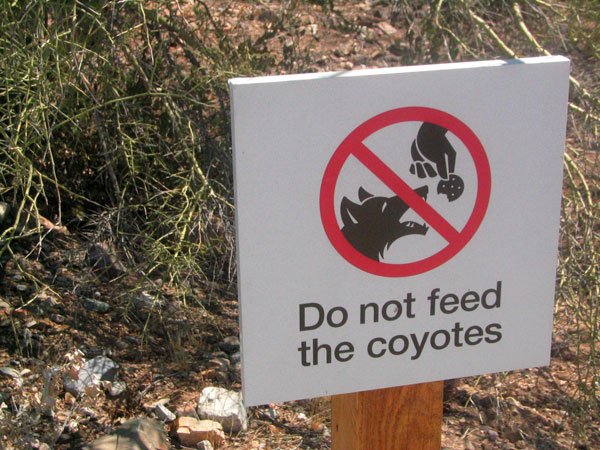
A crucial rule for coexistence, as shown at the Arizona-Sonora Desert Museum. Image by Alyson Hunt.
Feeding wildlife is a terrible practice; it diminishes their inherent shyness and lack of aggression.
Plus, coyotes seem to get along just fine without any favors. The U.S. Department of Agriculture killed nearly 80,000 of the species in 2012. Colorado, South Dakota, Texas, Utah and Virginia have bounty programs on coyotes.
On the other hand, we’ve removed the coyote’s primary competitor and predator, the gray wolf, which is an evolving ecological tale of its own.
According to Science, coyotes reached Chicago in the 1990s, likely hobo-style by following the rails.
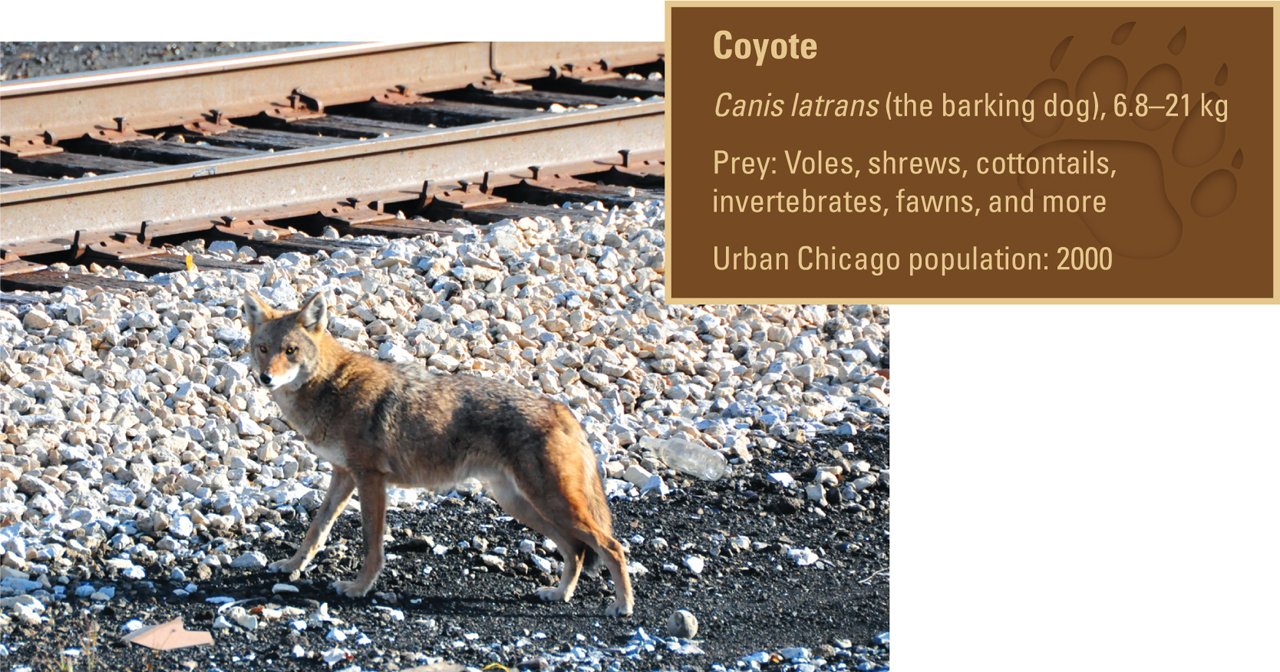
Not “riding the rails,” but walking them, coyotes reach urban areas. Image by Ryan Stavely from Science, September 24, 2013.
Highly adaptable, they switched a prairie lifestyle to a nocturnal one, hunting at dawn and dusk. What’s more, city and suburban coyotes learn to coexist with cars, freeway underpasses, even subways.
The old R&T digs in Newport Beach, California, abutted an expanse of open land wherein dwelled scads of California ground squirrels in a virtual megalopolis of burrows. Herons, Blues and Whites, were frequent visitors, as were families of coyotes.
Several of us kept binoculars handy to observe the goings-on. So slick and well-groomed, “our” coyotes could have been mistaken for German Shepherds.
With all those ground squirrels around, they must have thought they’d died and gone to coyote heaven. ds
© Dennis Simanaitis, SimanaitisSays.com, 2013
 Simanaitis Says
May I suggest an excellent book on the topic of coyotes. It’s called “The Voice of the Coyote” by J. Frank Noble. Written in the 1940’s. I have the original edition. Interesting perspectives from ranchers, native peoples etc. Right up your alley!
That is J. Frank Dobie. I just love auto-correct!
Thanks, Guy. Sounds very interesting.
By the way, there are other aspects of this Science article that are likely to foster other mini-essays here: A Cougar Tale and Bears in the Classroom.