
Simanaitis Says
On cars, old, new and future; science & technology; vintage airplanes, computer flight simulation of them; Sherlockiana; our English language; travel; and other stuff
JUST JOKING AROUND
MARK TWAIN said, “Man is the only animal that laughs, or needs to.”
Once our ancestors evolved open-ended thinking, they followed with a hard-wired sense of humor. And if you’d like to learn more about this, have I got a deal for you.
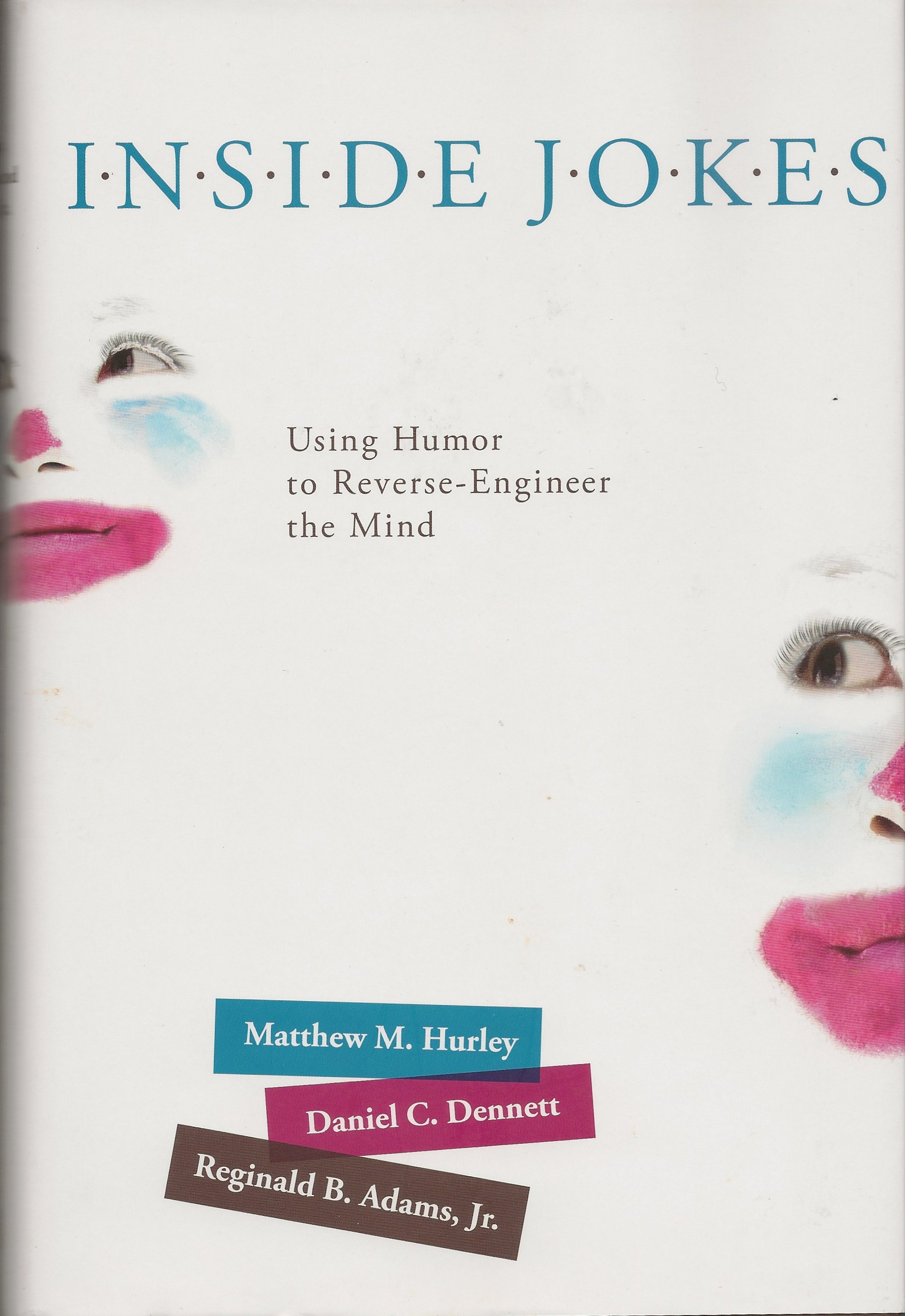
Inside Jokes: Using Humor to Reverse-Engineer the Mind, by Matthew M. Hurley, Daniel C. Dennett and Reginald B. Adams, Jr., MIT Press, 2011. Both www.amazon.com and www.abebooks.com list it.
As the book’s subtitle makes clear, Inside Jokes is anything but a mere collection of humor. It’s an evolutionary and cognitive study of the subject, the sort of thing that could be required reading in a psychology course on emotional development.
Humor, of course, can range from puns to grimaces, sitcoms to what the authors term uncategorized objets trouvés, things in real life that make us laugh.
A Buddhist walks up to the hot dog vendor and says, “Make me one with everything.”
Sections of the book begin with insights such as these.
The vendor gives him his hot dog, but not his change. When the Buddhist asks for it, the vendor replies, “Change must come from within.”
Briefly, the human brain evolved real-time assessments of its environment. (“Does that carnivore see me?”) Conscious and continuous double-checking of all this discovery and resolution “is maintained by a powerful reward system—a feeling of humor; mirth.” (“Ha! That carnivore missed me!”)
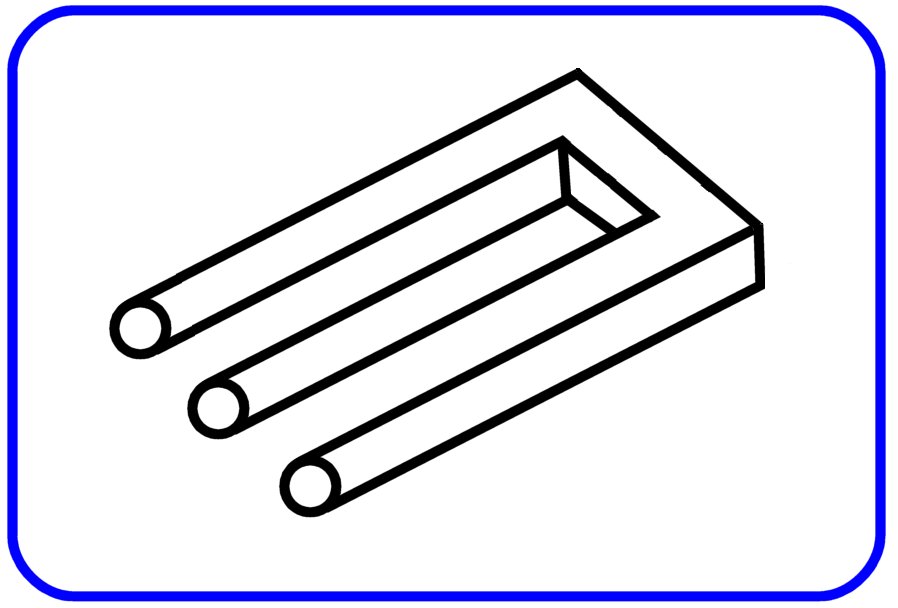
The Triple Entabulator is visual humor.
Said another way, humor occurs when something that’s taken as true turns out to be false, but with no serious downside.
A pun’s wordplay is an example of this; the two Buddhist jokes are puns, albeit not the simplest of them. Other humor can be essentially one joke seen again in another guise.
What’s the difference between a park bench and an English major? A park bench can support a family of four.
Compare with:
How do you get a philosopher off your porch? Pay for the pizza.
But, as the authors show, humor’s epistemic expectation/falsehood discovery can be rather more complicated.
A guy goes on a Caribbean cruise only to learn he’s enlisted to toil as a galley slave. He becomes addled by the experience and actually comes to appreciate the drumbeat coordinating the oars. The ordeal ended, he says to his oar mate, “You know, that drummer was really good. Do you suppose we should tip him?” The oar mate replies, “I didn’t on my last cruise.”
The authors also examine the Artificial Intelligence implications of humor. Can a computer be made to joke?
Yesterday my friend’s computer beat me at chess, but it was no match for me in kick-boxing.
After studying a computer’s cognitive and emotional potential, the authors conclude “If we ever set out to produce the kind of reasoning we do, we must endow it with something like humor and the other epistemic emotions.”
The book’s Epilogue claims There are two kinds of people in this world. Those who require closure
© Dennis Simanaitis, SimanaitisSays.com, 2013
 Simanaitis Says
A visitor goes up the mountain to ask a question of the Maharishi, who replies, “I can’t tell without seeing it but it sounds like the water pump.”
Ha! Great!
Sent from my iPhone
Actually there are two kinds of people in the world: those who believe there are two kinds of people in the world, and those who do not.
Bill’s joke is a variation of the one about the advice columnist who received a question from a woman who wanted to know what to do, having returned home early and finding her husband in bed with another woman when her car broke down on the way to work. In the version I read the columnist’s advice is to check the fuel system, which we all know is silly. You always check the spark first.