
Simanaitis Says
On cars, old, new and future; science & technology; vintage airplanes, computer flight simulation of them; Sherlockiana; our English language; travel; and other stuff
SCIENCE TIME TRAVEL
SUPPOSE YOU could travel back in time and share some 21st Century knowledge with someone of an earlier era. Whom to choose? What knowledge to share?
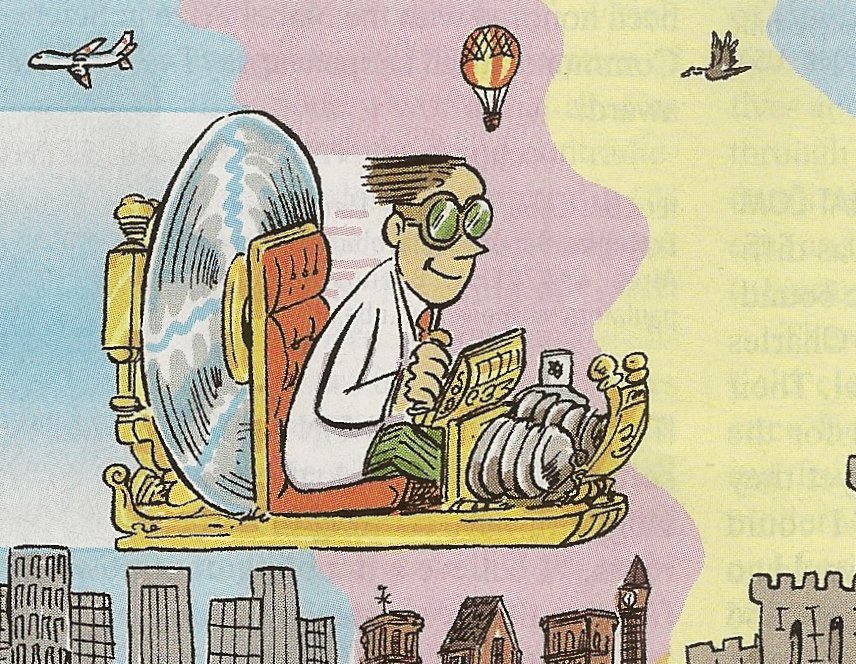
Image from Science, 5 July 2013.
In its “NextGenVoices,” 5 July 2013, Science, the magazine of the American Association for the Advancement of Science, reports on offering these questions to its members. Almost 200 readers responded. Here’s a collection of their thoughts.
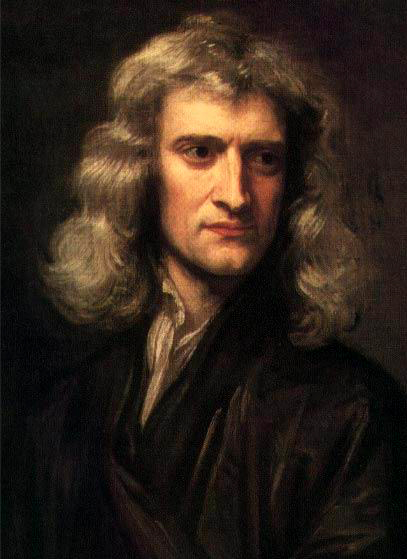
Sir Isaac Newton, 1642-1727, was one of the most influential scientists of all time. Portrait by Sir Godfrey Kneller.
Sir Isaac Newton, 1682, Einstein’s theory of Relativity. Matthew Hammond, Department of Biochemistry, University of Pennsylvania, notes that Newtonian mechanics (a special case of Einstein’s world view) came from Principia published in 1687. Hammond observes, “If Newton had discovered both his and Einstein’s contributions at the same time, the result would be an educational system that introduces a more complete view of physics to a wider audience from an earlier age…”
Ignaz Semmelweis, 1847, hand-washing in medicine. Samuel D. Rutledge, Department of Biological Sciences, Virginia Polytechnic Institute and State University, notes that Dr. Semmelweis discovered an effective way—vehemently rejected at the time—for doctors to mitigate puerperal fever: simply washing their hands with a chlorinated lime solution. Rutledge would support Semmelweis by offering modern evidence of the practice’s efficacy and also encouraging “the willingness and openness needed to accept alternative ideas—even those which may conflict with one’s own beliefs…”
Archimedes, 222 B.C., calculus. Jugal K. Shah, School of Medicine, University of California, San Francisco, observes that so much of today’s technology has been made possible through the mathematical techniques of calculus. He says, “…had calculus been introduced to the world 1900 years earlier than it was, the impact on humankind would be immeasurably large.”
Alfred Nobel, 1833-1896, inventor of dynamite, was called “the merchant of death” in an erroneous obituary; it’s said this prompted him to establish the Nobel Prizes.
Alfred Nobel, 1895, a Nobel Prize in Science Communication. Paula de Tezanos Pinto, Departmento de Ecologia, Genética y Evolución, Universidad de Buenos Aires, posits an imaginary conversation with Alfred Nobel as he was arranging endowments to honor achievements in physics, chemistry, medicine, literature and peace. “Scientists are communicators,” she would remind Nobel, “writers needing to share ideas with clarity to different audiences.” She observes—and Nobel agrees in her imagined meeting—that “…science is not just for scientists.”
Thomas Edison, 1900, solar panel design. Dan Ferrell, Alexandra, Virginia, would share with Thomas Edison the environmental challenges of the 21st Century and give him today’s knowledge of solar panels. This could encourage work leading to “…Edison Panels that would be on every Victorian home in the world, especially in hard-to-reach locations…”
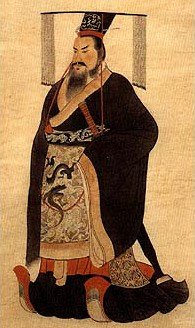
Qin Shi Huang, 259 B.C.-210 B.C., was the first emperor of China, an imperial line that was to last nearly two millennia.
Emperor Qin of China, 221 B.C., the capabilities of women. Jian Zhang, School of Mechanical and Automotive Engineering, South China University of Technology, says he would persuade the emperor “to give women more chances to receive education and give full play to their talent in science and technology, culture, politics and the military.”
Charles Darwin, 1866, Gregor Mendel’s results. Antoine de Morrée, Stanford University School of Medicine, observes that scientific exchange was long hampered by geographic and linguistic boundaries. Mendel’s results provided proof of evolution by natural selection, and sharing this “would result in a modern synthesis 50 years ahead of time…” De Morrée says, “we would be much further in our understanding of human genetic diseases and closer to their treatments.”

“The Blue Marble.” Image from NASA.
Britain, early 19th Century, “The Blue Marble.” Steven M. Roels, Department of Zoology, Michigan State University, says, “…instead of a piece of technical knowledge, I would share …the photo of Earth taken by the Apollo 17 astronauts in 1972. ‘The Blue Marble,’ as it is often called, shows both the unity and finitude of the planet and its resources.” Roels feels that offering this to a soon-to-be-industrialized culture “would provide perspective.”
Whom and what would you choose? ds
© Dennis Simanaitis, SimanaitisSays.com, 2013
 Simanaitis Says
Leonardo da Vinci
In answer to the question, what of Leonardo’s inventions I would focus on, it would probably have to be flight. Helicopters and perhaps even fixed wing propeller aircraft would probably not surprise him too much, but jet air craft, rockets and space shuttles would probably be quite an exciting new area that would intrigue him.
Hi, Andy, Neat thoughts. Many thanks. Please post them at the website for a broader audience. Cordially, Dennis
Sent from my iPhone
Oops. I see they’ve been posted. Again, many thanks.
No one. As a devotee of science fiction, I am too aware of the dangers of fiddling with the space-time continuum. Knowing the randomness of the conception process, and the number of progenetors who would have to have been conceived in perfect dupication between myself and whatever contemporary of any individual I might feel would benefit from modern knowledge, I am quite convinced that the least deviation from the sequence of events that led to my appearance on the planet would wipe out my existence . . . and yours too, by the way.
Of course, eliminating myself by such means would wipe out any change I suggested, leaving me present and whoie to contemplate again the consequences of acting or forebearing.