
Simanaitis Says
On cars, old, new and future; science & technology; vintage airplanes, computer flight simulation of them; Sherlockiana; our English language; travel; and other stuff
BMW i3
TECHNICAL DETAILS of the 2014 BMW i3 urban electric vehicle have now been revealed. Is it a major step forward for BEVs? Is it a technical marvel? Is it merely BMW’s analog of the GM EV1?
Yes, to some extent, each of the above.
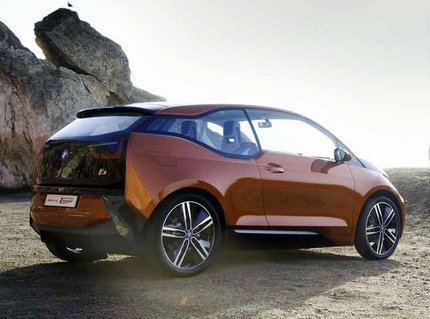
The BMW i3 comes to the U.S. sometime in 2014. A price of around 40,000 € ($52,000) has been predicted for the European version introduced before this.
BMW’s talking points for the i3 are on-target: “Born electric. Naturally intelligent,” “The state of sustainability” and “Synchronized with your city.” Also, it and other BEV (battery electric) siblings are part of BMW meeting California’s ZEV (Zero Emission Vehicle) Program.
This program is an evolution of the California ZEV requirement back in the 1990s that encouraged—though perhaps this is too soft a word—GM to build the EV1.
Available in lease-only from 1996-2002, the EV1 was a technical marvel of its era—and utterly unprofitable to GM. Once the ZEV Program loosened up, the GM EV1 program was discontinued. The cars were retrieved in 2002; most were scrapped. Generally, EV1 enthusiasts felt unhappy about the whole deal. Conspiracy was alleged, especially by those unfettered by any concept of corporate profit.
But I stray from the point. What of the BMW i3’s technical marvels, two in particular, its rear-mounted BEV or REV drivetrain and its carbon-fiber body structure?
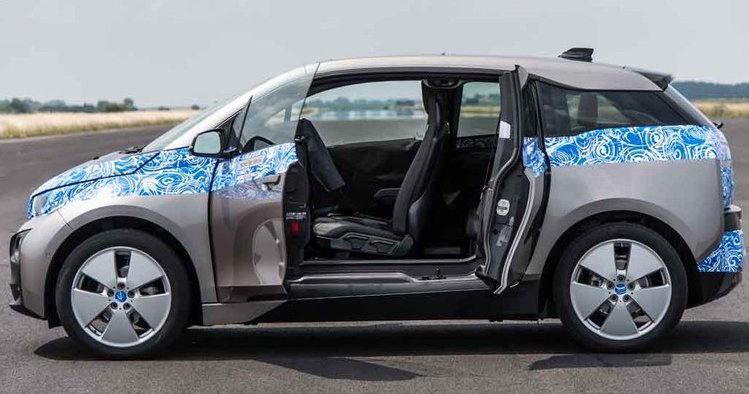
The i3’s door layout gives optimal access.
In standard form, the i3 is a pure BEV. Its range of 80 to 100 miles evidently depends on how many times one probes its claimed 7.2 seconds to 100 km/h (62 mph). The GM EV1 did a 7.6 sec.
The standard i3 has an Eco-Pro setting that trades performance for another 12 miles; and Eco-Pro+ for perhaps another dozen. A recharge of its 500-lb. 22-kWh lithium-ion battery pack is said to take four to five hours on a typical European 220-volt home circuit; a quick charge, the nominal 30 minutes to 80-percent capacity.
For more range, there’s the i3 in optional REV (Range-assisted) form. This adds a 650-cc two-cylinder gasoline engine that fires up automatically to maintain the battery pack at a specified charge level. The engine has no other responsibility; it never provides direct propulsion. BMW says a range-assisted i3 can travel around 180 miles before needing conventional refueling.
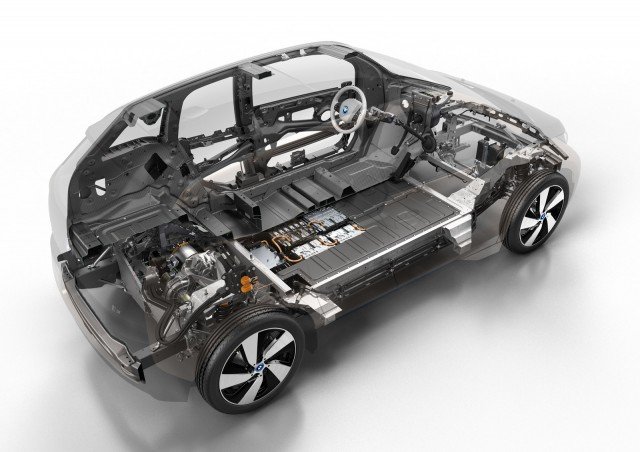
The i3 has rear drive, a low-mounted battery pack, a chassis of lightweight metals and a carbon-fiber passenger cell.
The i3 gains a great deal of efficiency from its light weight, 2635 lb. in standard form, 2800 lb. for the REV version. (By contrast, a Nissan Leaf BEV weighs 3352 lb.) The i3’s light weight comes from specific (spelled $$$) use of lightweight metals and carbon fiber.
Propulsion, suspension and other bits reside on aluminum and magnesium substructures, many of them artfully cast. The basic passenger cell, termed the Life module in an i3’s LifeDrive architecture, is entirely of carbon fiber, hitherto a feature limited to lofty exotics.
What’s more, this carbon-fiber fabrication is made by BMW’s partner SGL Automotive at their joint-venture facility in Moses Lake, Washington (about 180 miles inland from Seattle). Carbon-fiber production is energy-intensive, and the cost of shipping is balanced by relatively inexpensive hydroelectric power in the U.S. northwest.
It’s akin to Iceland making a profitable business out of aluminum smelting, despite obtaining bauxite ore from Australia (see www.wp.me/p2ETap-6Z).
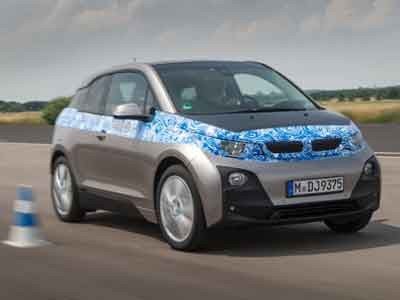
The i3 strives to carry iconic BMW features into its EV urban environment.
Considerations of energy certainly make for an interesting world—even one with Ultimate Driving Machines powered by electricity. ds
© Dennis Simanaitis, SimanaitisSays.com, 2013
 Simanaitis Says
Interesting, but!! This sounds like a big gamble for BMW. I hope they will succeed, but let’s try the thing first and find out how liveable it is. The curse of limited ev range remains, however – despite the relatively low weight. The design is a bit clumsy, but overall a good try. Now if only the electricity would be produced by wind or solar power the whole conception would make environmental sense and make our grandchildren happy! For those interested check out the Renault Zoe.