
Simanaitis Says
On cars, old, new and future; science & technology; vintage airplanes, computer flight simulation of them; Sherlockiana; our English language; travel; and other stuff
FUEL-CELL UPDATE
IT’S NO longer “if,” but “when” hydrogen fuel-cell cars and trucks enter the mainstream. In the past few weeks, significant news from distinctly different quarters corroborates this. These include yet another major automaker linkage as well as reports from the U.S. Department of Energy and in a highly respected technical magazine.
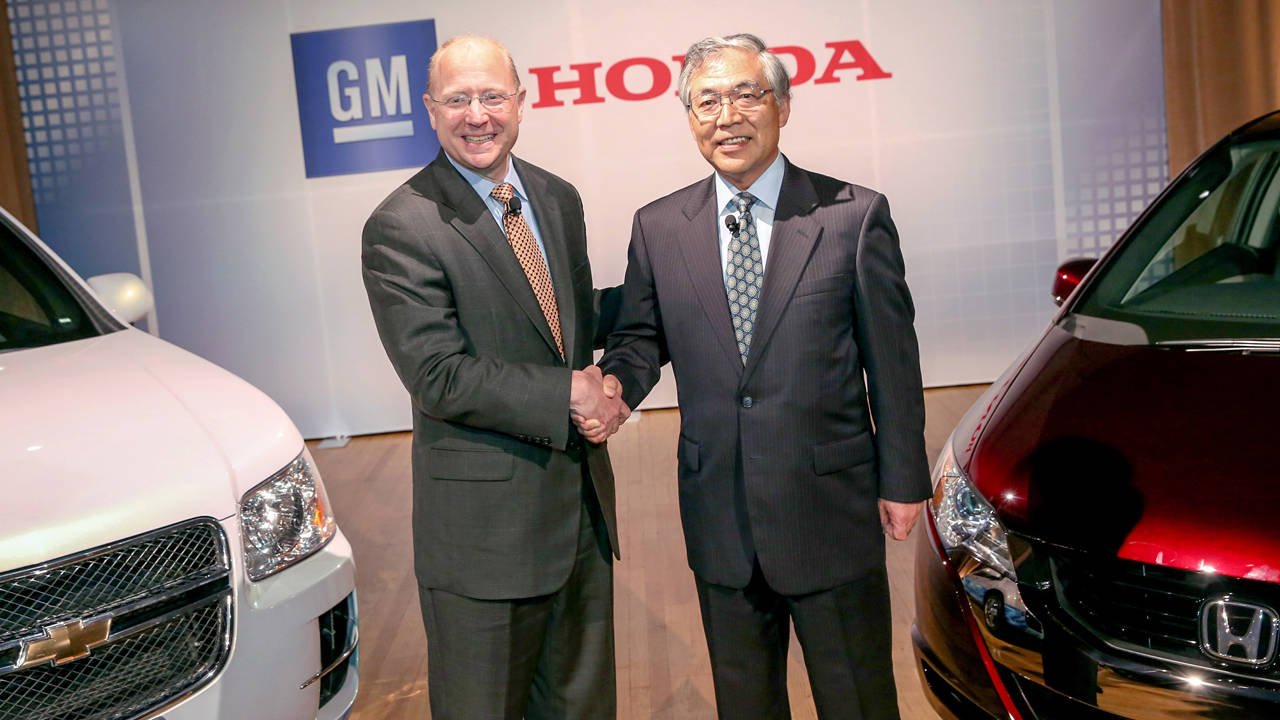
GM’s Steve Girsky and Honda’s Tetsuo Iwamura celebrate partnership of fuel-cell development.
The auto linkage is between GM and Honda; its specified goal, to optimize hydrogen fuel cells and onboard storage for 2020 applications. The partnership will have engineer exchanges, joint use of R&D facilities and shared sourcing of parts and materials.
Other automaker fuel-cell partnerships already announced include Daimler/Ford/Nissan and BMW/Toyota. Daimler’s Mercedes-Benz, Honda, Hyundai and Toyota all have plans for U.S. sales of hydrogen fuel-cell cars during 2015. The Toyota is expected to be unveiled this November. Hyundai already has limited production in its Korean home market. The Daimler/Ford/Nissan alliance has said it’ll be introducing fuel-cell cars by 2017.

The Honda Clarity FCX, already in limited lease use since 2010, is expected to evolve for general sale by 2015.
At the same time, the U.S. Department of Energy has initiated H2USA (see http://goo.gl/f7kX3), a public-private partnership to develop the refueling infrastructure. Daimler, GM, Honda, Hyundai, Nissan and Toyota have joined, together with the likes of the American Gas Association, the California Fuel Cell Partnership and the Fuel Cell and Hydrogen Energy Association.
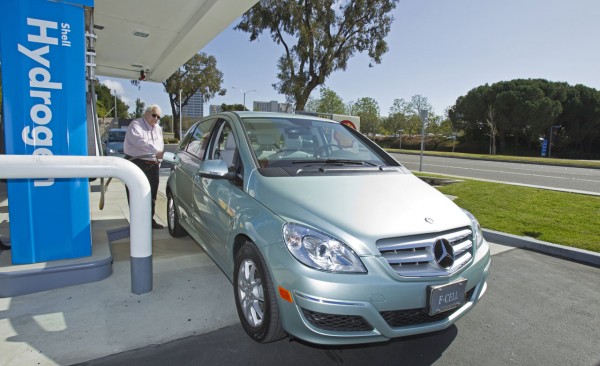
I refill a Mercedes-Benz F-Cell at one of my nearby hydrogen stations here in Orange County, California.
Southern California is seen as one of the hubs of this gas station development (and, here, the term “gas” is technically correct). As I never tire of noting, there are already two hydrogen stations, each accessible 24/7, within 8 miles of my home here in Orange County, California. Others are underway, with at least 68 public stations in the state by 2017.
A recent report from the highly respected MIT Technology Review (see http://goo.gl/1tcAH) adds gravitas to this. It makes the point that falling costs are an important element of a fuel-cell future. Toyota spokesman Chris Hostetter is quoted as saying its fuel-cell sedan coming in 2015 might be priced around $50,000, making it less expensive than the battery-electric Tesla Model S.

Toyota’s 2015 production fuel-cell car will likely resemble this concept car.
Plus, I wouldn’t be surprised to see the Toyota fuel-cell car far exceed the ($77,400, largest-battery) Tesla Model S’s EPA range of 265 miles. I offer as evidence my own single-tank drive of 436 miles from Las Vegas to San Diego in one of Toyota’s earlier versions back in 2007. See www.wp.me/p2ETap-3l.
The U.S. Department of Energy has released its latest analyses of greenhouse-gas emissions from various propulsion options in the mid-term (http://goo.gl/7FyGL). It’s important to stress these analyses are on a total well-to-wheel basis; that is, from the sourcing of its fuel, through its production and distribution, to its use.

Data from Program Record #13005 (revision #1), May 10, 2013, U.S. Department of Energy.
On this well-to-wheel basis, a 2035 fuel-cell vehicle is projected to emit less than half the CO2-equivalent gram/mile of a conventional gasoline car today. It would even beat a battery-electric car when operated in parts of the U.S. relying heavily on coal for its electricity.
Several of the extended-range, plug-in and conventional hybrid concepts look very promising too. So does cellulosic-sourced conventional combustion.
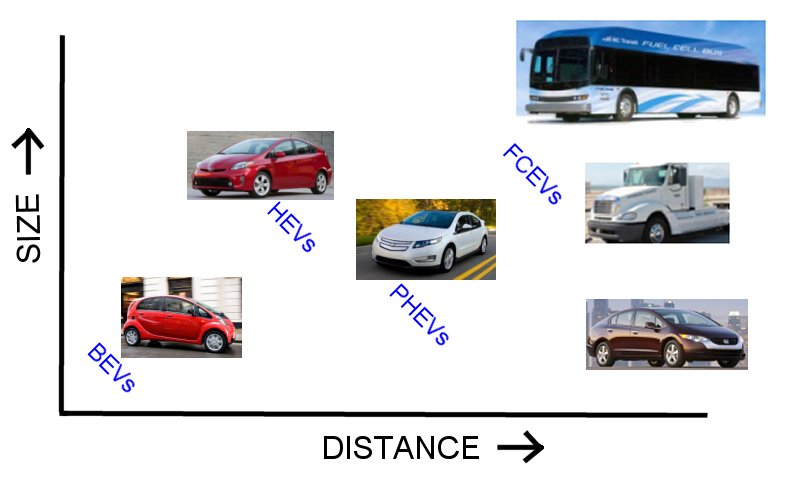
Optimized mobility depends on the mission: vehicle range and size.
All these reports corroborate what I’ve been learning from specialists for years now. In particular, an oft-cited future of multiple-propulsion mobility, each with its appropriate niche, is looking better and better.
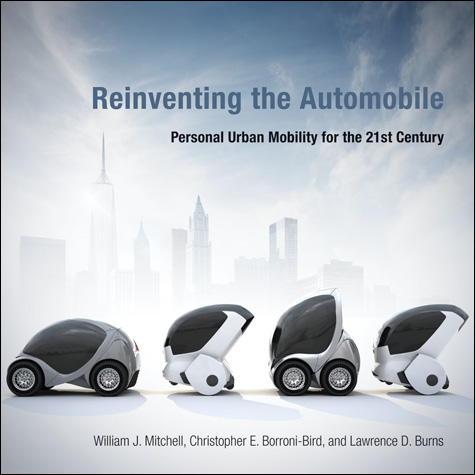
Reinventing the Automobile: Personal Mobility for the 21st Century, by William J. Mitchell, Christopher E. Borroni-Bird and Lawrence D. Burns, MIT Press, 2010. Both www.amazon.com and www.abebooks.com list it. See also www.wp.me/p2ETap-hR.
Mitchell, Borroni-Bird and Burns sure got it right. ds
© Dennis Simanaitis, SimanaitisSays.com, 2013
 Simanaitis Says