
Simanaitis Says
On cars, old, new and future; science & technology; vintage airplanes, computer flight simulation of them; Sherlockiana; our English language; travel; and other stuff
SINSHEIM AUTO & TECHNIK
THE SOUTHWESTERN German town of Sinsheim is about 50 miles northwest of Stuttgart, 22 miles southeast of Hockenheim’s Formula 1 circuit.

In May 1999, I had been visiting the university city of Heidelberg, about 20 miles to the northwest. What a lovely and historical city this is.
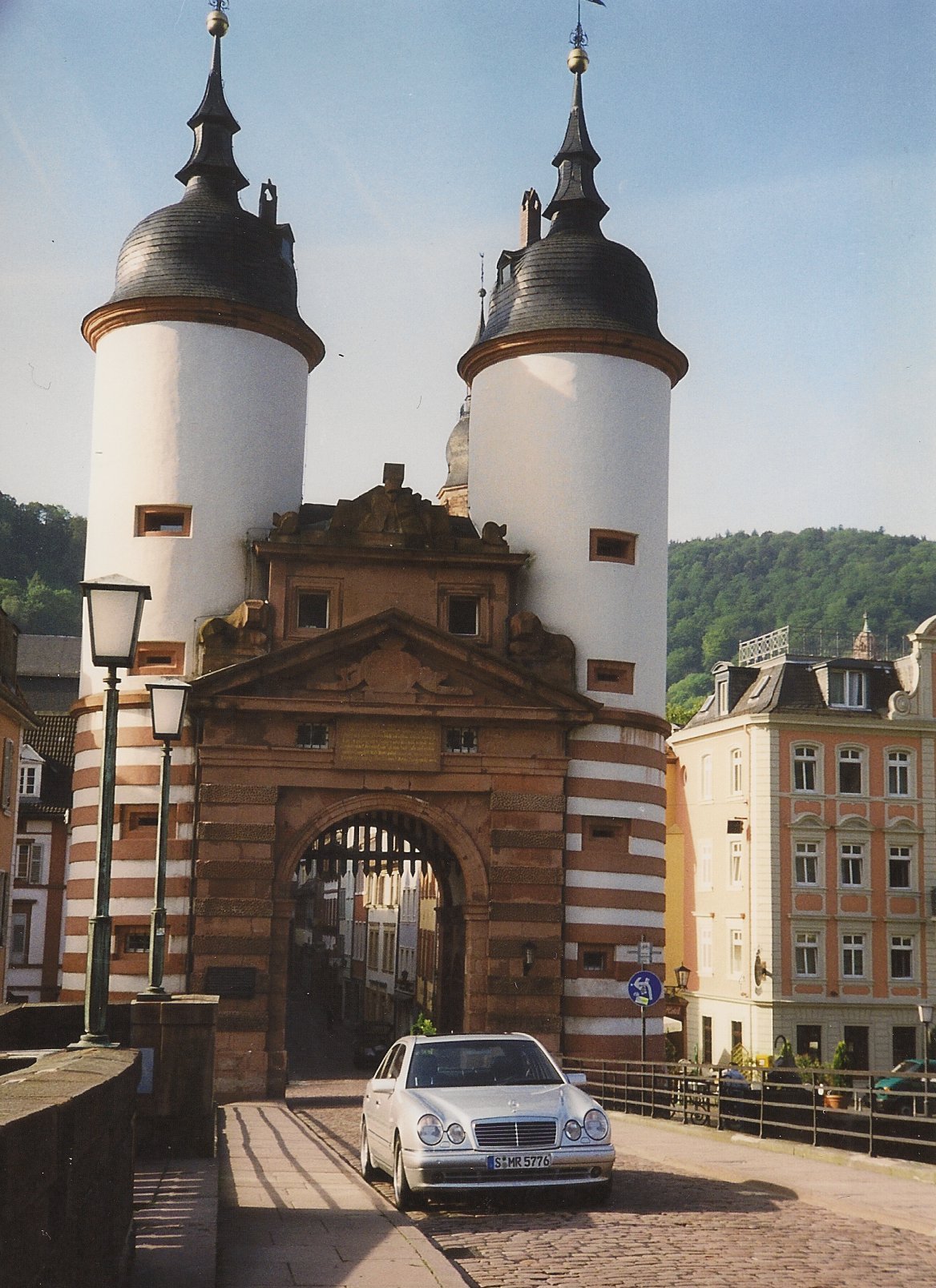
My drive poses in front of a Heidelberg gate.
Ambling my way south to Stuttgart, I was approaching Sinsheim on the A6 Autobahn—but then I made for the nearest exit.
The reason? Right next to the Autobahn, there was a gaggle of aircraft—these days including two SSTs, an Air France Concorde and Tupolev Tu-144.

If you’re into Technikstoff, Sinsheim is well worth a visit.
The Auto & Technik Museum Sinsheim (http://goo.gl/TCR14) is one of the more eclectic collections I’ve ever visited, sort of a raffish Deutsches Museum that can be appreciated in a single day.

The entrance to Museum 2 contained an American welcome. Thanks, Barry.
The museum is Europe’s largest private collection of things technical, with more than 3000 exhibits, displayed indoors and outdoors, on about 7.4 acres (think 7 1/2 football fields).
There are more than 300 classic cars, 200 motorcycles, 40 racing cars, the largest permanent collection of Formula 1 cars in Europe, 60 aircraft and 20 locomotives.
What’s more, many of the exhibits have mixed displays of auto, aircraft and general social history blended together.

I like the cultural mix of many Sinsheim exhibits. The flappers and this Bugatti are certainly comfortable with each other.
An addition since my visit is something of a museum oddity: a replica of one of the six Bugatti Type 41 Royales. This faux Coupe Napoleon is powered by an American V-8, built for the French film, Rebus, and accompanied by another of the era’s hotties.
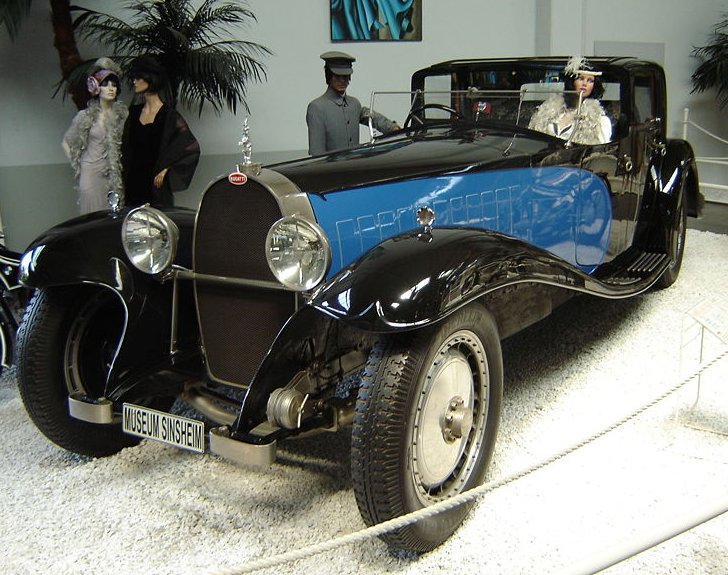
Sinsheim’s film replica Bugatti Type 41 Coupe Napoleon. Image by Petr Kadlec.
Another oddity is the single publically exhibited example of a Vector W8, designed and built by Californian entrepreneur Jerry Wiegert.
American cars get dedicated exhibits. Those of the 1950s are particularly well represented.
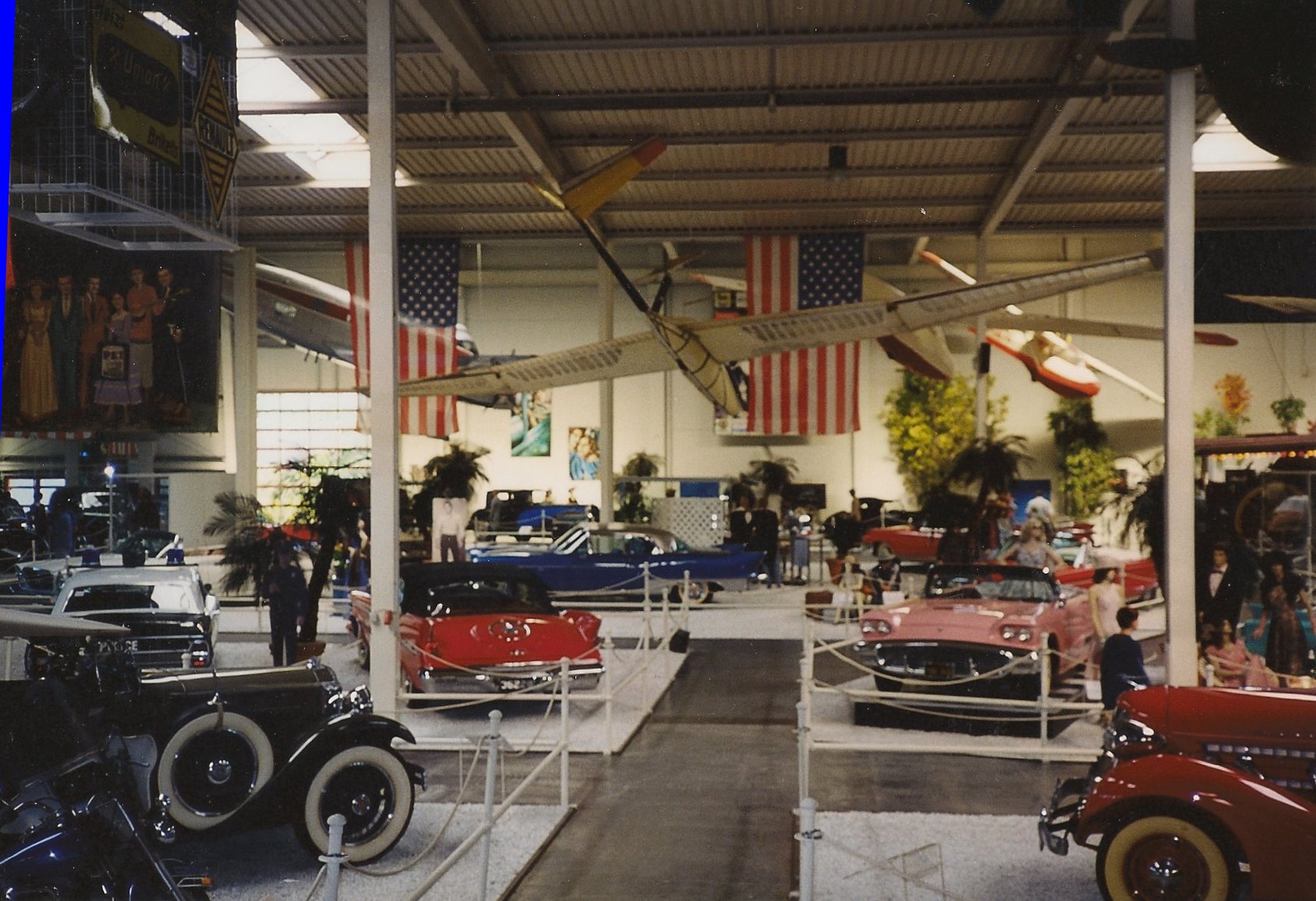
American cars have a prominent place at Sinsheim.
I learned to drive on my dad’s 1950 Ford Tudor, but the family’s bright red 1955 Ford Convertible was the first car of which I had independent use. The museum’s 1956 certainly brought back memories.

Sinsheim’s Ford Convertible looked familiar.
The 1950s exhibit had mannequins dressed in clothing of that era (though I confess I don’t recall the girls in my crowd wearing white gloves).
The Formula 1 collection is much larger now than when I visited. But it was special enough in 1999 to have a Tyrrell Project 34, the radical six-wheeler from 1976-1977. The car’s dual front wheels were 10-inchers—the original Austin Mini diameter.

Tyrrell’s Project 34 six-wheel Formula 1 car had its moment of glory with a 1-2 finish in the 1976 Swedish Grand Prix.
The paired front wheels were chosen not for reduced drag (the conventional rear tires figured in frontal area). Rather, they diminished front lift, gave more contact patch and permitted more disc brake area, albeit with greater weight.
And, if this seems an excess of wheels, the Auto & Technik Museum Sinsheim offers a single-wheel motorcycle.
In 1910, a fellow in Paris named Erich Edison-Puton came up with the idea of powering a unicycle with a 150-cc 3.5-hp De Dion one-cylinder mounted within its rim. What’s more, this is where he sat as well.
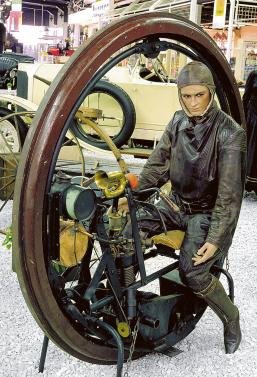
Perhaps the ultimate Sinsheim thrill ride, the Monowheel.
Restoration expert Ferdinand Schlenker made the museum’s Monowheel fully operational. For a brief look at Herr Schlenker in action, see http://goo.gl/KgkbG. For others taking part in such technical delight, see http://goo.gl/005la. ds
© Dennis Simanaitis, SimanaitisSays.com, 2013
 Simanaitis Says
The art museum in Martigny, near Montreux, has a car collection in its basement gallery, including Swiss cars that probably even you never heard of.
Thanks, Ivan. Another new one for me.
Dennis, I visited SINSHEIM AUTO & TECHNIK this May on my tour of German auto museums. It is still quite impressive. Where else can you walk through both SSTs? Also there are a lot of military vehicles along with the cars, planes and two wheeled conveyances.
Dennis, you are too young to remember the “white glove” era. I was a student at UCBerkeley in the early-mid-50s. Any female student wishing to visit San Francisco,would ALWAYS wear a nice dress, hat , and gloves of some color, often white.
Hi, Bob, You mean Berkeley gals don’t do that now? Cordially, Dennis
Sent from my iPhone