
Simanaitis Says
On cars, old, new and future; science & technology; vintage airplanes, computer flight simulation of them; Sherlockiana; our English language; travel; and other stuff
ONLINE HOOKUPS
I SPEAK here of hookups in the more permanent sense of the M-word—of marriage. A recent report in the Proceedings of the National Academy of Science, June 3, 2013, proposes (a multipurpose word, here) that spouses who met online have marriages at least as stable as those who met in traditional ways. Indeed, even more stable.

The paper, “Marital satisfaction and break-ups differ across on-line and off-line meeting venues,” is available online at http://goo.gl/tgyPH. It evolved from a nationally representative survey of 19,131 people who married between 2005 and 2012.
Regardless of how they met, 92 percent of the people continued to be married; 5 percent reported being divorced; 2.5 percent were separated; 0.6 percent were widowed.
The researchers then did deeper mining of data by determining the means of hookup. Here’s a summary of the offline data.

Image from Cacioppo et al, Proceedings of the National Academy of Sciences, June 3, 2013
It’s interesting that work or school (together, 33 percent) provided a lot more success than bars or clubs (less than 9 percent). Also, nearly 8 percent of the sample reported growing up together. And, last, the classic “blind date” captured less than 3 percent.
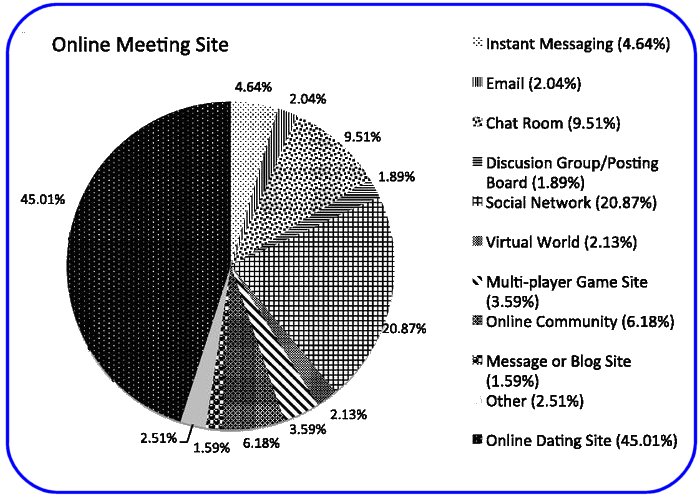
Image from Cacioppo et al, Proceedings of the National Academy of Science, June 3, 2013.
The online data show how out-of-date I am, in that I was surprised by the multiplicity of these online meeting venues. Online dating sites were represented by 45 percent of the respondents. Social networks accounted for another 21 percent. Multiplayer game sites/virtual worlds attracted around 6 percent (do you suppose these are the e-bars/e-clubs?).
There’s a multitude of online dating sites, with other data indicating that eHarmony and Match each accounted for about a quarter of the action.
The researchers noted “a dramatic shift since the advent of the Internet in how people are meeting their spouses.” In fact, more than one-third of those married between 2005 and 2012 met their current spouses online.
Next, they assessed demographic factors of age, ethnicity, income, education, religious affiliation and employment. Briefly, they note, “males, 30-49-year olds, Hispanics, individuals from higher socioeconomic status brackets and working respondents more often reported meeting their spouses online than offline.”
How successful were the hookups?
The percentage of marital breakups was statistically different for online hookups (6 percent) versus offline hookups (10 percent). The differences were similar even with accounting for matters of demographics.
For those still married, the researchers asked about marital satisfaction. Here, the results were closer with a score of 5.64 for the onlines verses 5.48 for the offlines. Among the satisfied onliners were the relatively newly weds, the unemployed, the Catholics and the Atheists. (What fun to discuss why this is so.)
As a sidelight into the legitimate workings of science, the paper has interesting authorship which addresses the matter of commissioned research. The online dating service www.eHarmony.com gave Harris Interactive the task of performing the national survey. Gian Gonzaga, at Gestalt Research and a former director of eHarmony Labs, designed the research. Academics John T. Cacioppo and his wife Stephanie, both in the Department of Psychology at the University of Chicago, oversaw the analyses and wrote the paper. It’s noted that John Cacioppo is also a scientific advisor for eHarmony.com. Two independents, statisticians Elizabeth L. Ogburn and Tyler J. VanderWeele, a Harvard postdoc and professor, respectively, analyzed the data.
And, last, in the paper’s “Conflict of interest statement,” it’s noted that “In addition, an agreement with eHarmony was reached prior to the analyses of the data to ensure that any results bearing on eHarmony.com would not affect publication of the study.”
Any time I’m confronted with questionable research, I now know to look for such statements of transparency and objectivity. This is how science should function. ds
© Dennis Simanaitis, SimanaitisSays.com, 2013
 Simanaitis Says