
Simanaitis Says
On cars, old, new and future; science & technology; vintage airplanes, computer flight simulation of them; Sherlockiana; our English language; travel; and other stuff
MURRES, MULTI-TASKING
QUESTION: DO polar bears eat penguins? Answer: Not usually, as the polar bear (Ursus maritimus) is native largely within the Arctic Circle of the Northern Hemisphere and the penguin (Sphenisciformes Spheniscidae) lives almost exclusively in the Southern Hemisphere, especially Antarctica.

The thick-billed murre (inset) apparently shares a tailor with the penguin. Image from Science, 24 May 2013.
However, a recent item in Science magazine, 24 May 2013, offers a tale of the thick-billed murre (Uria lomvia), attired similarly to the penguin, but lacking the latter’s evolutionary specialization.
In a sense, the thick-billed murre suffers from biological multi-tasking.
Seventy million years ago, ancestors of the penguin were flyers as well as divers. However, they survived better at diving and swimming—and the rest is evolutionary history.
By contrast, thick-billed murres are both flyers and divers. Related to the extinct auk, they live in polar and sub-polar regions of the Northern Hemisphere. Thick-billed murres spend their lives at sea, except when breeding in dense colonies on cliffs.
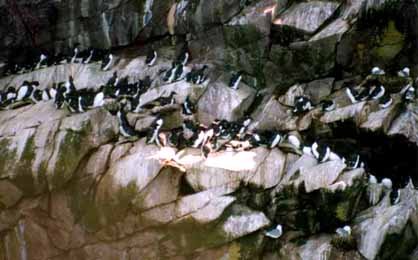
Colonies of murres on an Alaskan cliff. Image by Emmalee Tarry.
Kyle Elliot, a graduate-student researcher at the University of Manitoba in Winnipeg, Canada, and his team studied these birds and published an online report in the Proceedings of the National Academy of Sciences (see http://goo.gl/KuoTq). The researchers note the murres’ high costs of flight when compared with their energy expended in diving.
Because of their stubby spans, these birds have to beat their wings really quickly to lift off and maintain flight. Once aloft, thick-billed murres burn energy at 31 times their rate at rest, the highest known ratio for a bird. What’s more, noted Elliot, “…they’re horrible at landing.”
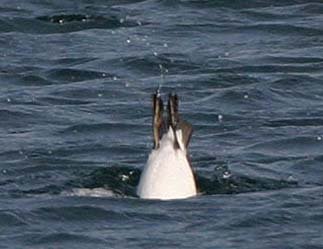
Compared with other seabirds, the murre is a reasonably efficient diver.
In the water, thick-billed murres are better divers than many aquatic birds. However, they expend more energy while diving than penguins do.
In the evolutionary realm, it appears that the penguin improved its diving and swimming abilities by forsaking flight. In a sense, it concentrated on what it does best.
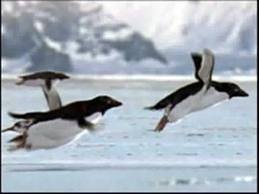
BBC documentary, 2008. Hint: It was April 1.
I conclude on a less than completely scientific—but delightful—note. I recall the BBC April Fools’ Day 2008 spoof, “Miracles of Evolution,” in which penguins appear to fly. For an introductory trailer, see http://goo.gl/B5Wpb. For information on the making of this spoof, see http://goo.gl/xA9S5; also, visit http://goo.gl/5Kc4X. ds
© Dennis Simanaitis, SimanaitisSays.com, 2013
 Simanaitis Says