
Simanaitis Says
On cars, old, new and future; science & technology; vintage airplanes, computer flight simulation of them; Sherlockiana; our English language; travel; and other stuff
F1 ENGINES 2014—HONDA 2015
RACING IMPROVES the (Honda) breed. The company’s recent announcement to return to Formula 1 in 2015 as McLaren’s engine supplier makes great sense for Honda, its production cars, its engineering and marketing—and for the sport.
We are in the last year of F1’s current 2.4-liter normally aspirated V-8s. New regulations for 2014 require 1.6-liter direct injected turbocharged V-6s. (Original proposals for inline-4s were shouted down by F1 designers who noted that inline powerplants couldn’t be used as stressed members of an F1 chassis as is the case with vee configurations.)
Kinetic Energy Recovery Systems get enhancement as well. As before, braking energy is recovered and stored for added power. Hitherto limited to 60 kW (80 hp), KERS output will be doubled for 2014. Also, whereas current KERS give perhaps six seconds of enhanced performance per lap, the new systems will offer as much as 33 seconds.
The new engines will have Energy Recovery Systems in a broader sense. Downstream of the turbo, an ERS captures remaining heat and sends it to a Heat Motor Generator Unit, the electrical output of which supplements the brake-derived energy.
Rev limits will drop from the current 18,000 to 15,000 rpm. More significant, the engine durability requirement currently set at 2000 km (1242 miles) will be doubled.
Each of these regulations has significant synergy with production cars. Thus far, for example, BMW has experimented with road-going ERS. And, indeed, in one sense, road-going hybrids are ahead of their F1 counterparts. Their engines add energy to battery packs, a feature not permitted (nor likely optimal) in F1.
Honda’s return in 2015 will mark its fifth entry into F1, the first being 1964-1968 when it ran its own team.
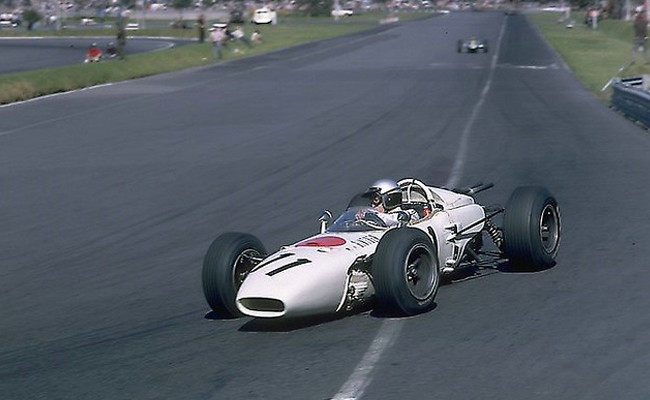
Richie Ginther gave Honda its first GP victory at the 1965 Mexican Grand Prix. The team’s other driver was another southern Californian, Ronnie Bucknum.
Honda’s previous McLaren linkup was fabulously successful: McLaren-Honda took the World Constructors Championship four times in succession, 1988-1991. With three of these, the World Drivers honors went to Ayrton Senna (www.wp.me/p2ETap-pF); teammate (and more than occasional rival) Alain Prost won the other.
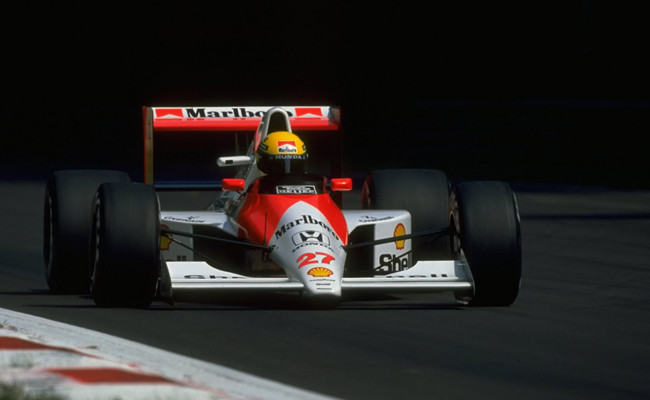
One of Ayrton Senna’s many victories with McLaren was here at 1990 Monza; teammate Gerhard Berger came 3rd. Alain Prost, destined to join McLaren in 1991, was 2nd at this race in his Ferrari.
These days, responding to world pressures for enhanced mpg of road cars, Honda is working on downsized direct-injected turbocharged powerplants featuring energy recovery. Marketing ties with the new F1 engines would be strong.

Soichiro Honda celebrated the 1988 F1 season for good reason: McLaren-Honda won the Constructors Championship; Aryton Senna took the Drivers Championship; teammate Alain Prost was 2nd in the Drivers honors.
Since its founding by Soichiro Honda in 1948, the company has always been engineer-driven. Nor has it shied away from racing. Its 1964 entry into F1 coincided with introduction of what’s generally considered its first viable 4-wheeled product, the S600.
Honda quickly learned—and continues to recognize—the benefits of rotating key personnel through competition as well as production assignments. This is likely to be enhanced now that Honda is once again taking on the F1 challenge. ds
© Dennis Simanaitis, SimanaitisSays.com, 2013
 Simanaitis Says