
Simanaitis Says
On cars, old, new and future; science & technology; vintage airplanes, computer flight simulation of them; Sherlockiana; our English language; travel; and other stuff
HRG CAR-TO-PITS RADIO
CAR-TO-PITS communication is taken for granted today, especially in the grander levels of racing. Yet the first cars to use this feature came in 1948, long before pitboard communication was phased out. What’s more, this first in automotive racing history was achieved not by a famous marque, but by a member of England’s sports car cottage industry, HRG.
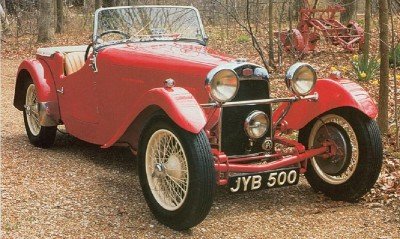
Less than 250 HRGs were built, 1935 to 1956; most of them, classic roadsters.
Even when E.A. Halford, G.H. Robins and H.R. Godfrey introduced their sports car in 1935, the HRG (“Hurg,” as it quickly became known) retained vintage features. Its beam front axle, for instance, jutted out ahead of the radiator, which set the HRG apart from “modern” sports cars of the era.
The HRG’s nearest spiritual kin were the chain-drive Frazer Nash and the Morgan 4/4, the latter’s nomenclature emphasizing its newly added rear wheel in 1936 (see www.wp.me/p2ETap-14b). Like others of England’s cottage industry, HRG depended on suppliers for its engines, a 1 1/2-liter ohv Meadows, a sohc Singer of similar displacement and a 1074-cc sibling of the Singer powerplant.
HRG continued this classic theme after World War II with a stunning variation—45 cars fitted with streamlined bodywork. Introduced immediately after World War II, these aerodynamic HRG roadsters predated the 1948 Jaguar XK-120 by more than two years—and in fact make the latter look a bit frumpish.

Beneath this HRG’s aerodynamic bodywork lurked a more than traditional English roadster. Image by Liftarn.
The aero bodywork was suspended by outriggers from the HRG’s classic—and willowy—steel ladder chassis. It came at a premium of an equivalent $1467 in 1946, the aero model priced at ₤1246 ($5021 then; figure $59,936 today), the standard 1500 at ₤882 ($3554 then, $42,424 in 2013 dollars). And, yes, sports cars were not for the impecunious.
A team of four aero HRGs entered the 1948 Manx Cup voiturette race around the Isle of Man. This Ecuire Lapin Blanc (Team White Rabbit) was supported by Monaco Engineering Works of Watford, England, and managed by John Wyer. Yes, that John Wyer, of the later light blue and orange Gulf Oil livery.
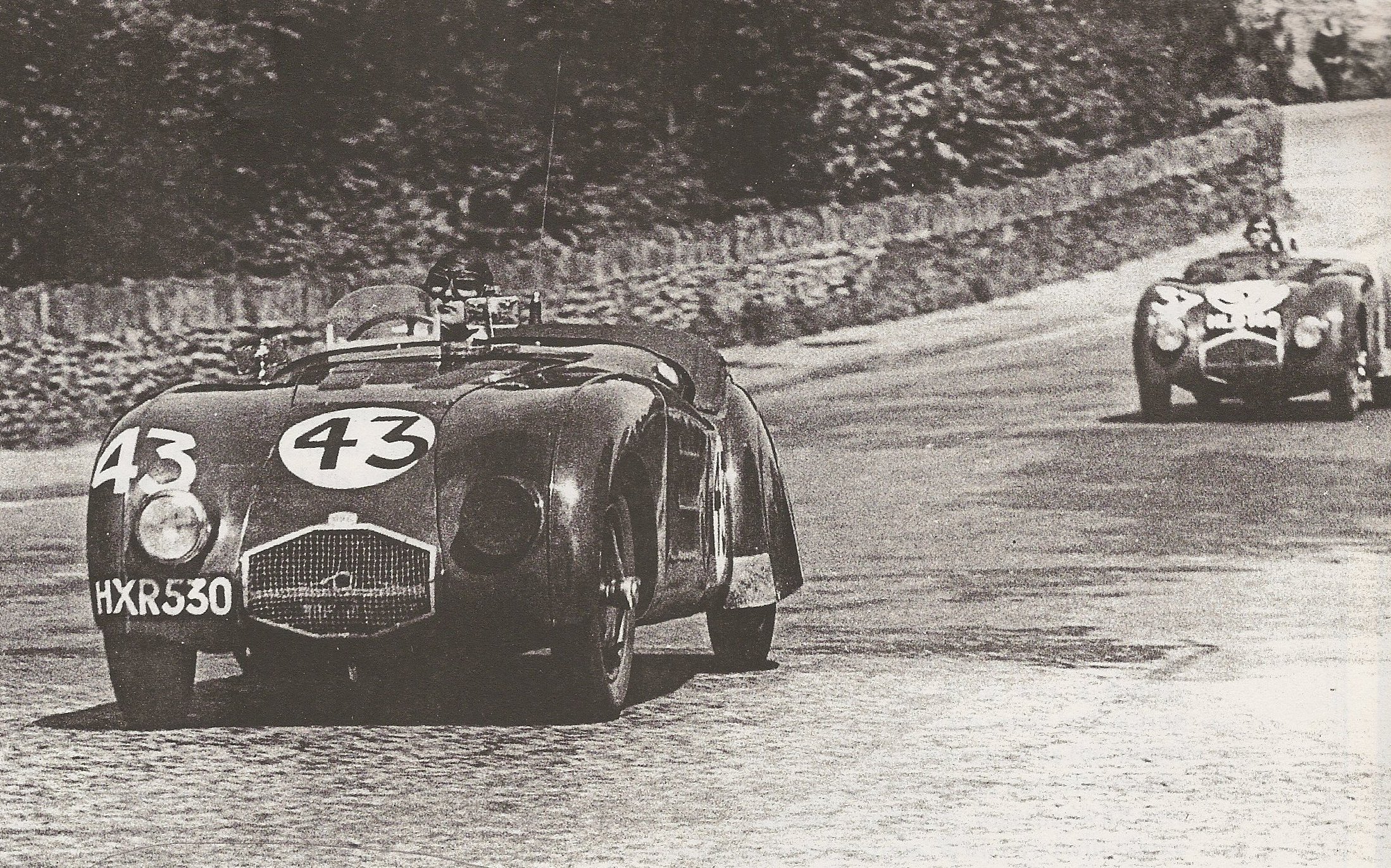
A pair of HRGs at the 1948 Manx Cup, May 25, 1948. The radio antenna of #43 can be seen on its rear deck. Image by Guy Griffiths, from Specialist British Sports/Racing Cars of the Fifties & Sixties, by Anthony Pritchard, Osprey, 1986.
It was at this Manx Cup event that two-way continuous radio communication came to racing. Pye Telecommunications of Cambridge, England, were specialists in mobile radio-telephones of the era.
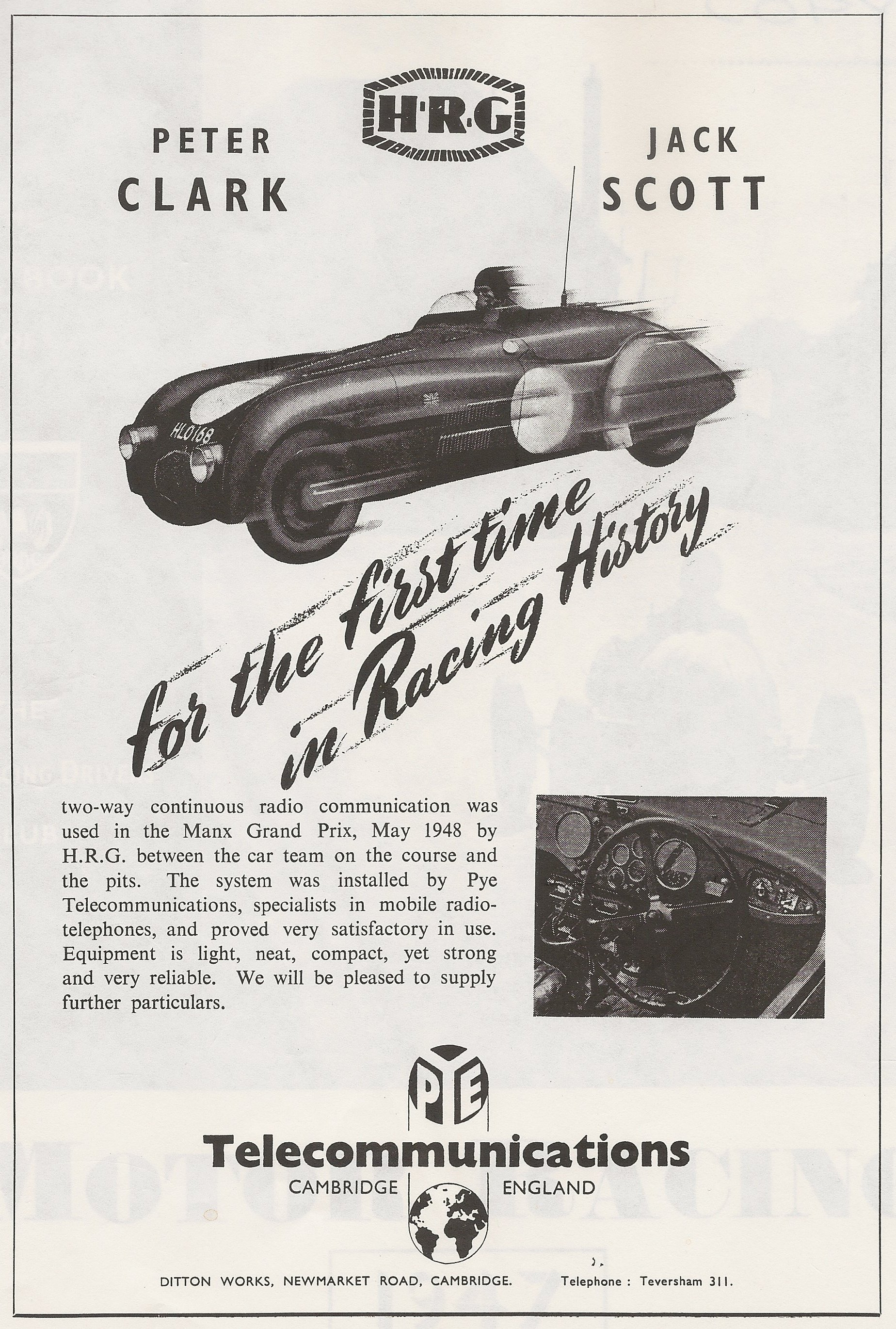
A contemporary ad for Pye Telecommunications, in The Year Book for the British Racing Drivers’ Club: Motor Racing 1947.
Three of the four Ecurie Lapin Blanc cars finished 6th, 7th and 9th in that Manx Cup. A photo shows HXR530 as radio-equipped; a contemporary ad has HLO168 similarly fitted.
Later, in July 1948 at Belgium’s Spa 24-hour race, a trio of HRGs competed, two aero roadsters and a 1500 fitted with coupe bodywork.
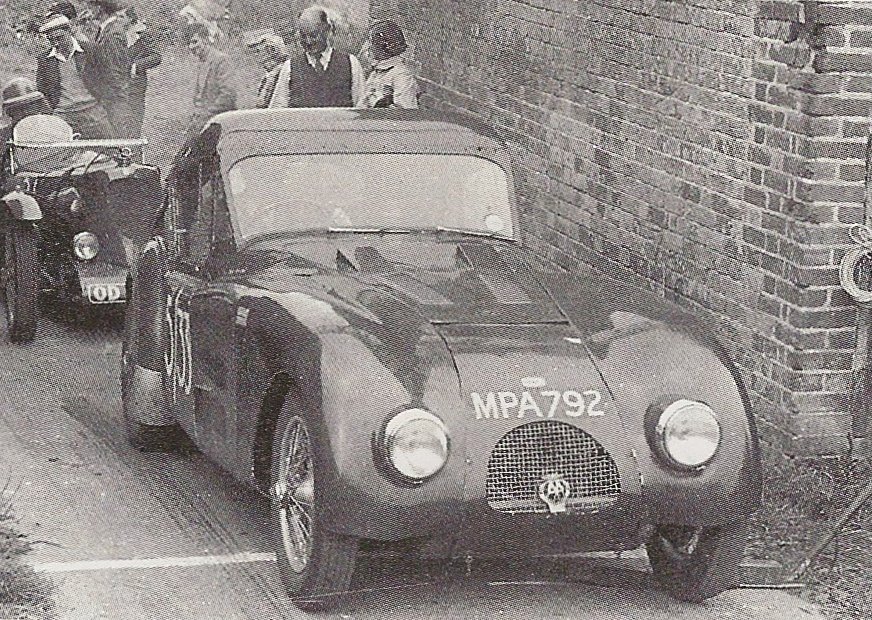
This HRG 1500 coupe completed the Ecurie Lapin Blanc team at the 1948 Spa 24-hour race. Image from Classic and Sports Cars A-Z of Cars 1945 to 1970, by Michael Sedgwick and Mark Gillies, Bay View Books, 1989.
Overall, they finished 9th (aero), 13th (coupe) and 16th (aero), records indicating at least the aeros carrying radio communications.
Commendable achievements indeed in 1948 for a product of the English cottage industry. ds
© Dennis Simanaitis, SimanaitisSays.com, 2013
 Simanaitis Says