
Simanaitis Says
On cars, old, new and future; science & technology; vintage airplanes, computer flight simulation of them; Sherlockiana; our English language; travel; and other stuff
BRAZILIAN CARS
A RECENT report from the Associated Press titled “Cars Made in Brazil Are Deadly” makes for fascinating reading (http://goo.gl/A1bKq). In particular, typical of the BRIC (Brazil/Russia/India/China) group of quickly developing nations, Brazil is becoming increasingly car-focused.

However, because of regulations and cost, these cars are often without the safety advances of their counterparts built in North America, Europe and Japan. This report prompts me to share my views on this interesting topic, with thanks to AP.
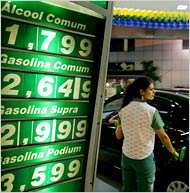
Brazilians have their choice of ethanol (E100) or several grades of gasoline (all of which are typically E18 to E25, i.e., 18- to 25-percent ethanol). Image by Lalo de Almeida for The New York Times, April 10, 2006.
We hear a lot about Brazilian cars being dual-fueled, ethanol-based from that country’s sugar cane, with a separate gasoline tank to mitigate ethanol’s cold-start and driveability problems. And, note, to a Brazilian “cold” means something like 60 degrees Fahrenheit. But the AP report is the first I’ve heard about some Brazilian-built cars being shoddy and bereft of air bags, antilock brakes and other safety features we take for granted.
The levels of car ownership, the U.S. versus BRIC nations, are dramatically different. According to http://goo.gl/CXQ4, the U.S. has 797 motor vehicles per 1000 people, third from the top in a world’s list. (Tiny San Marino has more cars than people, 1263/1000; Monaco, 863/1000). By contrast, Brazil’s 259/1000 is 61st on the list, just a tick behind Russia’s 271. China is 111th on the list, with 85 cars/1000 people; India, even further down at 157th of 191 countries, 18/1000.
The AP report notes that 40 million Brazilians moved into the middle class during the past decade. With this came a boom in auto sales and, alas, a huge increase in traffic deaths.
Brazil’s traffic deaths rose 72 percent. During this same period, the U.S. recorded 40 percent fewer deaths.
Part of this is attributable to the inexperience of Brazil’s first-car motorists. On the other hand, earning a driver’s license in Brazil is considerably more complex than doing so in any U.S. state. See http://goo.gl/hmKtt, in particular the requirements of prior psychological testing—followed by 45 hours of driving theory.
Driving conditions in Brazil vary from highly developed to rugged and challenging, as do driving styles. Another aspect, though, is a lack of state-of-the-art safety regulations.
Again, compared with the developed world, Brazil is late to regulating the automobile. Only next year will air bags and antilock brakes be required on all new cars. And, even then, there’ll be no governmental agency charged with monitoring automobile crashworthiness.
According to IHS Automotive, an authoritative auto consultant cited in the AP report, automakers earn a 10-percent profit on Brazilian-made cars, compared with 3 percent in the U.S. and a global average of 5 percent. Elimination of air bags and antilock brakes is part of this cost saving. Also attributed are models based on older platforms, inferior materials and even the number of welds in unibody construction.
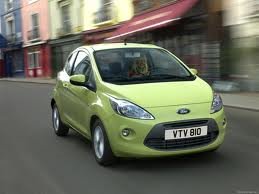
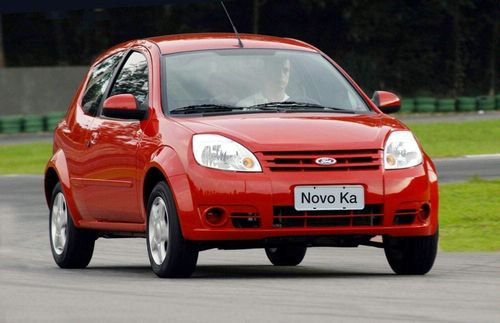
The European Ford Ka, above, is in its second generation. The Brazilian version, below, is built on the first-generation Ka platform.
Cited in the AP report was Marcilio Alves, a researcher in auto safety and an engineering professor at the University of Sao Paulo. “The electricity used in building a car is about 20 percent of the cost of the structure,” he said. “One way to save electricity is either reducing the number of spot welds or using less energy for each spot weld made.”
The potential result is a shoddy unibody with a lack of controlled deformation that’s crucial in dissipating the energy of a crash.
Regulations—and independent assessment of them—have given developed countries enhanced degrees of safer mobility. The BRIC nations deserve no less. ds
© Dennis Simanaitis, SimanaitisSays.com, 2013
 Simanaitis Says