
Simanaitis Says
On cars, old, new and future; science & technology; vintage airplanes, computer flight simulation of them; Sherlockiana; our English language; travel; and other stuff
GETTING THE COLOR RIGHT
AS REPORTED in Science magazine, 3 May 2013, researchers have solved a historical quandary with plenty of time to get things right by early 2015, the 150th anniversary of a significant event in American history. It was on April 21, 1865, that the President Abraham Lincoln Great Funeral Cortege departed Washington, D.C., for its somber travel to Springfield, Illinois. Hundreds of thousands of mourners paid their respect as the train passed by.
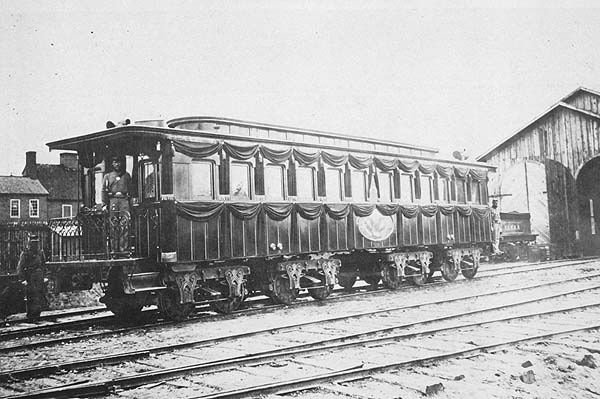
The Lincoln Funeral Car, United States, April 1865. Image by Andrew J. Russell, in the Library of Congress.
Honoring the 150th anniversary of this event, the Lincoln Funeral Car Project is constructing a full-scale replica of the nine-car train that will follow the historic route. For progress reports, see its Facebook page at www.facebook.com/2015LincolnFuneralTrain.
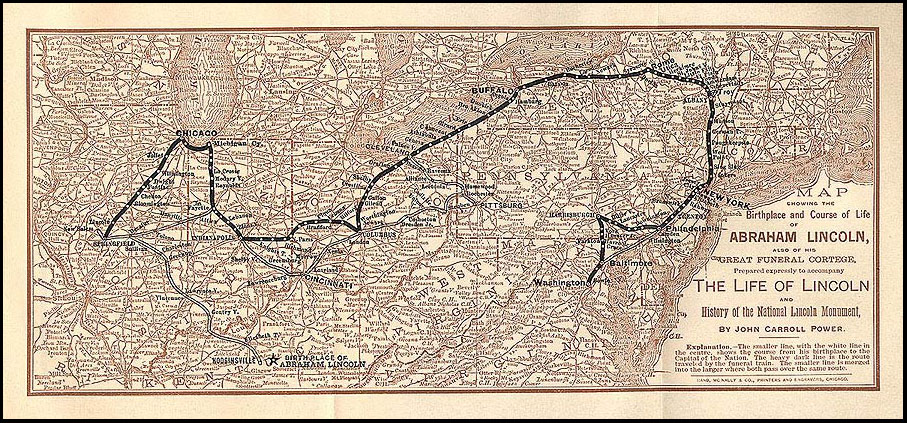
The Lincoln Great Funeral Cortege route, 1865. The cortege was in Washington, D.C., from April 15 to 21; it arrived in Springfield, Illinois, on May 3. Image from the Lincoln Highway Museum, http://goo.gl/X9Kts.
The Great Funeral Cortege reversed the 1654-mile route taken by president-elect Lincoln to his first inauguration in 1861. Lincoln’s coffin as well as that of his son William, who predeceased the president in 1863, rode in this first presidential private railroad car, named the United States.
Built by the U.S. Military Railroads, the United States had wheels of especially wide tread allowing it to operate on tracks of different gauges. The car was never used by Lincoln in life and was sold after his burial. It was used on the Union Pacific Railroad during construction of the Transcontinental Railroad.
The historic quandary concerns the car’s actual color when used in the cortege. Contemporary accounts ranged from “claret red” to a “rich chocolate brown.” No color photography existed. What’s more, the car was all but destroyed by fire in 1911.
The uncertainty was heightened by a culinary note: In 1865, the term “chocolate” likely referred to the beverage served in coffee houses, typically a Dutch chocolate of dark maroon color, not the milk chocolate we enjoy today.

This model of the Lincoln Funeral Car was constructed at one-twelfth scale by Wayne Wesolowski in 1995. He adopted the “rich chocolate brown” hue, with subtle maroon overtone reflecting what that term implied in 1865. Image from Science, 3 May 2013.
Almost 20 years ago, chemist Wayne Wesolowski, then teaching at Chicago’s Benedictine University, built a one-twelfth-scale model of the train. Based on the contemporary reports, he chose a brown hue with maroon overtone.
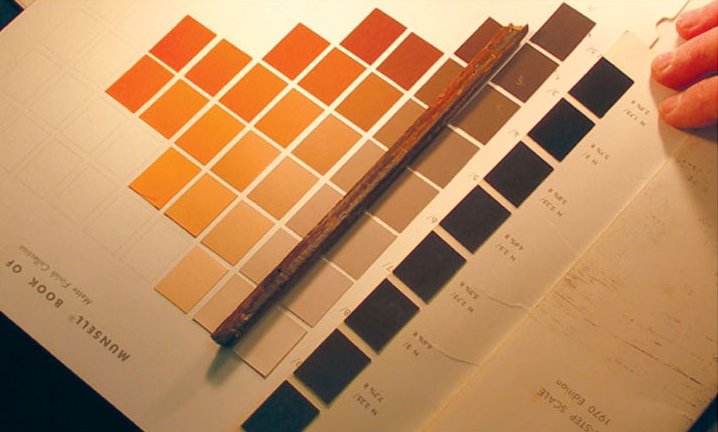
Later chromatic analyses sought to confirm the model’s color. Image from Science, 3 May 2013.
Now at the University of Arizona, Wesolowski took the matter of color a step further. A fellow in Minnesota had inherited a surviving portion of window frame from the original car. Wesolowski and colleagues compared microscopic fragments of this pencil-size piece with standard color charts, the sort of things found in magazine art departments.
The research was fruitful. The Lincoln Funeral Car’s original color was indeed a somber maroon, just a bit darker than used on the model. ds
© Dennis Simanaitis, SimanaitisSays.com, 2013
 Simanaitis Says