
Simanaitis Says
On cars, old, new and future; science & technology; vintage airplanes, computer flight simulation of them; Sherlockiana; our English language; travel; and other stuff
AN (OLD) WAY WITH WORDS
“Hear me, mother! Pull that black worm off the bark and give it to this old man. And no spitting in the ashes!”
Amazingly enough, this is an ur-speech. Spoken 15,000 years ago to hunter-gathers in Asia, there’s a chance they’d have understood at least part of it.
Researchers at England’s University of Reading used a statistical model to identify commonalities among seven Eurasian language families, these cognates evolving from a single ur-language spoken around 15,000 years ago.
Full details of the National Academy of Sciences paper are at http://goo.gl/ZEQ6N. A summary in The Washington Post, May 6, 2013, recommended to me by colleague Gary Carlson, can be found at http://goo.gl/lgG35.
The findings are of interest, indeed controversial, to linguistic specialists because conventional wisdom has it that words don’t survive for more than 8000 to 9000 years. The list of ur-words is fascinating to me because some are expected (mother, me, you, fire), whereas others are a surprise (worm? bark?).

Seven language families are represented. Not in the study are Chinese-Tibetan, several African, Native American and Australian language families.
The seven language families in the study are Altaic (whence comes modern Turkish, Uzbek and Mongolian), Chukchi-Kamchatkan (far northeastern Siberia) Dravidian (south India), Indo-European (Sanskrit, modern Balto-Slavic, Germanic, Hellenic, Italic—and, of course, English); Inuit-Yupik (the Arctic); Kartvelian (Georgian and related languages) and Uralic (Finnish, Hungarian and a few others).
Merely as an aside, this last one conjures up an image of two rival Indo-European brothers arguing on the trek about “north or west?”
The researchers started with 200 words generally accepted as basic to any language. This in itself is a neat list to examine: http://goo.gl/jF5jI. It contains lots of family relationships, body parts, locational and geographical names and things we do with—and to—each other.
Then the researchers made thousands of comparisons of these proto-words among language families. Might Inuit-Yupik’s “hand” and Indo-European’s “hand” sound similar?
It turns out the answer is yes.
Last, the researchers rated cognates in terms of how often they appear among the seven language families. If a word appears in four or more of them, it’s termed “ultraconserved.” And, in fact, most of the words lurking in that opening quote are ultraconserved.

The 23 ur-words. The numbers signify their language family appearances.
“Thou” made all seven families; making six of them was “I.” (This sentence sounds like bad poetry, doesn’t it?) Top-fivers were “not,” “that,” “we,” “give” and “who.”
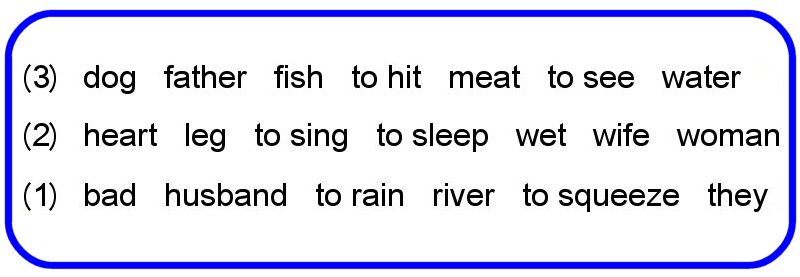
Some of the also-rans with less than four votes, their language famaily appearances shown.
Mark Pagel, an evolutionary theorist at the University of Reading, headed the study. His comments bring warmth to the academe of linguistics. Pagel said, “I was really delighted to see ‘to give’ there. Human society is characterized by a degree of cooperation and reciprocity that you simply don’t see in any other animal.”
Why “bark”?
Observed Pagel, “I have spoken to some anthropologists about that, and they say bark played a very significant role in the lives of forest-dwelling hunter-gatherers.” Think bark baskets, stripped and braided into rope or fabric, burned as fuel.
And “to spit”? Linguists say it’s onomatopoetic. It’s not recorded who first said “p’touey,” but it’s close.
I’m not into online contests (i.e., expect no prize), but here’s a challenge: What’s your favorite monologue using ultraconserved words? ds
© Dennis Simanaitis, SimanaitisSays.com, 2013
 Simanaitis Says