
Simanaitis Says
On cars, old, new and future; science & technology; vintage airplanes, computer flight simulation of them; Sherlockiana; our English language; travel; and other stuff
FUZZY QUADROS
A FRIEND passed along an amazing video of two flying robots balancing a rod—and tossing it back and forth! “Could this be a hoax?” my friend asked.
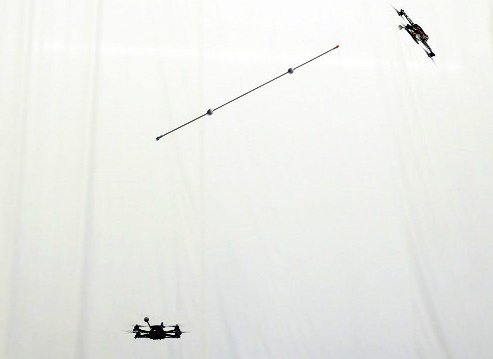
The quadrocopter on the left is about to catch the rod tossed by the one on the right. This and other images from http://goo.gl/NalS7.
Amazing though it is (see the video at http://goo.gl/z9zVc), it’s an example of the marvelously advancing state of fuzzy logic controllers.

A quadrocopter has four rotors, one opposing pair rotating clockwise, the other pair counterclockwise. The pad on this Swiss research quadrocopter is for its rod balancing.
Unlike a helicopter, a quadrocopter doesn’t need to alter the pitch of its rotor blades. Instead, it achieves yaw, roll and other maneuvers by selectively changing rotational speeds of its four rotors. As one example, if one opposing pair speeds up while the other pair slows down, the quadrocopter will yaw (twist horizontally) in response to their difference in torque. If two on one side speed up, the quadrocopter will roll to the other side.
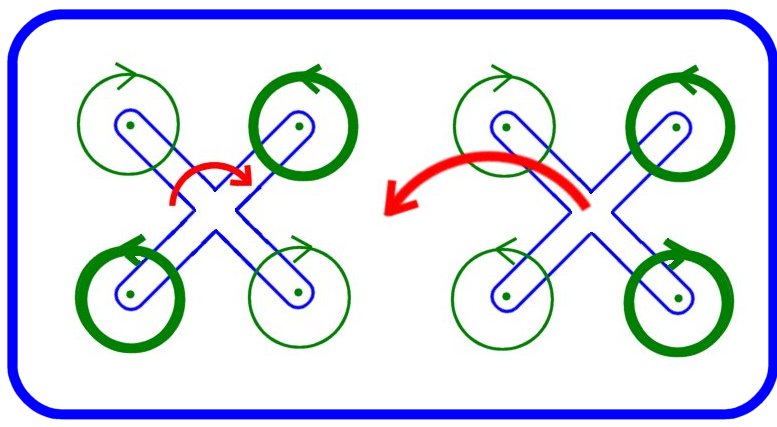
The quadrocopter on the left will yaw to the right. The one of the right will roll to the left.
The first quadrocopter, called a Quadrotor, was invented by Dr. George de Bothezat. It flew in 1922—but not very high (16 ft. 5 in.) and well nigh uncontrollably.
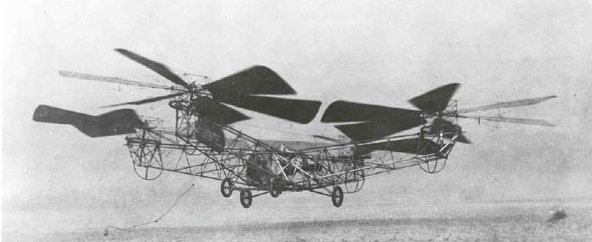
The De Bothezat QuadRotor demonstrated a proof of concept in 1922.
Advances over the years in electronics, particularly in gyros, controller logic and miniaturization, have brought the technology down to the hobbyist level. Amazon.com offers basic model quadrocopters for less than $40.
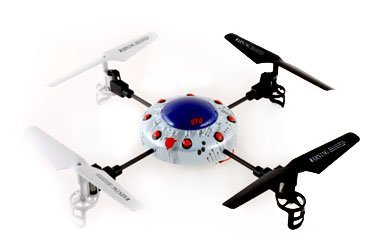
This Syma X1 4-channel 2.4G RC is available from www.amazon.com.
Professor Raffaello D’Andrea and his colleagues at the Swiss Federal Institute of Technology in Zurich are the ones doing the rod tossing with their advanced UAVs (unmanned aerial vehicles). A key to their sophisticated UAV control is adding a learning algorithm to the basic fuzzy logic.
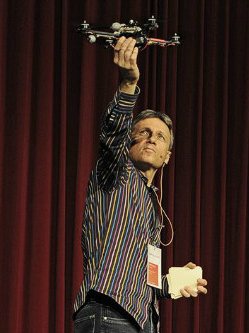
Prof. D’Andrea demonstrates one of the Swiss quadrocopters.
A fuzzy logic controller is a more general device than a traditional PID (proportional-integral-derivative) controller. Both sense inputs, process the information and give an output to achieve a desired state. It’s in the processing part that they differ.
PID uses traditional analysis to define mathematical functions that process the input. By contrast, fuzzy logic assesses the input in terms of probabilistic “membership” criteria and applies a set of rules to determine output.
For instance, a thermostat’s input would have membership defined in terms of temperatures. Its rules would be “IF very cold, THEN heat a lot;” “IF moderately cold, THEN heat a little;” “IF on target, THEN take no action;” “IF moderately hot, THEN cool a little;” and “IF very hot, THEN cool a lot.”
Generally, fuzzy controllers are no more complex (that is, they need no more processor memory) than their PID counterparts—and they’re no less effective. Today, fuzzy control is used in everything from industrial processes to automobiles and washing machines.
In 1991 at the Industrial Conference on Fuzzy Systems in Austin, Texas, I saw a two-dimensional version of rod-balancing based on a fuzzy logic control. Also shown was a video of backing up a semi with double trailers, a notoriously memory-intensive PID challenge. The fuzzy logic controller handled it deftly.
The father of fuzzy logic (albeit with a couple of other 20th-century grandfathers) is Prof. Lotfi Zadeh of the University of California, Berkeley. He was at that Austin conference, and I felt compelled to make his acquaintance.
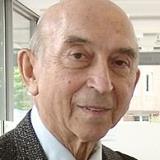
Prof. Lotfi Zadeh, now 92, published his work on fuzzy set theory in 1965 and extended it to fuzzy logic in 1973.
At the conference, Prof. Zadeh expressed kind interest why this guy from a car magazine knew about fuzzy logic. During our brief chat, some Russian mathematicians asked if the professor would object to a photo. I backed off to one side, but Prof. Zadeh pulled me back into frame.
I can imagine a quizzical comment at some university, “I recognize our Russian colleague in this photo and, of course, that’s Prof. Zadeh—but whoever is this fellow??” ds
© Dennis Simanaitis, SimanaitisSays.com, 2013
 Simanaitis Says
Pingback: IS PRIVACY GONE FOR GOOD? | Simanaitis Says