
Simanaitis Says
On cars, old, new and future; science & technology; vintage airplanes, computer flight simulation of them; Sherlockiana; our English language; travel; and other stuff
LE MÉTRO
THE PARIS Métro is one of the oldest—and most grand—of the world’s subterranean transportation systems. Its construction encountered ancient catacombs and other caverns even more unexpected. Its stations are exemplary of the world’s great art. And, by design, the Paris Métro is the high-performance sports car of subway systems.

An excellent source: Paris Underground, by Tamara Hovey, Orchard Books, 1991. Both www.amazon.com and www.abebooks.com list it.
Construction of the Paris Métro began in 1898, to be completed for this city’s 1900 International Exposition. It derived its name from the earlier Metropolitan Line in London opened in 1863 (see www.wp.me/p2ETap-FV).
Much of the Métro was built by means of cut-and-cover. In fact, several stations were fabricated above ground, then lowered into place and fixed in concrete pumped from the surface.
There’s a tale that one restaurateur visited his wine cellar—only to find the bottles firmly encased in over-zealously pumped concrete.
Parts of the Métro used the shield method of tunnel construction still employed today. A vertical tunnel was dug. Then the shield apparatus was lowered into place.
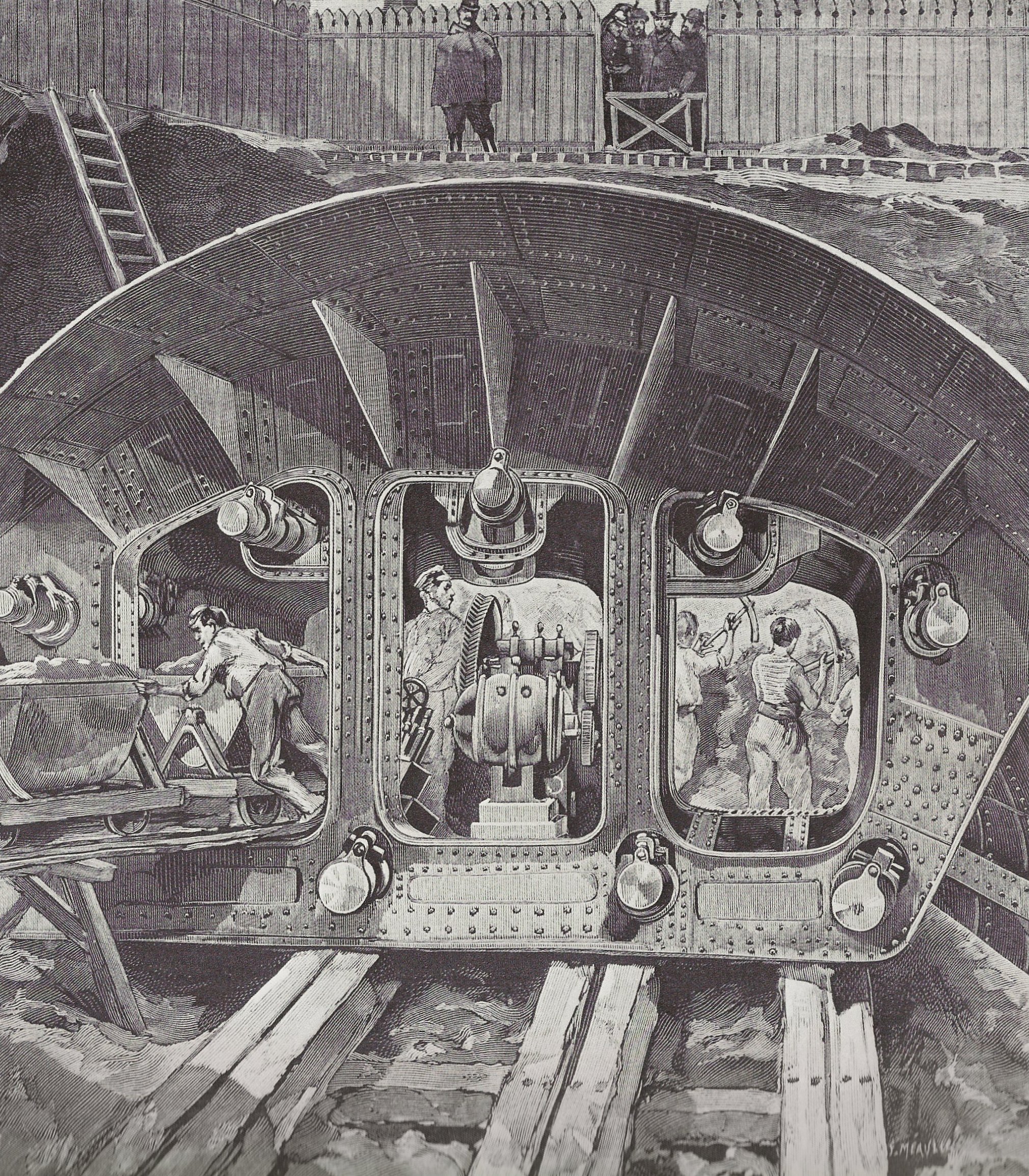
Diggers were protected by a shield that was then moved forward. This and other historic images from Paris Underground.
Workers excavated a path, with the shield then moved forward on rails by jacks driven though water pressure. Other workers followed and lined the resulting tunnel with metal rings. Finally, the rings were joined and covered in masonry.
Unlike London’s uniform clay, the geology of Paris is decidedly mixed. In some places, workers encountered sand; in others, white chalk; in yet others, great banks of stone. Different construction techniques were needed for the varying geology.
The Métro’s planners had to avoid ancient catacombs, underground lakes, the Phantom of the Opera and earlier excavations. Forty percent of Paris is honeycombed with such abandoned subterranean galleries. One of these, beneath the Place du Danube, had been mined for gypsum, used to make the purest form of plaster—“plaster of Paris.”
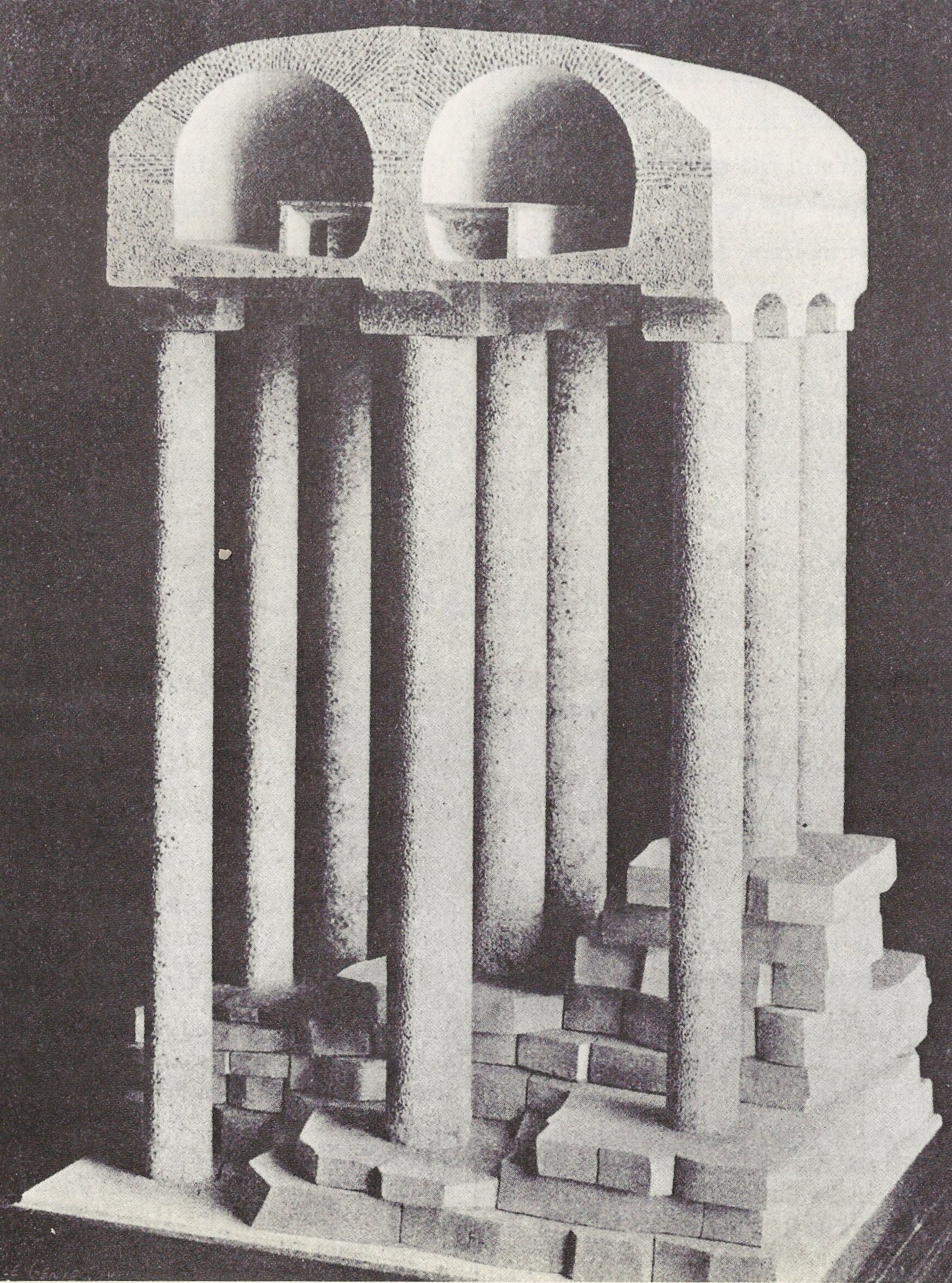
Westbound riders on the Métro’s Line 7bis may not realize that its Place du Danube station stands on 220 concrete columns in a huge cavern.
To traverse this cavern, engineers built an underground bridge. The two Métro tunnels are on giant pillars of concrete, sunk through the gypsum floor down to stable limestone.
The Métro has beauty combined with this engineering, both below and above ground. The Louvre-Rivoli Station has works of art from the Musée du Louvre. The Varenne station, near the Musée Rodin, exhibits a replica of Auguste Rodin’s famous bronze, The Thinker.
And, my favorite, are the station entrances designed by the master of French Art Nouveau, Hector Guimard. Of the 141 originally in place, 58 survive (including one moved to the Montreal Metro’s Square-Victoria station). Four reproductions exist in Chicago, Lisbon, Mexico City and Moscow—and, if you count artful miniatures, one resides here at home.
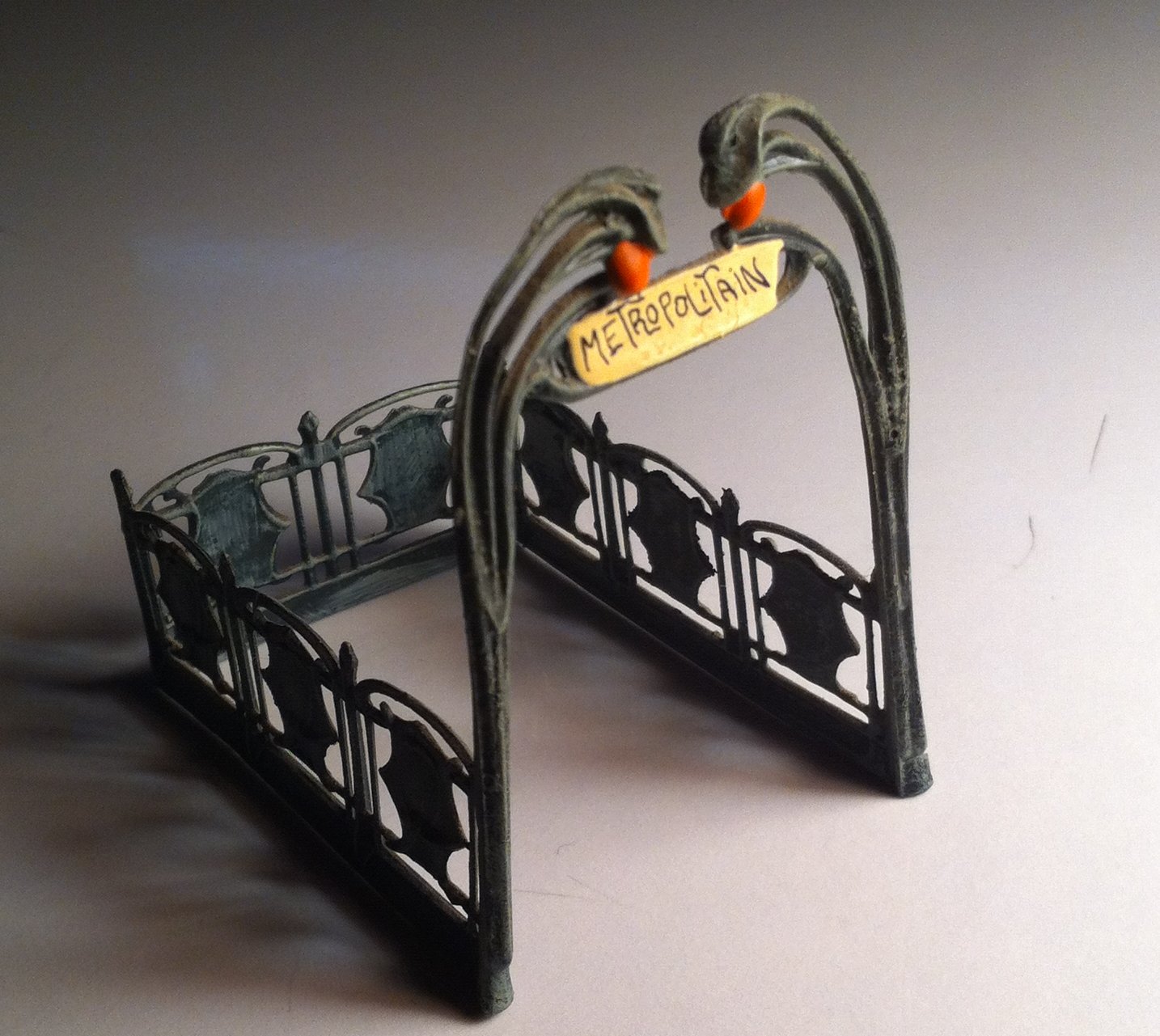
Hector Guimard’s Art Nouveau Métro entrance, in miniature.
It’s said one is never more than 500 meters (1640 ft.) from a Métro station entrance. This implies, of course, that Paris has many small stations, with a logical corollary justifying why the Métro is the sports car of subway systems.
Small stations imply short trains. (Imagine the inanity of accessing a train longer than its station.) To be efficient, short trains operate close to one another with minimal “headway.” And, to accomplish this, they must be quick getting to speed between stations.
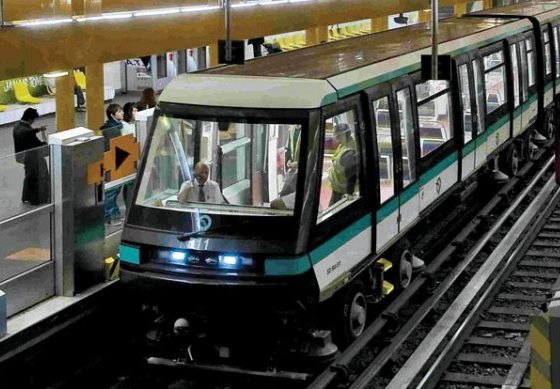
Many trains of the Paris Métro run on rubber tires—Michelins, in fact—for enhanced traction. Conventional steel wheels and rails are failsafes.
Top speeds on the Paris Métro and London Underground are about the same, around 50 mph. A London train takes 19.8 seconds to reach this velocity. A train of the Paris Métro does it in 15.8.
Zut alors! ds
© Dennis Simanaitis, SimanaitisSays.com, 2013
 Simanaitis Says
One thing that I saw in some of the Paris Metro stations was a glass wall with sliding doors at the edge of the platform designed to prevent the horror story of people on the platform being accidentally (or as in recent events deliberately) knocked off the platform onto the tracks.
This should be a mandatory feature everywhere.