
Simanaitis Says
On cars, old, new and future; science & technology; vintage airplanes, computer flight simulation of them; Sherlockiana; our English language; travel; and other stuff
BIG SHIP, BIG DATA
AN INTERESTING article by Thomas Laqueur, “Why Name a Ship After a Defeated Race?,” in the London Review of Books, 24 January 2013, discusses seven recent books on the RMS Titanic. In particular, the article brings Big Data and other insights into the ship’s tragic sinking in the North Atlantic on that frigid night of April 15, 1912.

At the time of her maiden voyage, the Titanic was the largest ship on the sea; indeed, the biggest man-made object in the world. It was generally known that her aft-most stack was essentially for show; it had nothing to do with the ship’s three engines.
The Titanic tale is a familiar element of western culture. There’s a thriving business in the sinking of this supposedly “unsinkable” ship and her memorabilia, real or otherwise. Quite a few motion pictures have been based on the Titanic, some well-known, others less so.
Jules Brulatour, founder of Universal Pictures, brought out what has since been recognized as the world’s first exploitation movie. It was written, filmed and screened within five weeks of the disaster.

Actress Dorothy Gibson starred in the first Titanic movie, shown in 1912 within weeks of the sinking, which she had survived.
The Brulatour movie starred Dorothy Gibson, a 22-year-old real-life Titanic survivor, actress (and Brulatour mistress)—not to be confused with a Gibson Girl popularized by illustrator Charles Dana Gibson.
In 1943, Nazi Propaganda Minister Joseph Goebbels commissioned a film titled Titanic. It was an arrogant bit of anti-British/American capitalism and German-crew bravery and selflessness.
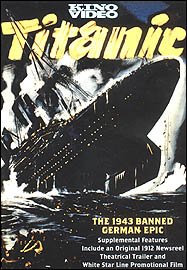
The propaganda film, Titanic, put an anti-capitalist/pro-Nazi spin on matters in 1943, but not for long.
Not surprisingly, this propaganda film was filled with inaccuracies; a fictional German First Officer Herr Petersen warns the ship’s snobbish, sleazy owners to slow down, but they refuse and …. Apparently the flick made even Goebbels cringe, because it never made German motion picture screens and later he banned it throughout occupied Europe.
The British film, A Night to Remember, 1958, based on a 1955 book of the same name, is considered the most accurate description of the disaster. Nominated for six Oscars, The Unsinkable Molly Brown was a 1964 musical based loosely on Titanic fact. Though a hugely profitable flick, the 1997 epic Titanic is considered less than accurate on many counts. Indeed, its portrayal of First Officer William McMaster Murdoch led to an apology from Twentieth-Century Fox and a ₤5000 donation to a school fund in Murdoch’s hometown.
Not that controversy didn’t reign during the disaster. There was lifeboat space for 1178 people; perhaps 2224 passengers and crew were aboard. An officer on the port side interpreted the captain’s “women and children first” to mean “and only those.” His counterpart on the starboard side admitted men onto a lifeboat if no women or children were waiting for a place.

Unlike this Titanic lifeboat, others left the ship with less than a full complement of people.
To an extent, the ship’s First-, Second- or Third-Class status affected survival, but not as much as folklore suggests. It is true that some passages from steerage to the lifeboat deck were blocked. However, it was gender, rather than class, that proved more deciding.
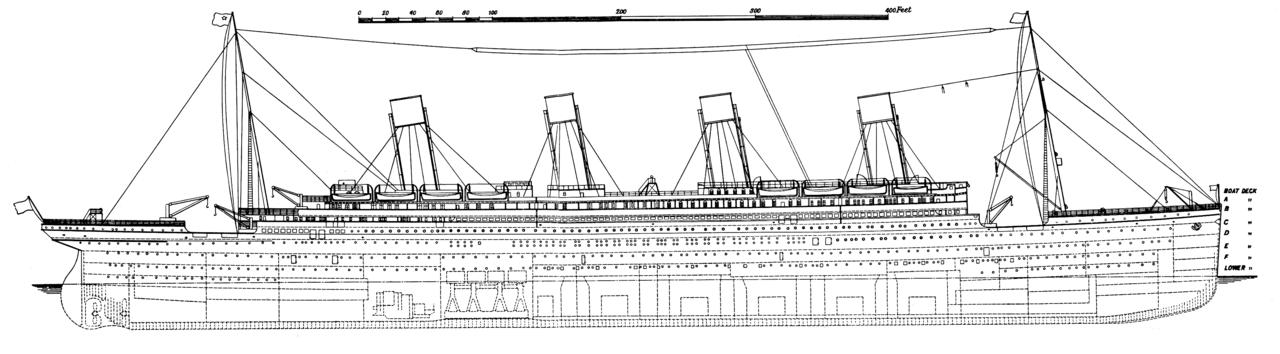
As its name suggests, the Boat Deck held the lifeboats. Promenade or A Deck was First Class; Bridge or B Deck, mostly First Class, some Second; Shelter or C Deck, a mixture of all three Classes; Saloon or D Deck, another mixture of the three; Upper or E Deck, all three; Middle or F Deck, Second and Third Class; Lower or G Deck, the lowest accessible to passengers. Below these, Orlop Decks were for cargo; Tanks Top, for engines, boilers and other mechanicals.
The adage “women and children first” prevailed. Women in Third Class survived at a higher rate than men in First Class. Every child in Second Class survived. Yet, the greatest rate of passenger loss came among men in Second Class, where 92 percent perished. This compared with 67 percent of men lost in First Class and 84 percent of them lost in steerage. Among crew members, 78 percent of the men perished; only 13 percent of the women did. Foreign staff of the First-Class restaurants paid a heavy toll, 95 percent perished.
The article in London Review of Books notes that a vast set of Titanic data comes free with the open-source computer program R. The R Project for Statistical Computing is at www.r-project.org; see also http://math.ucdenver.edu/RTutorial.
Big data, a big ship. ds
© Dennis Simanaitis, SimanaitisSays.com, 2013
 Simanaitis Says