
Simanaitis Says
On cars, old, new and future; science & technology; vintage airplanes, computer flight simulation of them; Sherlockiana; our English language; travel; and other stuff
HOLMES AND MATHS
I’VE PURPOSELY chosen the word “maths” for this bit of Sherlockiana. Not only is this a common British term for the subject, but it also suggests its richness, everything from probability and statistics to number theory to theoretical dynamics.
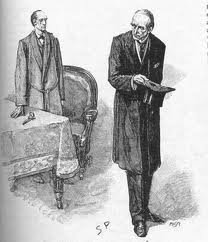
Both Holmes, left, and Moriarty had evident prowess in maths.
Professor James Moriarty, the Canon’s arch criminal, is its only prominent mathematician. It turns out, though, that Holmes himself is no maths dolt.
The SIAM, American Mathematical Society and Mathematical Association of America are the big three of such organizations in the U.S.
As confirmation of this, I cite the Society for Industrial and Applied Mathematics, one of the U.S.’s three prestigious mathematical organizations. Full details—together with droll humor—are offered in the SIAM News, vol. 45, Number, April 2012 (http://goo.gl/8CYK7).
The article is written by researchers at the Oxford Centre for Collaborative Applied Mathematics, part of Britain’s University of Oxford.
OCCAM researchers were given a fascinating assignment: to act as technical advisors on mathematical aspects of the movie, Sherlock Holmes: A Game of Shadows.
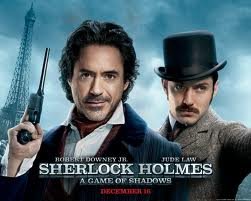
Sherlock Holmes: A Game of Shadows, Warner Bros., 2011, starring Robert Downey, Jr., as Sherlock Holmes and Jude Law as his chronicler, Dr. James H. Watson.
Moriarty, of course, was a published mathematician, with The Dynamics of an Asteroid confounding even the scientific press. According to Watson, Moriarty’s other paper, A Treatise on the Binomial Theorem, had won him “the mathematical chair at one of our smaller universities.”
Observes the OCCAM researchers, “Although the name of the university is never revealed, eminent scholars at our institution have assured us that it must have been a university located somewhere on the river Cam.”
The biggest challenge for the OCCAM researchers was to devise equations appearing on a giant blackboard in Moriarty’s office. These calculations by the evil professor had to be accurate for the time, circa 1890, and also hint at the Professor’s nefarious plans.
Here’s part of the researchers’ thinking: To construct a code for communicating with his henchmen, Moriarty would have certainly used his familiarity with binominals, with expressions of the form (a+b)n.
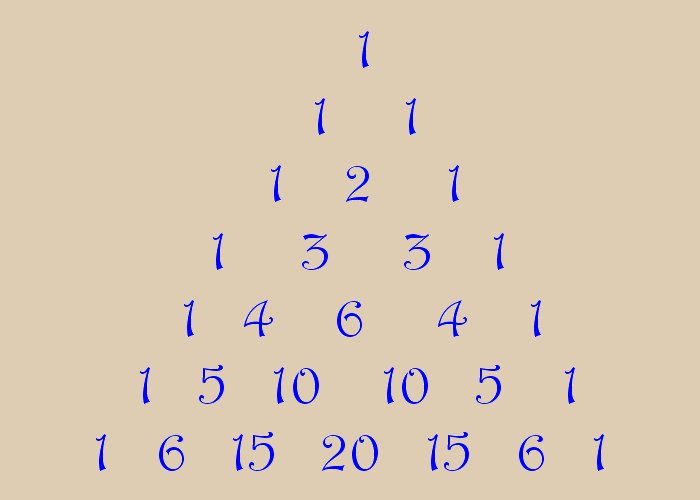
Pascal’s Triangle. Note that entries in each successive row are sums of elements to the left and right above them.
Pascal’s Triangle, a portion of which is above, gives the coefficients of (a+b)n, for n = 0, 1, 2, 3 and so on.
Note, for example, (a + b)4 = a4 + 4a3b + 6a2b2 + 4ab3 +b4.
The full code is described in the SIAM News article, together with mathematical details of a Moriarty lecture tour. The article also offers the clues Holmes uses—the Pascal Triangle and related Fibonacci numbers—to break the code and save the world.
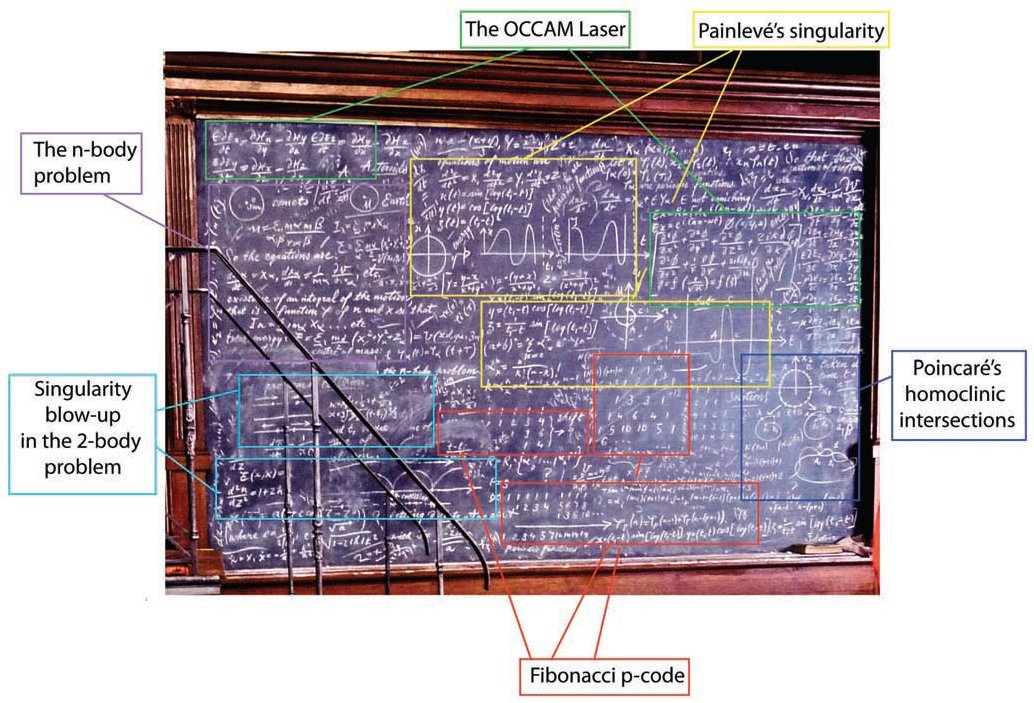
Moriarty’s blackboard. Image with OCCAM details from the SIAM News website.
In full disclosure, the researchers say that, other than the blackboard, very little of their mathematics made it to big screen. However, Warner Bros. did make a donation to the OCCAM. ds
© Dennis Simanaitis, SimanaitisSays.com, 2013
 Simanaitis Says