
Simanaitis Says
On cars, old, new and future; science & technology; vintage airplanes, computer flight simulation of them; Sherlockiana; our English language; travel; and other stuff
HYDROGEN I.C., PART 3: BMW
BMW WAS another automaker exploring H2 I.C. Back in 2006 I went to Berlin to sample the company’s dual-fuel gasoline/hydrogen 7 Series. This car took advantage of liquid hydrogen, LH2, to enhance density for extended range. It had dual fuel as part of BMW’s research theme of a bridge to a hydrogen future. The company also built several LH2-only cars.
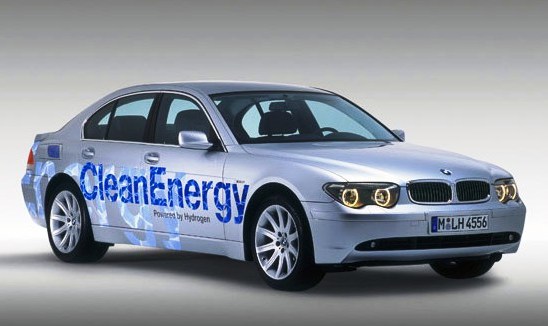
Prior to converson, a BMW Hydrogen 7 was a gasoline 760 Li.
Liquefied hydrogen carries greater than 75 percent more energy than its compressed counterpart, even when the latter is at today’s typical 10,000 psi.
However, it comes with tradeoffs. To remain liquid, hydrogen must be held colder than -423 degrees F, and this requires elaborate insulation. The Hydrogen 7’s tank is multi-layered with a vacuum interliner. So effective is its insulation that BMW says a snowman within the tank would last for 13 years.

Details of a BMW Hydrogen 7: 1. Liquid hydrogen tank. 2. Tank insulation. 3. Hydrogen filler. 4. Safety line to boil-off valve. 5. Heat exchanger/control unit. 6. Engine. 7. Intake manifold/hydrogen rail. 8. Boil-off management. 9. Gasoline tank. 10. Pressure control unit.
Inherently, there’s always a cushion of gaseous H2 in the tank above its liquid phase. When the car is run, this “boil-off” is used and is no problem. If not used, after about 17 hours the pressure must be relieved by venting the hydrogen to the atmosphere. Were the car left unused for 10-12 days, its fuel tank’s accessible hydrogen would be exhausted.
Wasteful though this is, there are no safety implications: Hydrogen disperses so quickly in the open that it’s safer than spilled gasoline. (With the latter, explosive vapors persist immediately above the spill.)
Driving the BMW Hydrogen 7 was almost anticlimactic. A steering-wheel toggle allowed me to switch between hydrogen and gasoline, and it was difficult indeed to recognize which fuel was being used. A slight difference in sound could have been attributable to the hydrogen’s quicker flame front. Tuning adjustments masked any changes in the 6.0-liter V-12’s output.
Refueling was part of the drive. Apart from a clunky nozzle, this was accomplished with no more drama than hydrogen refueling I’ve performed at compressed outlets. Also, during another visit, I sampled fully automated LH2 refueling at Munich Airport.
BMW produced 100 of these Hydrogen 7 sedans. As part of its Hydrogen 7 Pioneer Program, some went to demonstration programs in Europe and the U.S.

During this program, Hydrogen 7 cars traveled more than 2 million miles.
Others were offered to private individuals, including opera star Placido Domingo. These days, with BMW’s emphasis on hybrids and battery electric vehicles, H2 I.C has a comparatively low priority.
A last word on my Berlin adventure: Being an international group, we were each given instruction pamphlets in our appropriate languages, some evidently translated better than others. In offering advice—and, I’m sure, confidence—in the event of hydrogen venting and its accompanying alert, No. 1 on the English list was “Keep quiet.”
I suspect they meant “Keep calm.” ds
© Dennis Simanaitis, SimanaitisSays.com, 2012
 Simanaitis Says