
Simanaitis Says
On cars, old, new and future; science & technology; vintage airplanes, computer flight simulation of them; Sherlockiana; our English language; travel; and other stuff
WILBUR WOWS ‘EM AT LE MANS
AVIATION HISTORY was made on August 8, 1908, not far from Le Mans, when Wilbur Wright showed Europeans the absolute state of aeroplane art. He did this just off what’s now the Mulsanne Straight, la Ligne Droite des Hunaudières, of the Le Mans race car circuit. Today, a monument there celebrates this with a plaque depicting the Wright Flyer and its accompanying catapult launcher.

The Wright Flyer and its catapult tower at La Sarthe.
Spectators to the flight helped raise iron weights on this 25-ft.-tall launch structure. The aeroplane was pulled down its rail and lifted into the air. That day’s flight lasted only 1 minute 45 seconds. Two days later, with some 2000 people in attendance, Wright demonstrated the craft’s maneuverability with a figure eight and then a controlled, precise landing. Reported in Paris’s daily Le Figaro, “Nothing can give an idea of the emotion experienced and the impression left at this last flight, a flight of masterly assurance and incomparable elegance.”
The reporter also commented on the aesthetics of the Wright Flyer. Indeed, about this same time French post-impressionist Henri Rousseau painted Les Pêchers à la ligne avec Aéroplane, clearly a Wright biplane soaring above the fishermen.

Henri Rousseau included a Wright Flyer in his painting.
For a while there, Wilbur was living the high life in more ways than the obvious. He earned hundreds of thousands of francs, set record after record, acquired several gold medals and a nomination to the French Legion of Honor. It’s said he also gained 16 lb., thanks to the substantial cuisine of La Sarthe.
As Wilbur was demonstrating the Wright Flyer to the French, his brother Orville was trying to interest the U.S. Army in aviation. Neither was very successful in turning their aviation pioneering fame into a business endeavor. Aviation technology was fast accelerating. In many ways, the catapult-launched, wing-warping Flyer was being pursued—and before long, overtaken—by competitors’ craft.
Within a year, on July 25, 1909, Frenchman Louis Blériot would cross La Manche/The English Channel in his Type 11. American Glenn Curtiss would travel to France to demonstrate his own aviation prowess at the first international air show, La Grande Semaine de l’Aviation de la Champagne, held August 22-29 near Reims. And, in yet another location familiar to motorsports enthusiasts, in September 1909 there was a major air show in Brescia, Italy, destined to be home of the Mille Miglia. Among those present were a struggling author named Franz Kafka, who shared his experiences in The Aeroplanes of Brescia, and Italian poet, patriot and aeroplane enthusiast Gabrielle D’Annunzio. I’ll have more on this last rascal in another posting.
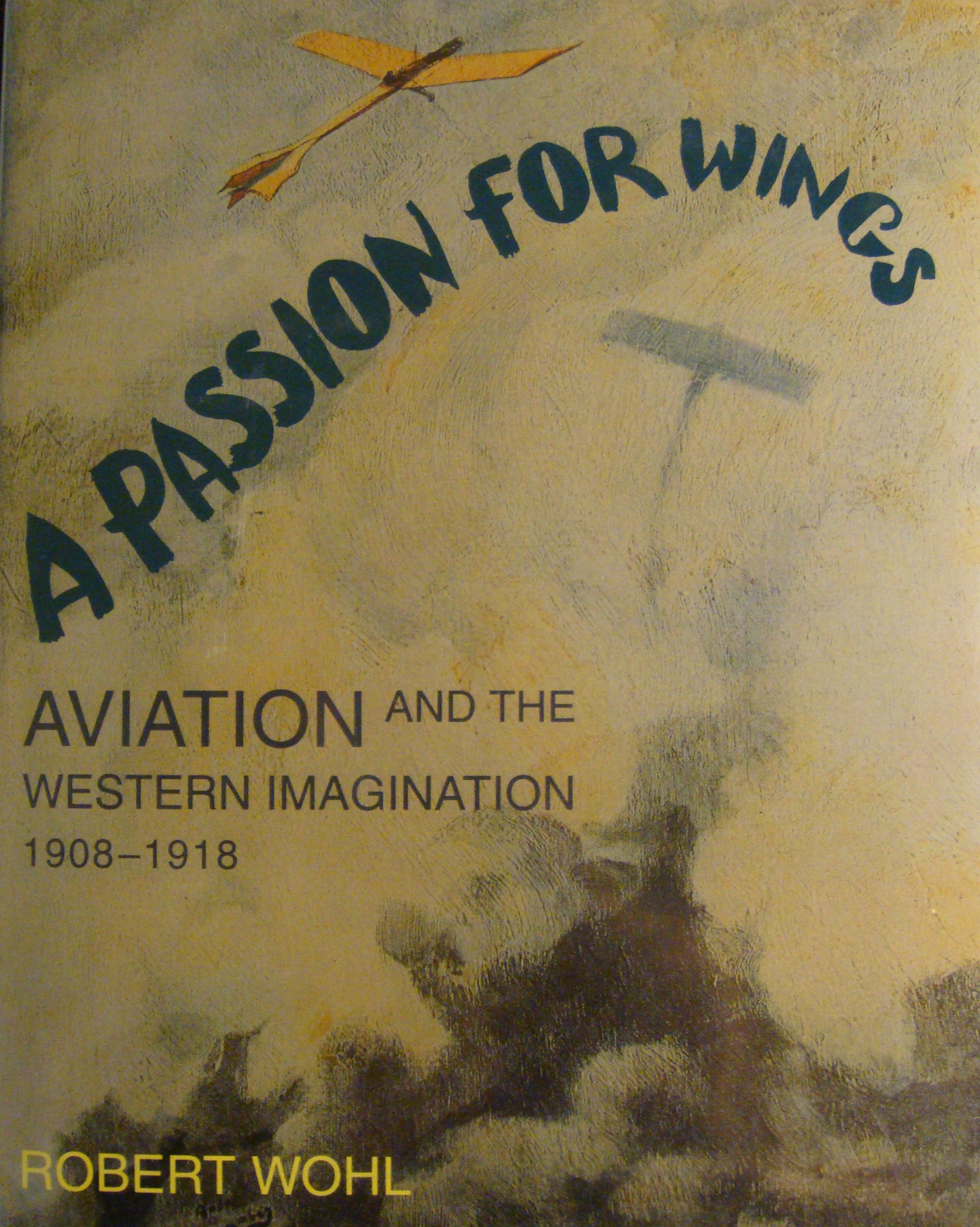
Robert Wohl’s book “A Passion for Wings” is a real treasure.
An excellent source on the era is A Passion for Wings: Aviation and the Western Imagination 1908-1918, by Robert Wohl, Yale University Press, 1994. It’s out of print, but shows up at places like Amazon.com and abebooks.com. I’ve seen copies in secondhand bookshops for around $30. A beautiful and thoughtful book. ds
© Dennis Simanaitis, SimanaitisSays.com, 2012
 Simanaitis Says
What a site to see (both the website and the French countryside). Beautiful job, Dennis!